


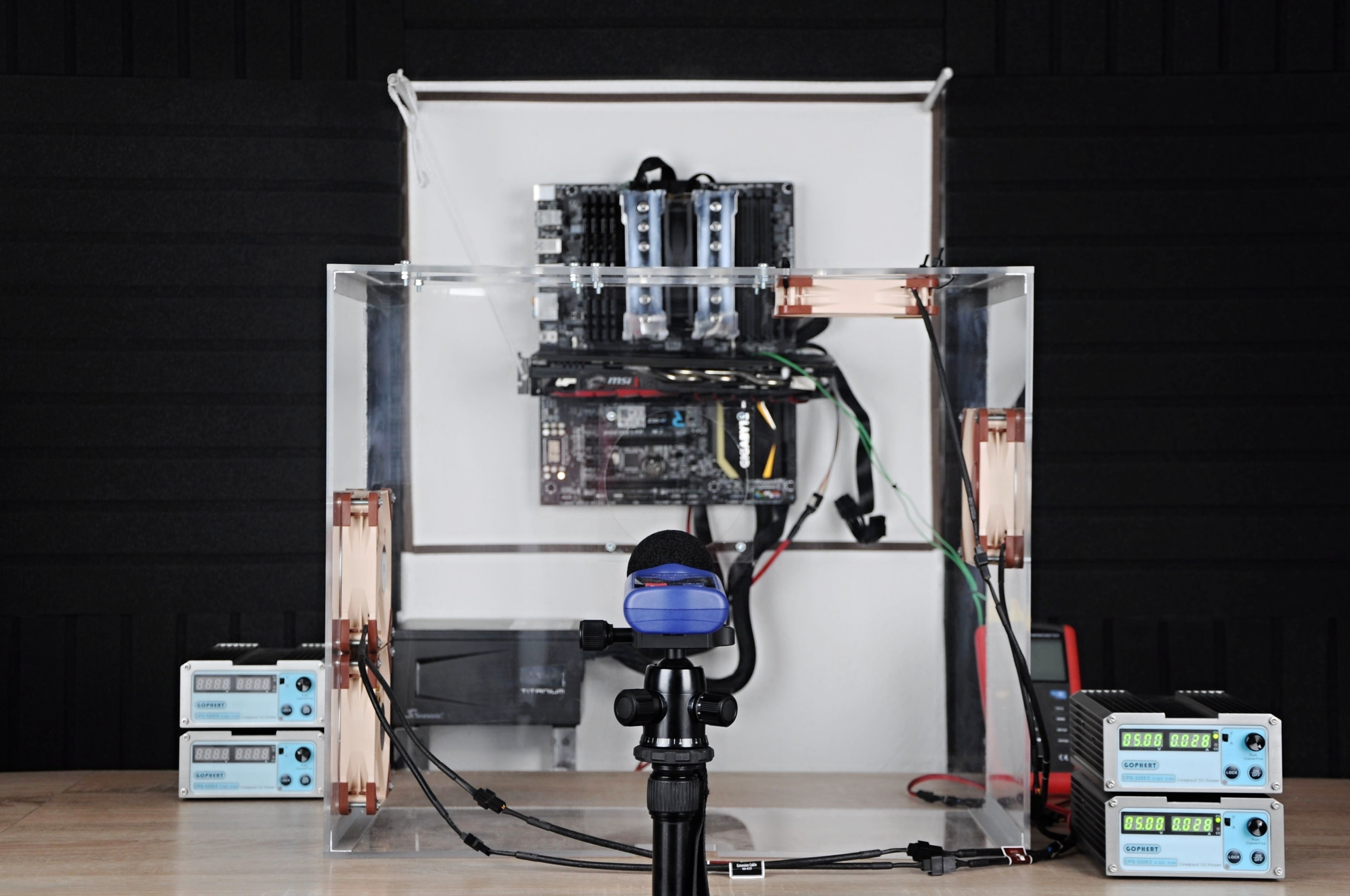
Here and there we come across the opinion that it is advisable to test fans in real life conditions, which we can easily refute. At the same time, we understand that a layman can best identify with the differences in component temperatures that arise precisely due to different fan airflows. To help you see the correlations of such tests with results from “unnatural” environments, here’s something we remembered.
Results: Very low noise level (31,5 dBA)
| Fans | Speed (rpm)@31,5 dBA |
| Akasa Piranha | N/A |
| Enermax Twister Pressure | N/A |
| Fractal Design Silent R2 | N/A |
| Gelid Silent 12 | 330 |
| Lepa BOL.Quiet | N/A |
| Nanoxia Deep Silence | 300 |
| Noctua NF-S12A FLX | 570 |
| Noctua NF-S12B redux-1200 | 330 |
| Phanteks PH-F120MP | 360 |
| Scythe Grand Flex | N/A |
| SilentiumPC Zephyr 120 | 330 |
| SilverStone SST-AP123 | N/A |
| SilverStone SST-FW122 | N/A |
| Zalman ZM-DF12 | N/A |
Why is there a missing value sometimes? Some fans cannot be slowed down sufficiently to make their speed correspond to the specified noise level. The minimum speeds are then above this level, thus the associated measurement cannot be made. This is why you won’t be able to find the result in the chart.






Small error, the fans on the Thermalright T-Rad2 are NF-A9x14, not NF-A9.
Yes, thanks! Fixed. 🙂