


DeepCool has launched the CH690 Digital cases, with a volume of nearly 60 liters. With this capacity, they were designed to handle various setups using the largest components available. In addition to truly long graphics cards – with practically no limits – they also support oversized liquid cooling radiators from the top, bottom, or side. And all of this comes with a focus on looks, defined by two tempered glass panels.
With the CH690 Digital, DeepCool has modernized the concept of cases designed for exceptionally quiet cooling of the most powerful components available today. All this comes with a striking appearance – but more on that later. First, let’s take a look at what the CH690 Digital cases, measuring 418 × 240 × 516 mm, actually support.
First and foremost, the cases support large coolers for both the CPU and the GPU. When it comes to liquid cooling, radiators can be mounted in four positions, including top (up to 420 mm), bottom (360 mm), and side (up to 280 mm). The front panel is tempered glass, providing a better view of the internal components. If you’re not building with liquid cooling and prefer tower-style air coolers with heatpipes, the case is wide enough to support coolers up to 182 mm tall. Current cooler models don’t even reach that height, so you’ll have some headroom – either for future, taller coolers or simply for easier handling with no tight squeezes.
And if you opt for a tower cooler, meaning you’re not going with any form of liquid cooling, there are up to ten expansion fan positions available. Note: the case does not come with any fans included (you’ll need to purchase those separately), but it supports ten 140 mm or the same number of 120 mm fans. There are three positions at the top, bottom, and side each, with one additional spot traditionally at the rear panel, above the PCI Express slots. Speaking of which, there are eight PCIe slots.

Motherboards are supported up to ATX form factor. This means mounting holes are provided not only for standard 305 × 244 mm ATX boards but also for smaller Micro ATX and Mini-ITX boards.
The CH690 Digital features tempered glass on two sides – traditionally on the left side and also at the front. These are typical locations for intake fans, but DeepCool took a different approach. To maintain a clear view of the interior, the front panel is glass, and any optional intake fans are mounted behind it, from the right. On the left side, there is also an I/O panel that includes three USB ports (2× Type-A + 1× Type-C), a 3.5 mm combo audio jack, and a power button.


Next to the I/O panel is a segmented digital display, which shows real-time system stats (temperature, power consumption, load, or clock speeds) for the CPU and GPU. That’s what gives the CH690 its “Digital” name. This display is expected to communicate with the motherboard via a 9-pin USB (2.0) header, which often goes unused for its original purpose (connecting USB 2.0 front panel ports), since most cases – including this one – prefer faster 19-pin connections (for dual 5 Gbps USB ports) or internal USB-C connectors.
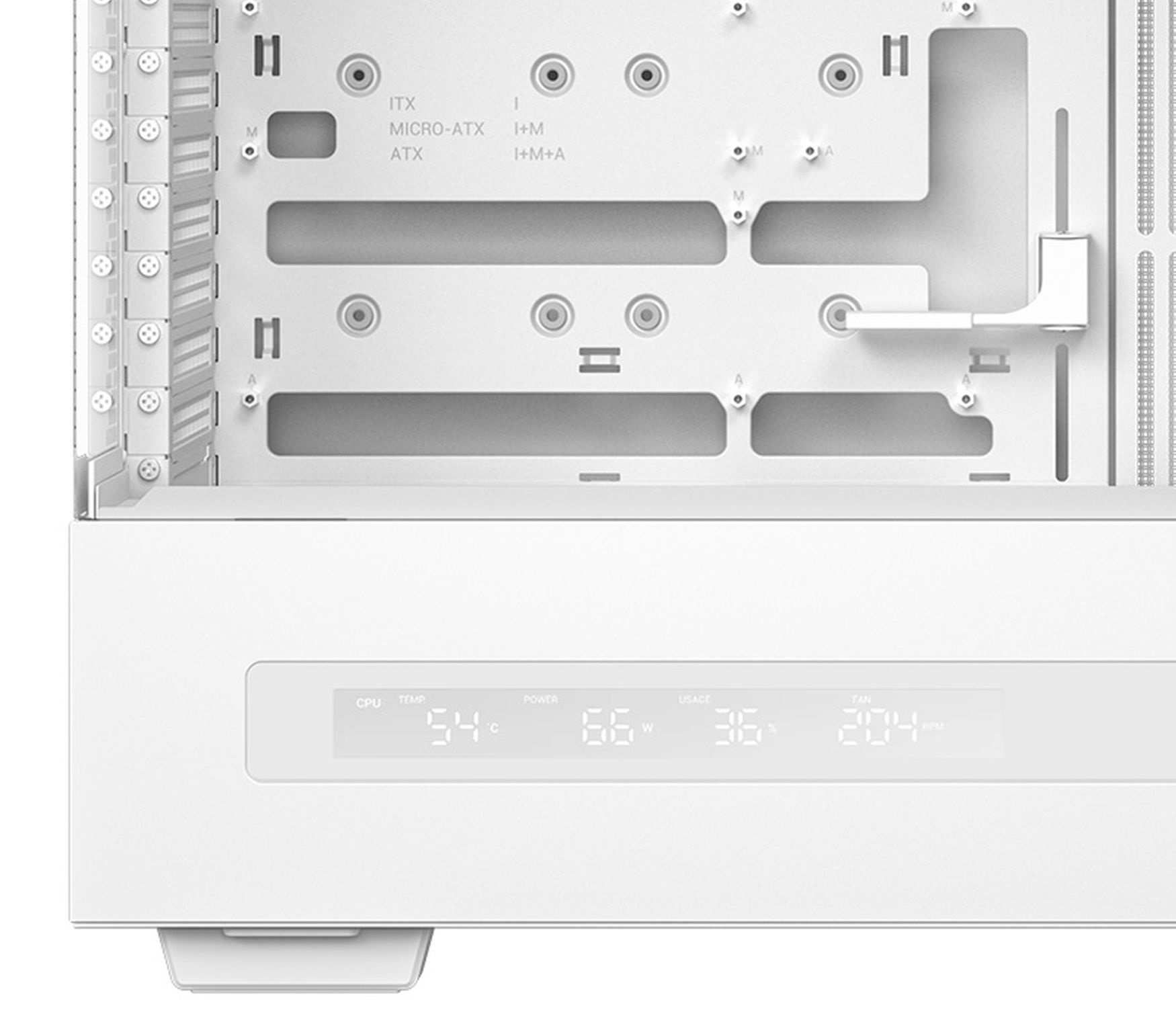
The CH690 Digital case also accommodates a 3.5″ HDD (in a single drive tray) and up to two 2.5″ storage drives. It supports ATX power supplies up to 180 mm in length. Also worth noting is the spacious cable management area behind the motherboard tray, offering up to 36.5 mm of clearance.
DeepCool’s suggested retail price for the black CH690 Digital (base model) is 100 EUR, while the white version labeled “WH” (CH690 Digital WH) is set at 110 EUR. Both models are expected to become available in stores starting May 13, 2025.
English translation and edit by Jozef Dudáš



The box shows “11C” in the article picture. Is that the room temperature? 🙂
Which picture do you mean? In any case, we have no idea in what conditions DeepCool takes their photos. But I assume it will be in a room with a higher ambient temperature than 11° C. 🙂
Suspiciously low temperatures reported by individual sensors can also be the result of incorrect readings from a specific sensor. The creator of HWiNFO discussed similar issues in this article. The results from various internal sensors should always be taken with a grain of salt. They may not represent the actual value – and may not even be close to it. 🙂
It’s the first picture (to the article) but appears to show 11C as it is taken at an angle 🙂
https://www.hwcooling.net/wp-content/uploads/2025/05/deepcool-ch690-00.jpg
That’s not the display – it’s a bit further back (and not visible in that photo :)). But yes, it looks like it says “11 °C”. In reality, though, it’s just two USB-A ports (11, haha) and the LED ring around the power button. From that angle, where only three sides are visible, it really does resemble the letter “C”. 🙂