


The new Liquid Freezer III Pro liquid coolers introduce one highly visible change compared to previous models (Liquid Freezer III) without the “Pro” designation. This change involves new P-series fans featuring seven blades (instead of Arctic’s typical five-blade design). Additionally, the coolers boast an exceptionally thick radiator profile, which should also contribute to achieving high cooling efficiency.
Out of nowhere, there appeared innovated Liquid Freezer III liquid cooler models with a “Pro” moniker, courtesy of Arctic. There are three variants, each featuring a 360mm radiator. The differences lie solely in color schemes and fan configurations. The base model has a black radiator with non-RGB fans (P/N ACFRE00180A), while two ARGB LED versions exist – one with a white radiator (ACFRE00188A) and another with a black one (ACFRE00184A).
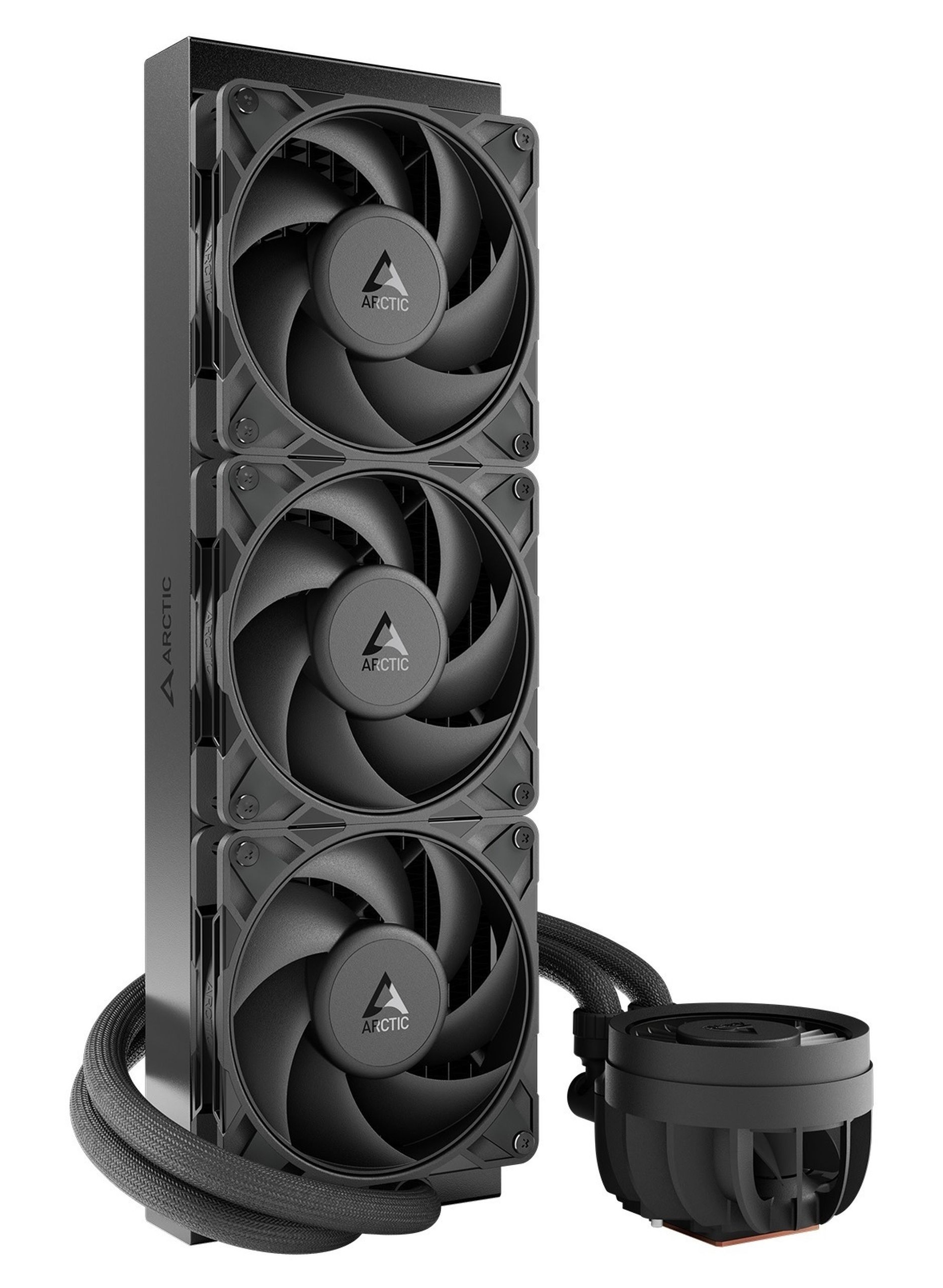


Arctic has implemented P12 fans but with seven blades (P12 Pro) this time. These aren’t geometric variations like those we’ve tested before, but completely new fan designs. The increased blade count allows for shorter blades while maintaining high static pressure – crucial for radiator performance (minimizing airflow reduction and maximizing cooling capacity).
The shorter blades also facilitate reduced vibrations. To further enhance this effect, the fans incorporate a stabilizing hoop. Overall, while maintaining comparable or better performance characteristics, these fans promise a more attractive acoustic profile than the five-blade P12 fans used in non-Pro Liquid Freezer III models. Interestingly, the non-Pro versions aren’t being discontinued, serving as more affordable alternatives – though the Pro models may eventually replace them as the new standard.

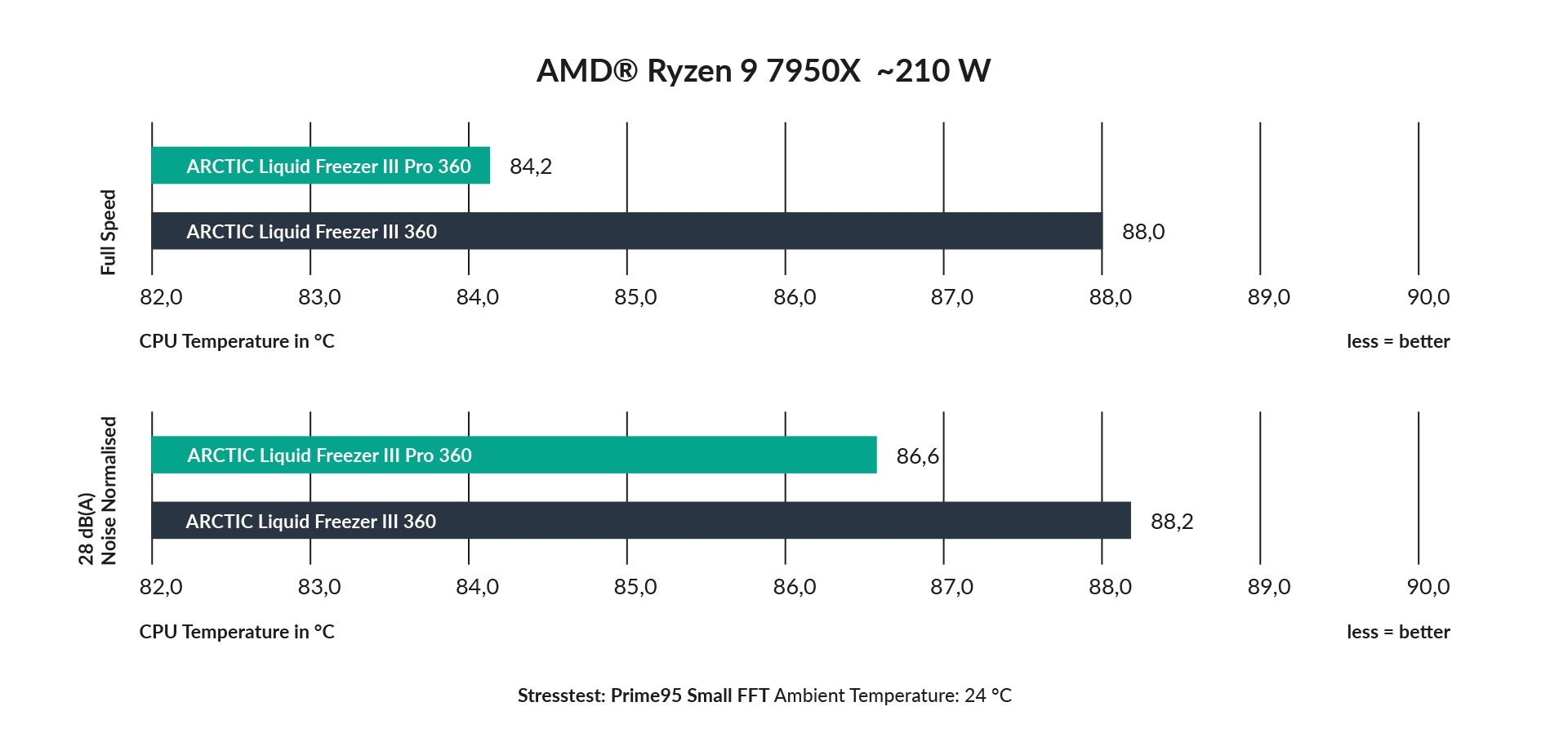
Internal testing by Arctic shows CPU temperature reductions of approximately 4-10°C. The exact improvement depends not only on the platform but also on the specific processor being cooled and its workload. The smaller improvement (~4°C) was observed with the Ryzen 9 7950X at ~210W, while the larger improvement (~10°C) came with the Core Ultra 9 285K at ~250W. According to Arctic’s tests, the Liquid Freezer III Pro 360 keeps the P-cores of this Intel processor (CU9 285K) below 70°C under comparable loads. This 10°C difference is claimed not just at maximum fan speeds but also in noise-normalized testing.

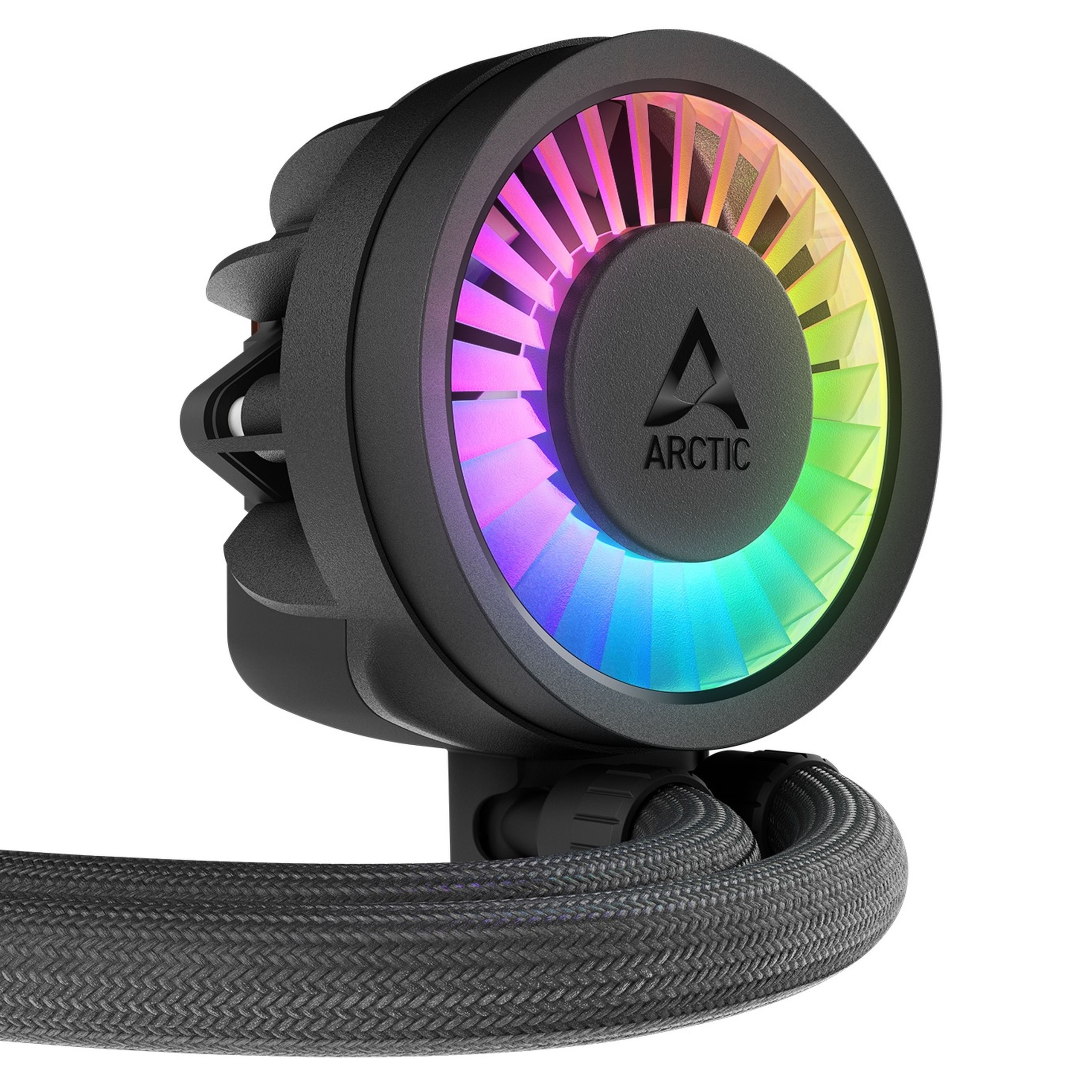
The Liquid Freezer III Pro coolers maintain the integrated fan in the water block for VRM cooling. The focus remains not just on cooling the processor itself but also its power delivery components. Our upcoming tests will reveal how effective this is, as we plan to compare the “Pro” model against the standard version and competing coolers. Our CPU cooler testing methodology also evaluates VRM cooling performance.
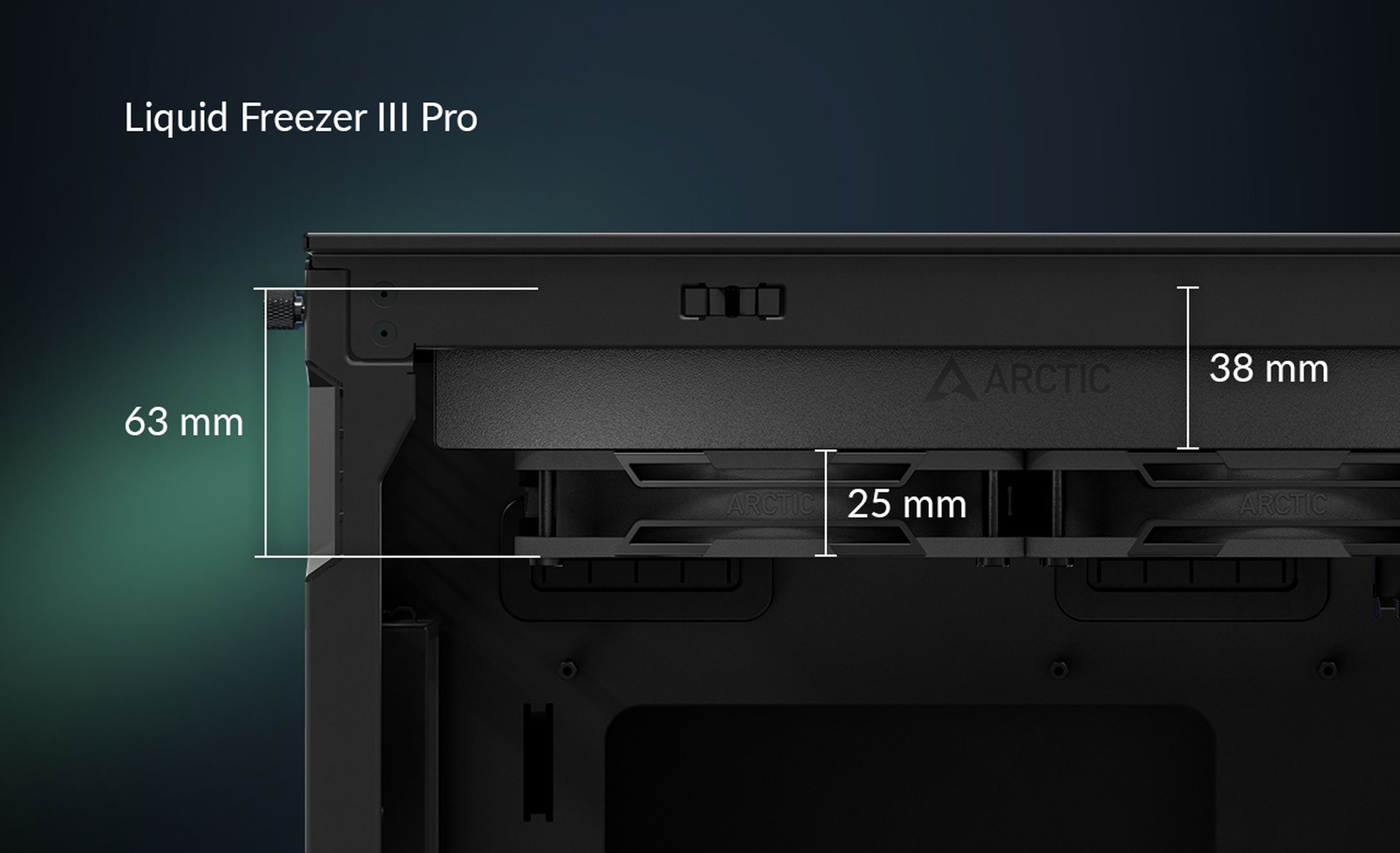
The high cooling performance of the Liquid Freezer III Pro comes partly from the thicker radiator – it’s 38mm thick, which is above standard. This naturally expands the liquid contact area, potentially delivering higher cooling capacity similar to coolers like the Enermax Liqmaxflo 360. Our previous testing showed that model performing quite well. Of course, the Liquid Freezer III Pro differs significantly – with different fans, different pump, different coldplate – so you’ll still need to wait a bit for full test results to evaluate its performance.
The coolers support Intel LGA 1851, LGA 1700 and AMD AM5, AM4 platforms. Installation uses a special frame that improves cooling efficiency (through optimized contact between CPU cores and coldplate) while also contributing to hardware longevity, as the frame eliminates unwanted motherboard deformation.
Liquid Freezer III Pro coolers are already available for order. On Arctic’s e-shop, the base model costs 94.50 EUR, the RGB version with black radiator costs 111.50 EUR, while the RGB model with white radiator is the most expensive at 114 EUR. These remain reasonable prices, though we’ll need to evaluate their actual features, or cooling performance across platforms – which we’ll certainly examine in due course.
English translation and edit by Jozef Dudáš




The former Liquid Freezer III (non Pro) already has a thick radiator (38mm). Both, Pro and non Pro, shares the same thickness.
Yes, we’re aware. The original text contained an incorrect interpretation suggesting the thicker radiator was an improvement over previous LF coolers. In reality, both the LF III and LF II models already feature 38mm thick radiators. However, it remains true that the “standard” radiator thickness for liquid coolers is typically 27mm. Most competing AIO solutions follow this convention, making the Liquid Freezer III Pro’s radiator thickness exceptional compared to most other offerings.
Interesting new fan design from Arctic. It doesn’t look like anything else, as far as I’m aware. Hope to see some tests soon!
Let’s believe it’s only a matter of time before these new fans become available standalone. When that happens, we’ll definitely test them. A detailed analysis of the fans on the LF III Pro could still happen even if they remain exclusive to the coolers, but the first scenario (standalone availability) would be better—simply because it’s more practical. After all, few people would buy an entire cooler just to remove its fans and install them as case fans, haha.
We’ll see. One way or another, we’ll find a path to properly evaluate these fans and understand their characteristics. 🙂
It looks like the Pros have a bigger hub, which could lead to interesting results at higher RPMs. Do you know if we can expect a 140mm variant as well?
We don’t have any information about a 140mm version yet.
A larger rotor hub would likely mean lower airflow, though combined with higher static pressure, I expect radiator performance (at comparable noise levels) might still improve. But… well, we’ll see. 🙂
In their announcement post on Reddit (https://www.reddit.com/r/arcticcooling/comments/1jl57ad/essential_cooling_pro_performance/), it is stated that “More sizes (240, 280 & 420 mm) available in Q2”.
I think there’s a high chance we see a 140 mm version, which should similarly be called P14 Pro.