


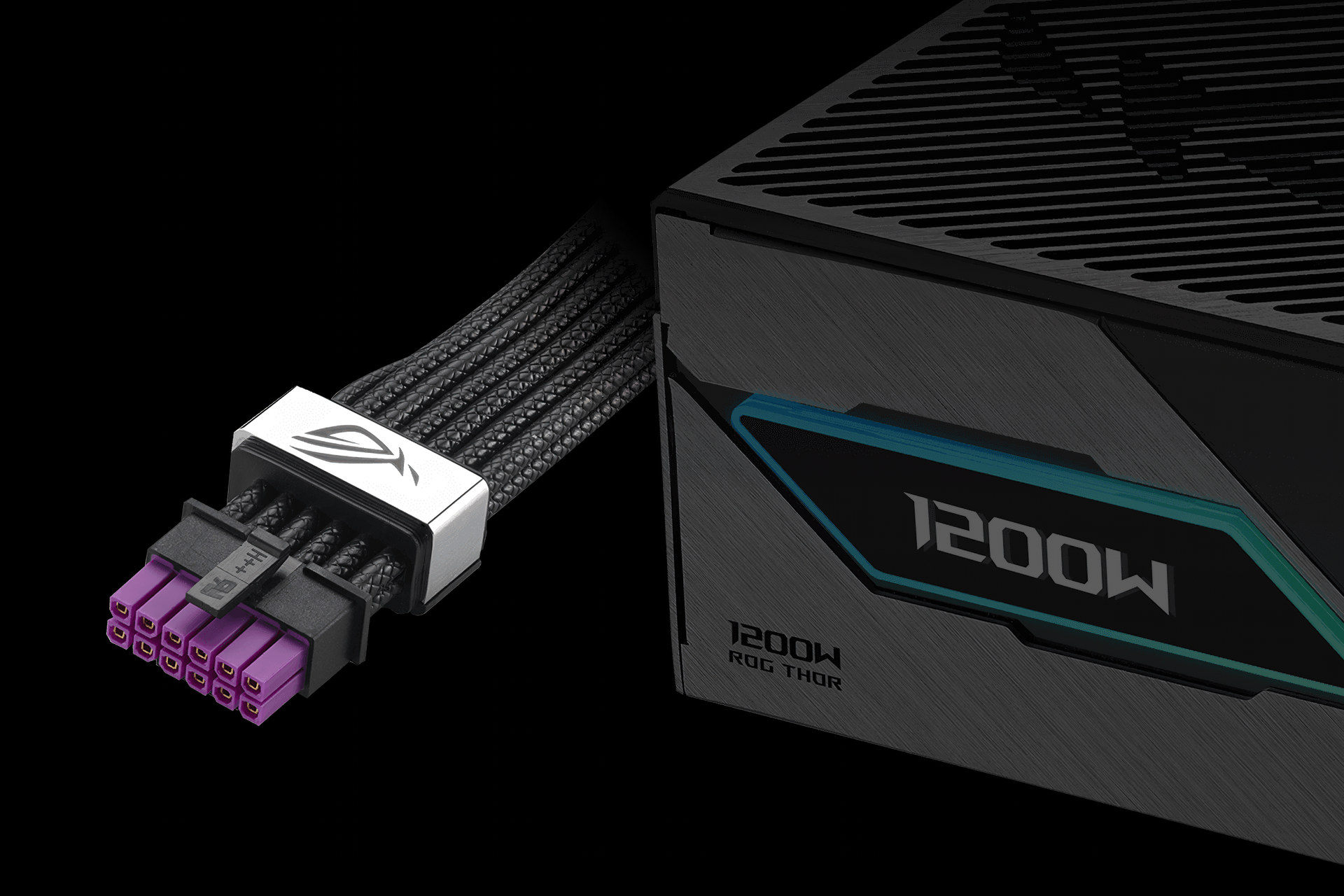
Failures of the 12V‑2×6 power cable (formerly 12VHPWR) have become the scourge of recent GPU generations. Especially for Nvidia cards pushing this power standard, but also for a few Radeon models using these connectors. Various attempts to work around or mitigate the risks have popped up; this time, Asus is introducing the Equalizer special‑purpose cable for its power supplies, that aim to prevent connector melting in several ways.
The ROG Equalizer cables are direct 12+4‑pin cables compliant with PCIe 5.1 and ATX 3.1 standards, designed for Asus power supplies (though they should work with others). In the future, they will be included with new batches of Asus ROG Thor III and Asus ROG Strix Platinum PSUs. Owners of older PSU versions will be able to purchase them as an upgrade, and they should receive a discount. This option is expected to be available starting in May, so if you’re considering such an upgrade, wait a bit longer before buying.
Update: According to Asus’s announcement, PSUs bundled with the ROG Equalizer cable will be more expensive than the original versions.
These cables include thermal protection in the form of a sensor that monitors whether the connector or wires are overheating, which is indicated by two additional conductors that connect to the PSU via a separate plug (this function will naturally work only with appropriate Asus PSUs). The connection should transmit temperature data to the PSU, which can then cut power supply if overheating is detected (which typically signals a connector failure).
Clarification (April 29 2026): The cables do not contain a temperature sensing as we erroneously reported before (we are sorry for this misinformation). The extra connector and wires are provided for Asus’ GPU-First voltage stabilitazion feature, which prioritises 12V power supply for purposes of voltage drop prevention.
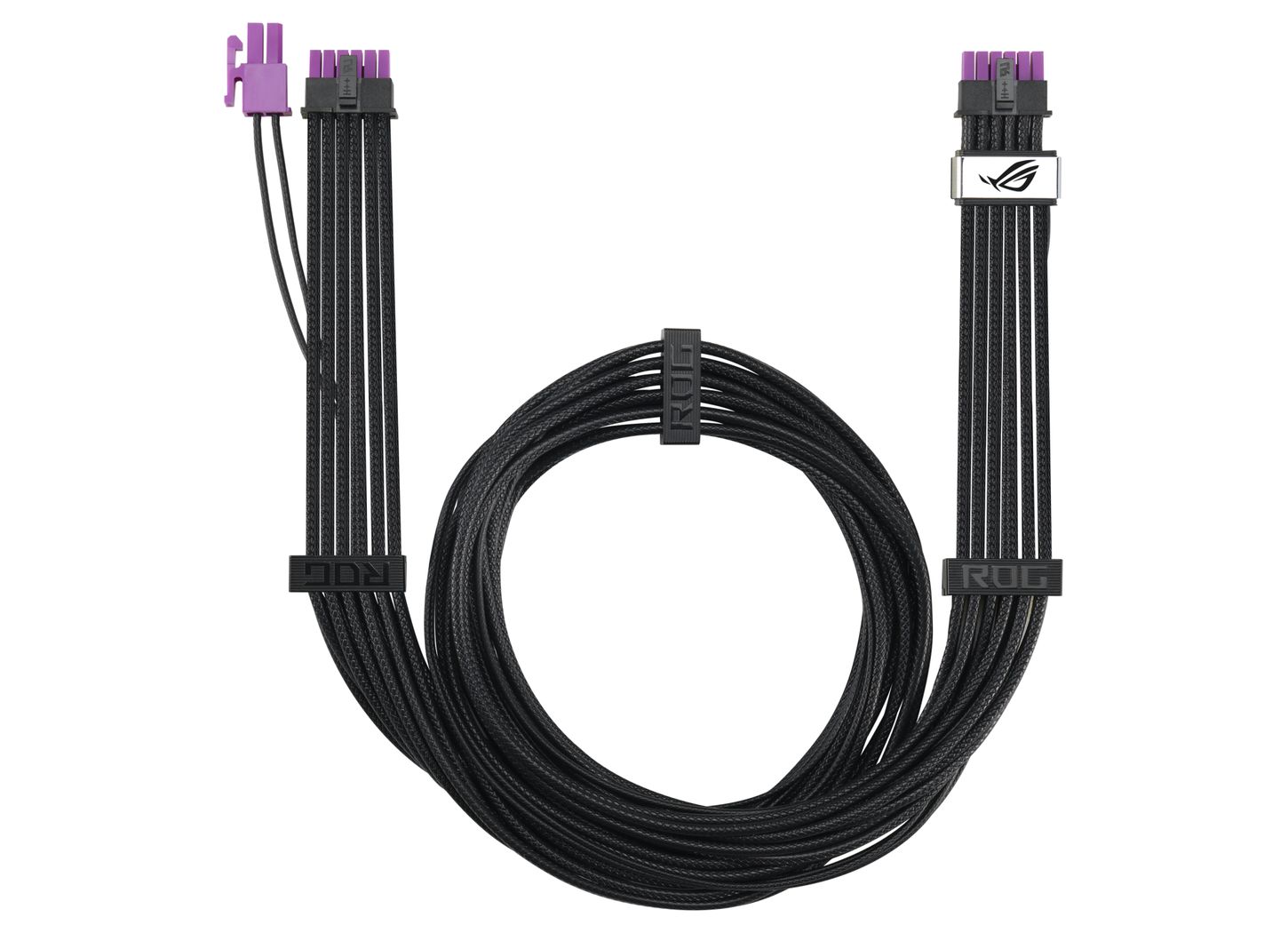
This protection should automatically work on the hardware level, without requiring any monitoring or intervention from a software running on the PC. However, the temperature data should be readable from the PC, and this capability is expected to be added to the GPU Tweak III+ application.
MSI recently introduced a similar ability of their PSUs to monitor 12V‑2×6 cable health with the GPU SafeGuard+ solution, but that technology monitors not only temperature but also current distribution and over‑current manifesting on individual pins, which is a higher level of protection.
Finally, connectors with real safety margin
Asus’s cables, however, have their own advantages in the form of “passive safety.” Besides the connector being dual‑colored to make incomplete insertion easy to spot when building or checking the PC, it also uses gold‑plated contacts to reduce resistance at the connector interface.
Most importantly—and likely the biggest advantage—the cables use a more robust version of the contact receptacles for each conductor, which according to specifications can handle higher currents than the standard 12VHPWR / 12V‑2×6 connectors. It’s precisely the lack of headroom—the fact that the connector spec did not allocate sufficient extra capacity for current imbalance—that is likely to be the main factor behind these connector failures, or at least one of the most important fators.
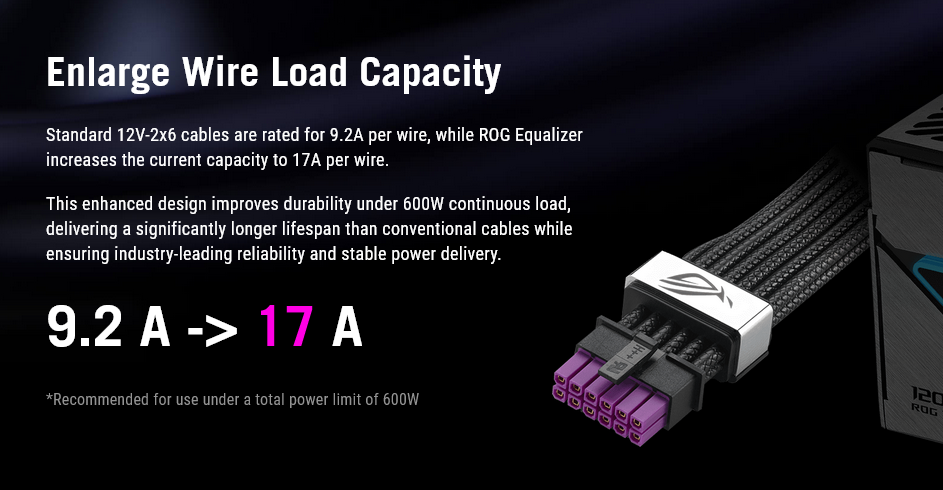
Asus states that the receptacles used in the ROG Thor cable can handle not just 9.2 A of current per pin like standard connectors, but are rated for 17 A. This means these cables should have substantial headroom and should survive incidents that would cause other connectors to melt or burn.
Asus claims the cable passed a test in which failure was simulated by cutting four of the six conductors, forcing 25 A through each of the two remaining wires instead of distributing the load across all six (which gives about 8.3 A per pin). While a standard cable overheated to 146 °C in the lab, the ROG Equalizer reportedly stayed at a safe 73.4 °C. This hopefully demonstrates that the more robust receptacles really do help.
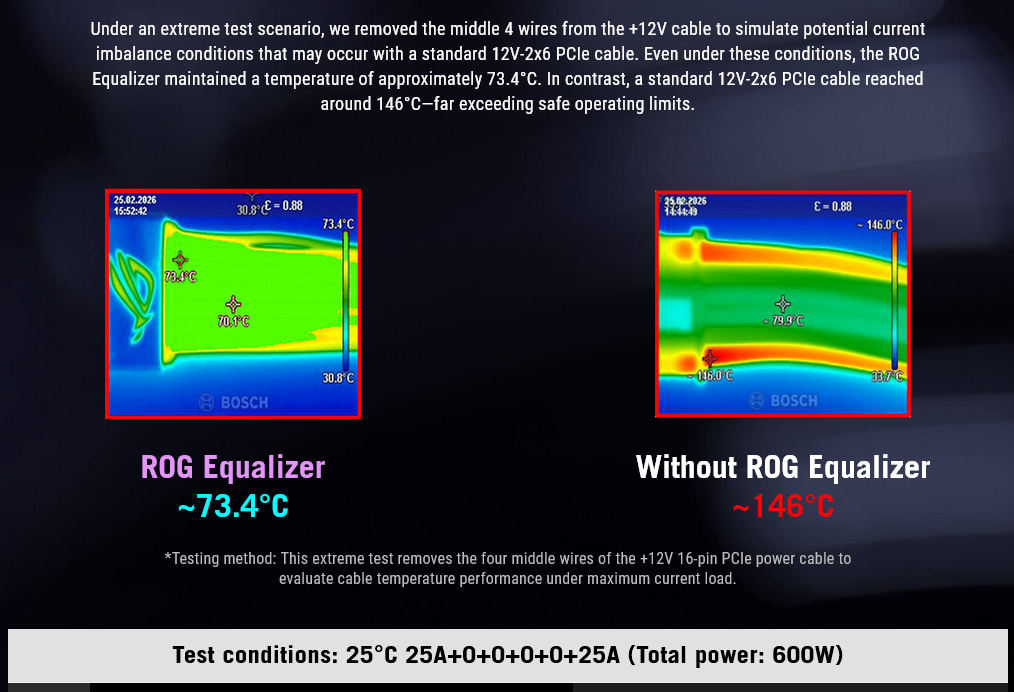
These are laboratory results, not results taken in real‑world conditions where the cable is enclosed in a case and may have worse cooling, especially near the PSU. The absolute temperatures may therefore not be directly representative. It’s also worth noting that cutting the middle wires and leaving the outer ones is not the worst‑case scenario, since it somewhat spreads the heat. If two adjacent wires were left intact (something that could happen if a bend deforms the connector and causes uneven engagement), they could heat each other more. Still, they would hopefully remain within a safe range anyway.
Update (11. 5. 2026): The temperature improvements are not actually real, it seems
Sadly it seems that the wire-cutting test is not at all what it seems and what we wanted, Asus may have been quite misleading in fact. The problem is that what was cut was just the wire lines, but what is not mentioned is that the cable features bridge connections 3cm from both connectors that in fact redistribute the current evenly across all the connector’s contacts again. And that is the explanation of the temperature improvement under this scenario, perhaps meaning that there is no actual improvement in contact reliability and safety. I feel the way this was presented is strongly misleading as this actual reason for the presented test results (the bridges) is not actually mentioned anywhere in the public presentation of the cables Asus provides. The issue is: The wires are never really the problem or the source of the 12+4pin cables melting or burning, the point of failure lies in the connectors and their contacts.
The bridging which now appears to be the actual meaning behind the Equalizer branding, is thus useless at best and will not make the cable’s connectors less likely to burn or melt. In fact, the hazard may be inadvertently increased by the bridges, because it being present 30 mm from the plugs makes the end of the cable very stiff and incapable of easy bending. That makes the cable exert increases forces and and deformations on the receptacle on the graphics card. And that is exactly what is dangerous with 12VHPWR/12V-2×6 cables, because the cable pulling on the receptacle or pressing it in any direction is what may contribute to uneven contact triggering the process that leads to overheating and melting.
In light of this, I would recommend to not buy these cables. Unless Asus shares more on the supposed higher reliability and increased ratings of the connector pins, which unlike the bridges could be a real reason to put more trust into these cables. In theory.
Early reports speculated that ROG Equalizer cables might include some mechanism to react to uneven currents and compensate for them (for example by adjusting resistance). This appears to have been incorrect. However, the strengthened, more robust contacts capable of tolerating significantly higher currents may in practice be more useful, as they directly increase resilience to exactly the type of failure that seems to occur frequently with 12+4‑pin cables. This is likely more beneficial than trying to work around what is a natural “failure mode” of the connector through load balancing. The more robust contacts will also help on the ground wires, whereas active load balancing would typically only affect the 12 V conductors.
We don’t yet know how much these cables will cost when sold separately (Update: Asus has announced the pricing to be $49). Price is generally the main problem with all such improvements—and the reason it’s hard to be enthusiastic when 12+4‑pin issues are solved this way. Instead of every user having to buy various premium add‑ons at their own expense just to work around a GPU‑side problem, the correct solution would be to fix or replace the flawed standard itself…
Source: Asus
English translation and edit by Jozef Dudáš
⠀



The extra two pin connector is for ROG’s “GPU-first” voltage stabilization thingy and not for temperature sensing. It has beeen present in Thor and Strix PSUs long before this new Equalizer cable. The Equalizer cable doesn’t have temperature sensor, and neither does MSI’s GPU Safeguard+.
So far, the only cables with a temperature sensor are found in select Asrock PSUs, Gigabyte T-Guard PSUs, future Seasonic Optiguard PSUs, and most recently, the Corsair ThermalProtect cable. But of course one could just wedge their own thermistor cable in between the +12v and ground rows of wires butted up to the plug and it’ll probably be closer to the pins than any of the aforementioned solutions.
Thanks for the clarification, I’ll update the article, and my apologies for publishing incorrect information.