





It is made in the same injection mould as the FC120, but still has noticeably better properties. Stronger material, higher weight, different bearings and a more powerful motor make the FK120 one of the most attractive options among inexpensive fans. But that’s only assuming the “right” adjustment. Outside of that, this fan can be quite uncomfortable and ironically for the same reason it is sometimes unbeatable.
Mounting and vibration measurement
Naturally, each tested fan must first be properly mounted. With all that we want to measure, and with the kind of precision that is required for relevant measurements, even the smallest details matter. The whole mounting system is quite complex and we are happy to have fine-tuned it to maximum satisfaction. Even if it meant hundreds of hours of tinkering. What’s so complicated about it? There’s more.
The fans are installed to the multi-purpose bracket. The substrate is a 2 mm thick metal plate to which the fan is attached, or the fan is attached together with an obstacle (e.g. a filter, hexagonal grille or liquid cooler radiator).
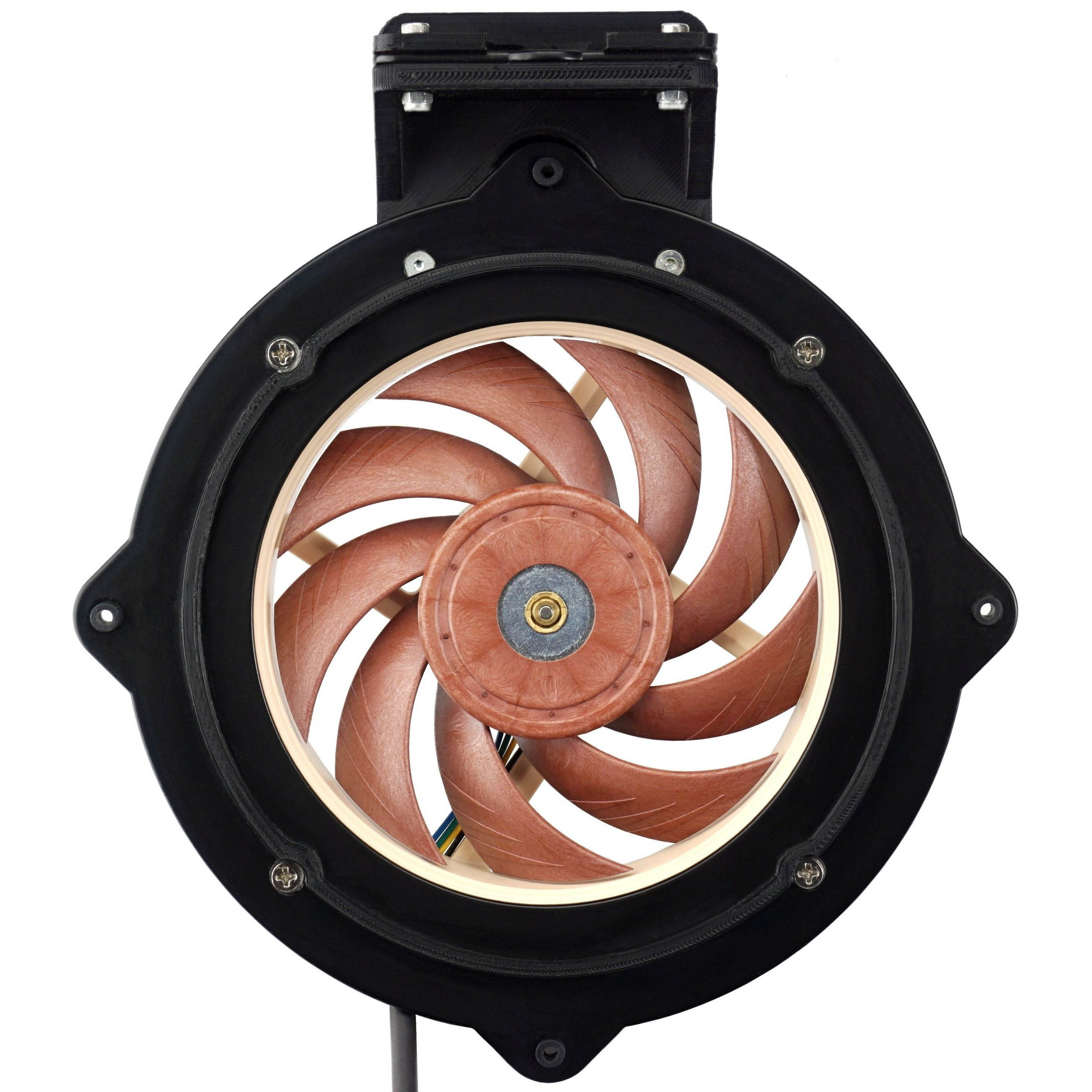
For correct and always equal pressure, the fans are always tightened with the same force with a torque screwdriver. If this were not the case, joints and clearances in the assembly could arise, in short, uneven conditions with undesirable distortion. For example, also for vibration measurement. On top of the fan mount there is also a bracket for the three-axis vibrometer sensor. The latter is magnetically attached via a steel insert, on which the sensor exerts a force of one kilogram and, thanks to the stop, is also always in the same place and in the same contact with the rest of the structure. These are the basics in terms of repeatability of measurements.
In order to capture the intensity at the highest possible resolution, the tray of the holder cannot be too heavy and at the same time it must be strong enough not to twist. This would again cause various distortions. Therefore, we used a hard (H19) aluminium (AL99.5) plate for the construction of the holder, whose weight is just enough so that free movement is not significantly restricted.
To achieve the finest possible resolution for vibration measurement, soft rubber inserts are provided in the mounting holes through which the bracket is installed to the tunnel. And just behind these inserts are silent blocks with a very low hardness of 30 Shore. These are also used so that the vibrations of the fans don’t spread to the tunnel skeleton. If this were to happen, then for fans with more intense vibrations, this secondary noise component, which is not related to the aerodynamic sound of the fan, would also be reflected in the noise measurement results.

This is where it is good to have ideal conditions, even though they are unattainable in practice, because fan vibrations will always be transmitted to the case skeleton to some degree. But each cabinet will react differently to them, or rather the final noise level will depend on a number of factors, starting with the materials used. Therefore, it is a good idea to filter out this extra noise component in tests and in practice take into account the measured vibration intensities. The higher these vibrations are, the higher the noise addition has to be taken into account.
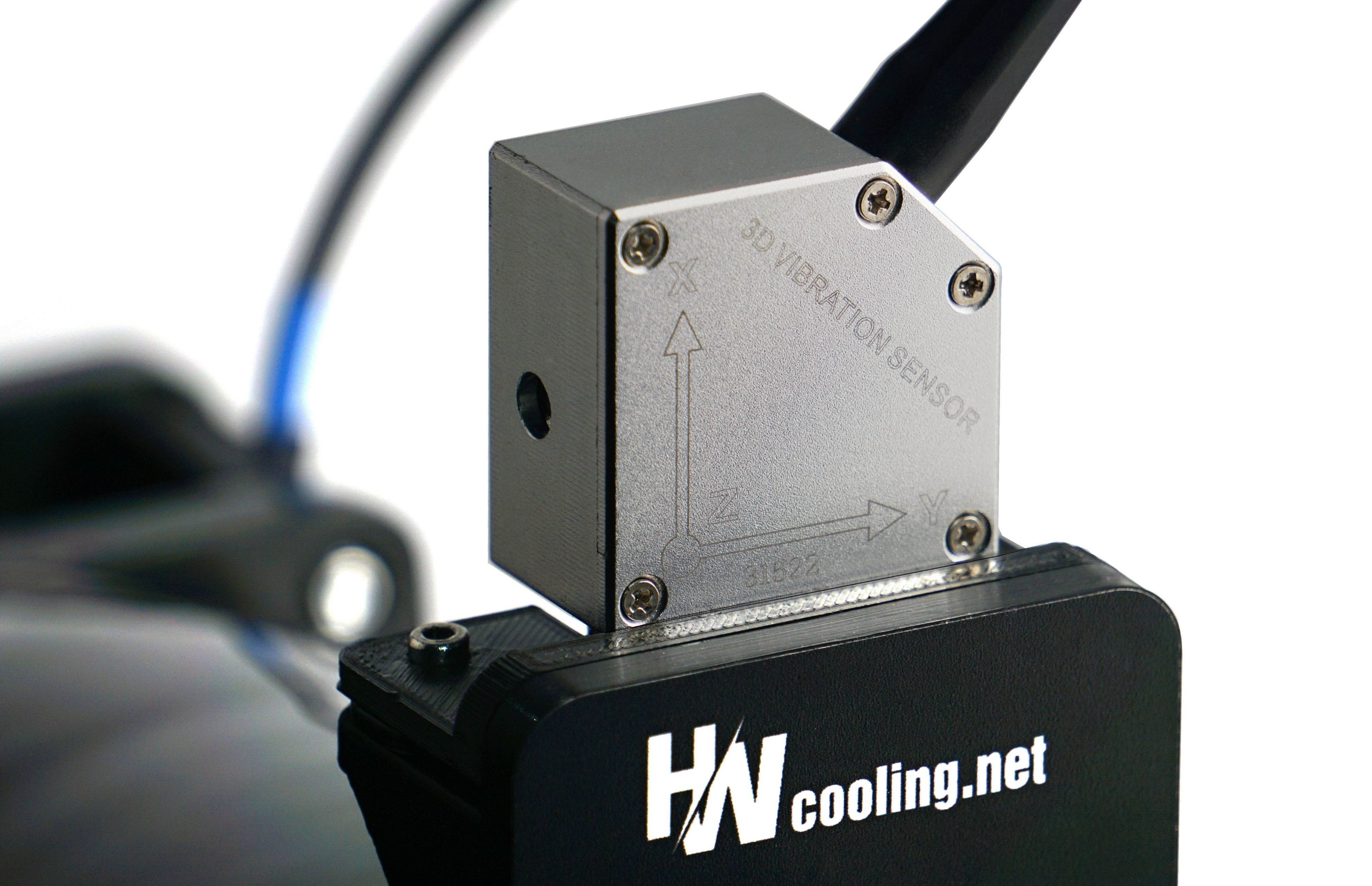
The silent blocks are naturally formatted to offset the bracket a bit from the rest of the tunnel, otherwise they wouldn’t make sense. This creates a gap that is sealed across the entire surface with a soft foam seal with closed cell structure (i.e., it’s airtight).
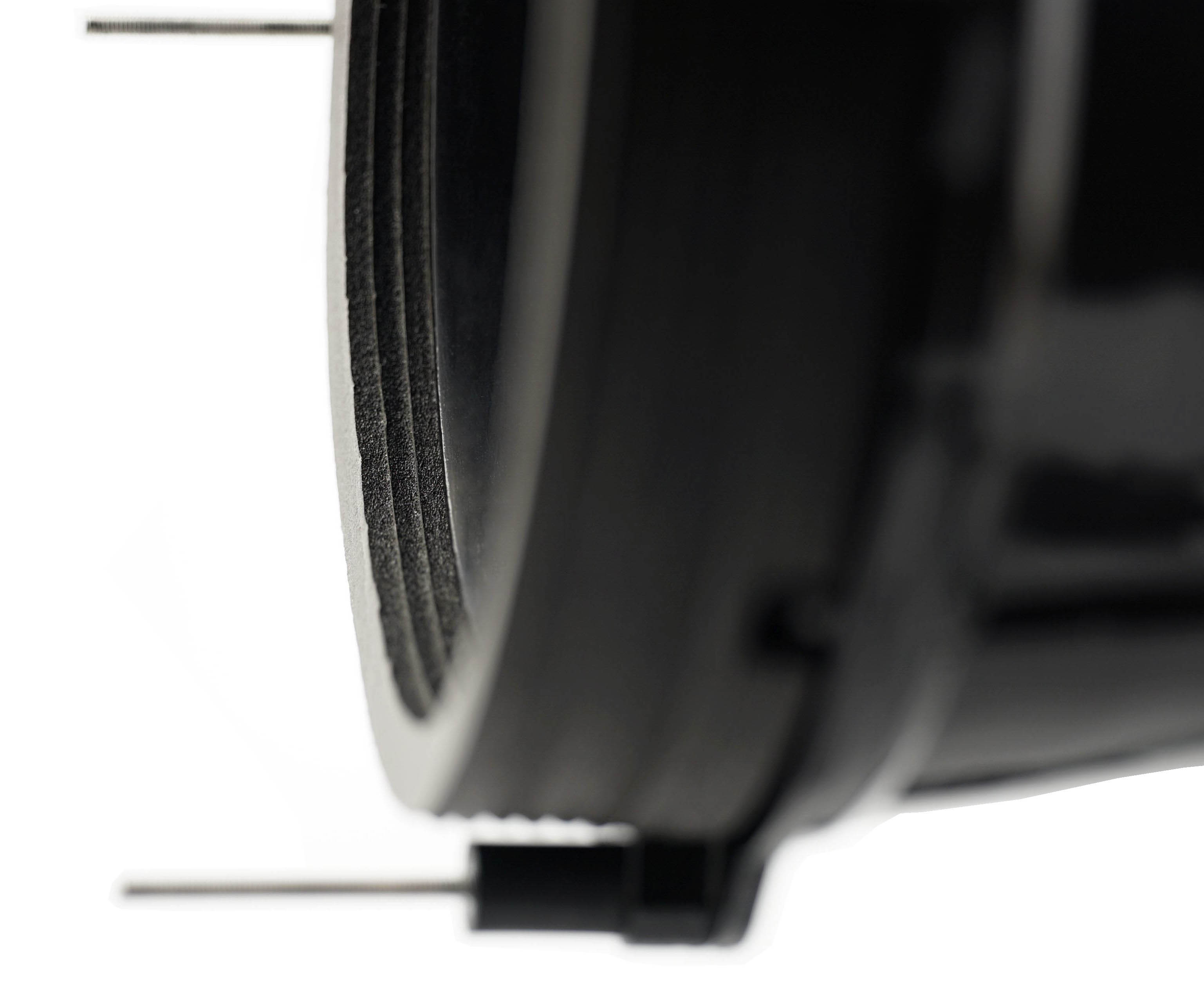
To properly center the fan rotor in relation to the other elements, the bracket includes a protruding frame that follows the inner contour of the seal. And to make matters even more complicated, the frame with the tested fan is pressed against this seal by a small force of compression springs, which in turn is set with the highest possible resolution for vibration measurement in mind and at the same time so that sufficient pressure is generated to maintain a flawless seal.
Vibration is measured with a Landtek VM-6380 vibration meter. It records the vibration speed (in mm) per second in all axes (X, Y, Z). For quick orientation, we calculate a 3D vector from the measured values and graph the “total” vibration intensity. But you can also find your results if you are only interested in a specific axis.
The most complicated part of the tunnel is behind us, and we’ll move on in the next chapter. But we will still stay at the beginning of the tunnel, we will just turn to the peripheries on the sides.



Thank you so much for your hard work bringing us these reviews!
Greetings from Brazil!
Hello
Your expert explanation helped me make my final choice between the two DeepCool FK120 fans and the ASUS ROG Strix fan XF120.
The price difference of these two fans in Iran is insignificant and is around 5 dollars.
Overall, according to your tests, I would choose the Deep Cool fan.
I hope it is the right choice.
Your friend from Iran
Choosing the most suitable fan for a specific scenario is highly complex. In addition to the fact that all situations in practice are more or less different, each has a different set of priorities of individual characteristics. Someone may prefer lower vibrations to a slightly higher airflow, so that the fan does not end up being a source of excessive secondary noise in interaction with, for example, the case.
But when you have looked through our tests, taken a look at the context, evaluated the pros and cons, you must have made the right decision. 🙂
it would be more complex if we had more high quality fans on the market, but nowadays it’s mostly limited to whether you want maximum performance without noise or maximum performance disregarding the noise
in the first case you get A12x25 (or T30 if you have space for that), in the other probably some monster from Delta
if we had high quality fans optimized for specific usecases (like Noctua had in older generations, before releasing the overwhelmingly good A12x25) we could extend that choice to low vs high impedance, but nowadays S12A is entirely irrelevant and their static pressure fans are only used to save money