At Computex 2025, we visited Gigabyte – one of the top manufacturers of graphics cards, motherboards, and other gear, including laptops. This year, the company focused strongly on laptops, but it also showcased other highlights, like a PC that is the closest thing to a fully Nvidia-powered computer today, with the GB10 processor. There was also a notable CXL memory expansion for systems that have filled all their RAM slots.
Stealth Builds with Invisible Connectors
Gigabyte also showcased motherboards with concealed connectors under its Stealth branding. As we noted in a previous article, a major challenge for these boards is the unresolved issue of compatibility with cases – specific cutouts are required for proper functionality. According to Gigabyte, its Stealth boards are compatible with more than 20 case models.

The company didn’t shy away from showcasing cases from other manufacturers – you’ll probably have no trouble recognizing the famous wooden front of Fractal Design North XL in the photo. The case on the very left is Gigabyte’s own product: the Gigabyte C500 Panoramic Stealth Ice.

In addition to Stealth-style cases, Gigabyte also displayed the Aorus C601 Glass Ice. Take note of the cleverly designed PSU tunnel, which allows front-side access to trays for HDDs or SATA SSDs.

With most cases, these drive bays can only be accessed from the rear after removing the second side panel. Here, you only need to detach the glass – an important difference if the back side of the PC isn’t easily accessible.
Arm in desktop: AI Top Atom
Gigabyte has also joined companies working with Nvidia on its compact AI workstation concept, DGX Spark (previously known as Project Digits). Several manufacturers will offer their own versions of this device, though all will likely share the same Nvidia motherboard (or at least, there are no signs of significant customization or unique PCBs yet). Gigabyte’s version, named AI Top Atom, features a sleek and attractive design.

We’ve got internal photos too, including an image of the anticipated GB10 “Superchip” processor, co-developed by Nvidia and MediaTek. It’s a 20-core CPU with an integrated GPU resembling the GeForce RTX 5070 in specs (6144 shaders on the Blackwell architecture) and comes with 128 GB of LPDDR5X memory. You can find more details on the system and processor in this article.

As you can see, the processor uses a chiplet design – its CPU and GPU are separate silicon dies connected via the NVLink-D2D interface. It’s somewhat analogous to AMD’s chiplet architecture.

Radeon AI Pro
On the AI front – but from the other camp – there’s also the newly announced Radeon AI Pro R9700, a professional version of the Radeon RX 9070 XT with 32 GB of memory. The card will hit the market in July, also in custom versions from various manufacturers, and Gigabyte is one of the first to showcase it.

Just like AMD’s reference design, the card uses a blower-type cooler, allowing four cards to be installed side by side, and is powered via a 12+4-pin connector.
The King of Low Profile Gaming
On the opposite end of the GPU spectrum – meant for gaming rather than AI – is the interesting GeForce RTX 5060 OC Low Profile 8G, a half-height card as the name states, despite being a two-slot design. It features three small-diameter fans, making the card fairly compact overall (18.2 cm in length).
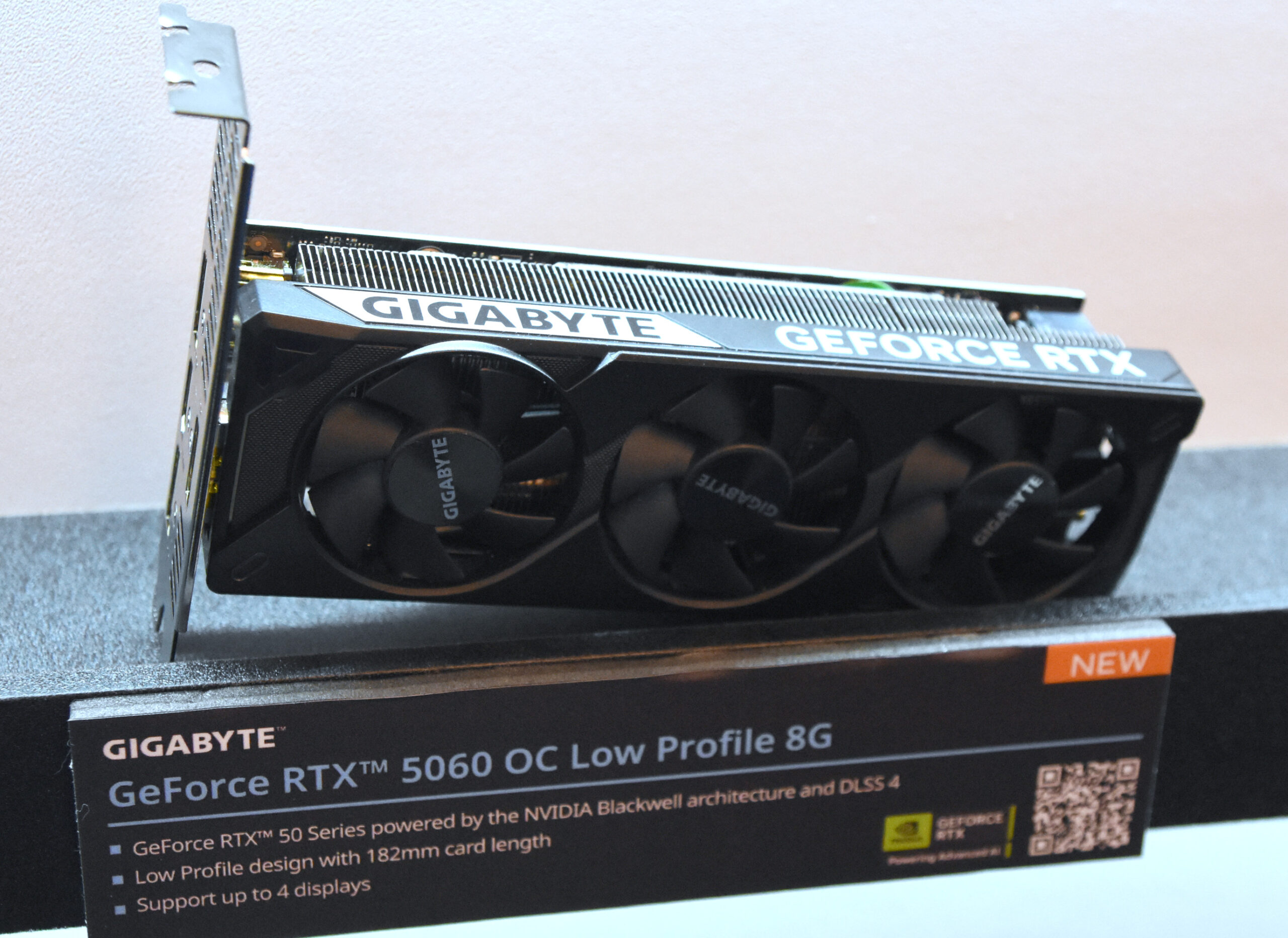
The appeal of this card lies in its compatibility with cases that have low-profile PCI Express slots (a low-profile bracket is included in the package), such as office PCs or SFF cases. This card should now be the most powerful GPU available in this format (at least until a similar product emerges in a future generation). Impressively, it still manages to offer four display outputs within the reduced bracket constraints.
External RTX 5090
An alternative to squeezing trimmed-down compact GPUs into SFF PCs is using an external solution. For this, Gigabyte offers the Aorus GeForce RTX 5090 AI Top, again targeting the AI market as well.

This GPU features Waterforce AIO cooling and connects via Thunderbolt 5 or USB4. It’s intended mainly for laptops, effectively serving as a full docking station with Ethernet, Thunderbolt, and USB ports.

Extreme AI Workstation with Threadripper and RAM on a PCIe 5.0 Card
Also aimed at AI applications is the full-fledged Gigabyte AI Top 500 TRX50 workstation. Naturally, it’s based on a Ryzen Threadripper CPU on a TRX50 motherboard with four PCIe 5.0 ×16 slots and eight fully populated DDR5 RAM slots. It’s outfitted with “just” two AMD Radeon Pro W7900 Dual Slot GPUs.

One of the most interesting components, however, is the third card below the two GPUs – which, as you can see, also houses DDR5 memory modules across four slots. This card, named Gigabyte AI Top CXL R5X4, extends system RAM beyond what’s possible with standard DIMM slots. It connects via the CXL interface (using a PCIe 5.0 ×16 slot) and is managed by a Microchip controller. The card can support up to 512 GB of RAM and multiple units can be used – but tapping into this memory space requires specialized software. An unpopulated version of the card is also on display, shown in front of the workstation setup.
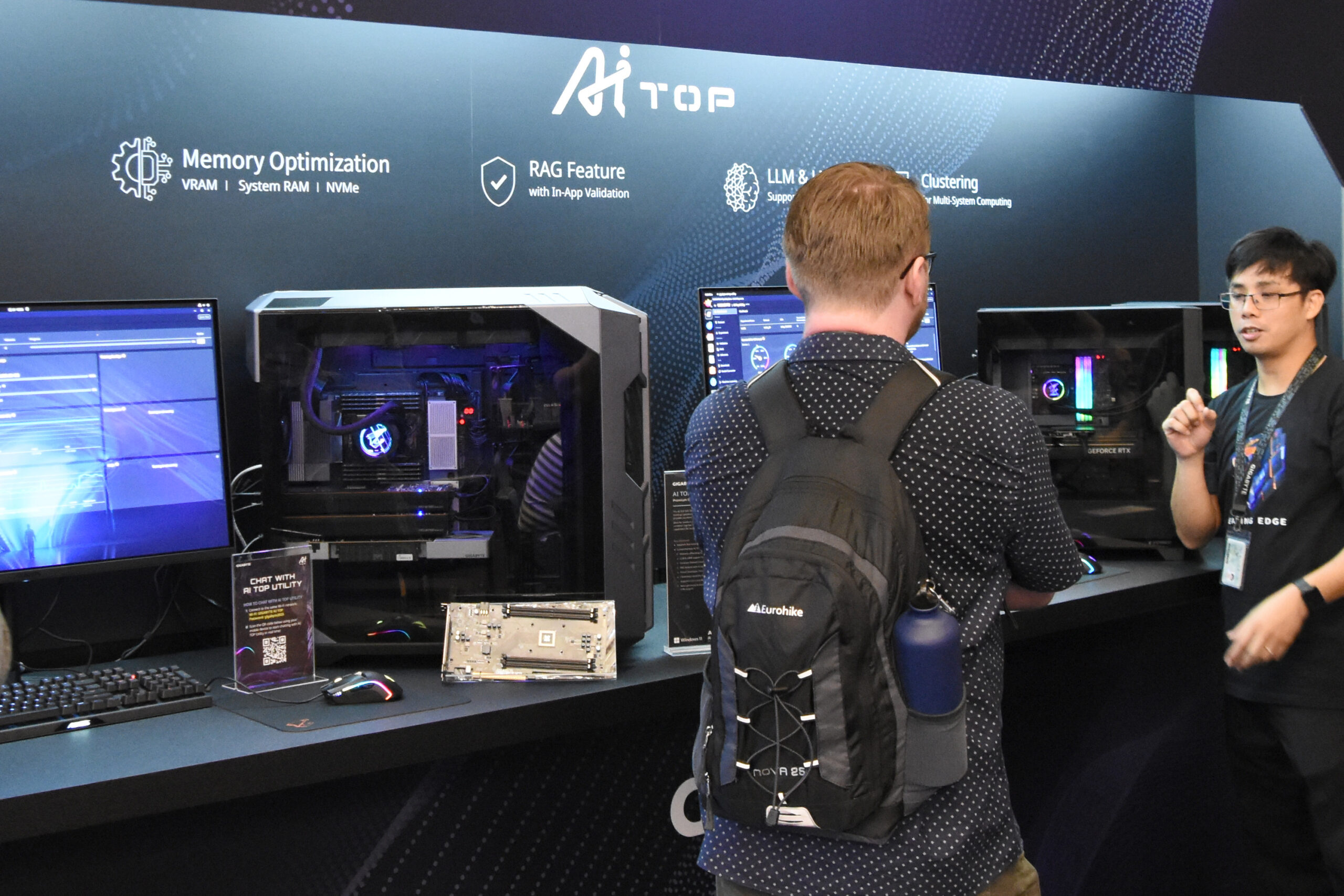
Similar CXL devices have appeared on the market using DDR4, which is interesting because they allow server operators to “recycle” modules from decommissioned systems. That’s not the case here, as this model uses DDR5 for maximum performance and capacity.
Gaming Laptops
And lastly, we’ve got a photo gallery of laptops. Gigabyte showcased gaming models primarily equipped with Arrow Lake processors and, of course, the latest-generation GeForce RTX GPUs.


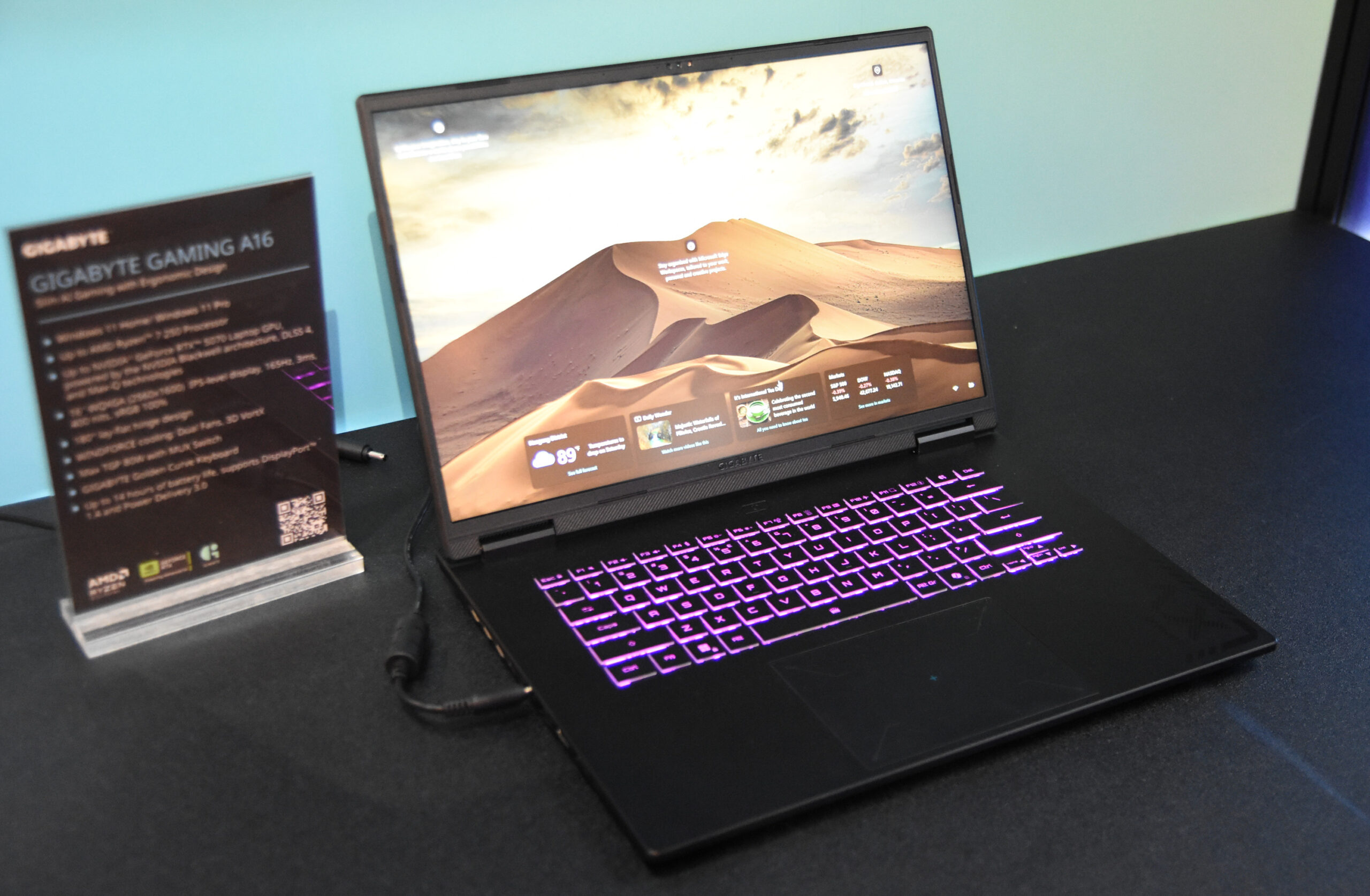

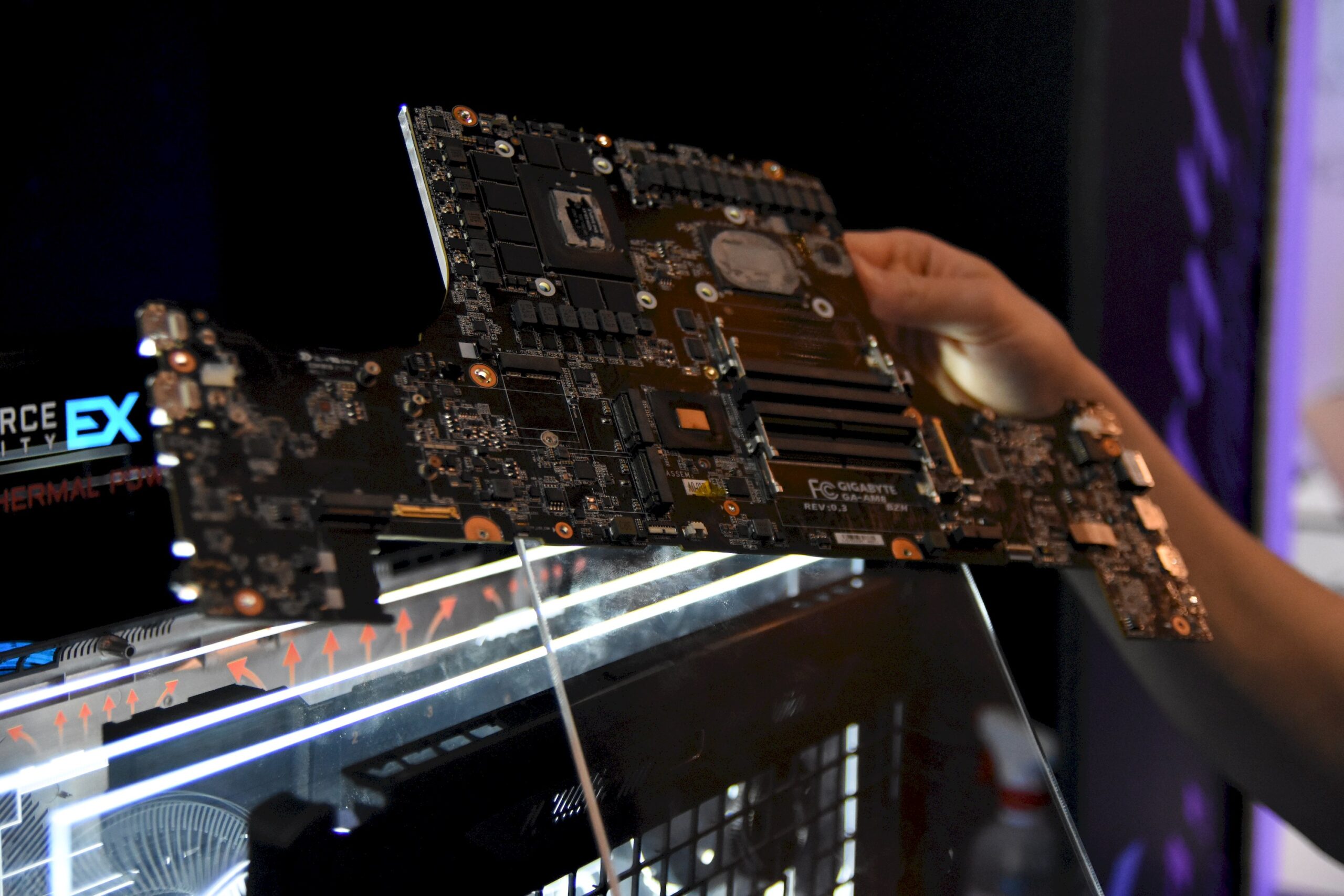
Also on display were notebook motherboards and a demonstration of the Windforce Infinity EX cooling system, capable of dissipating up to 95 W from the CPU and 175 W from the GPU in a gaming laptop.


Sources: Gigabyte, self
English translation and edit by Jozef Dudáš
⠀