


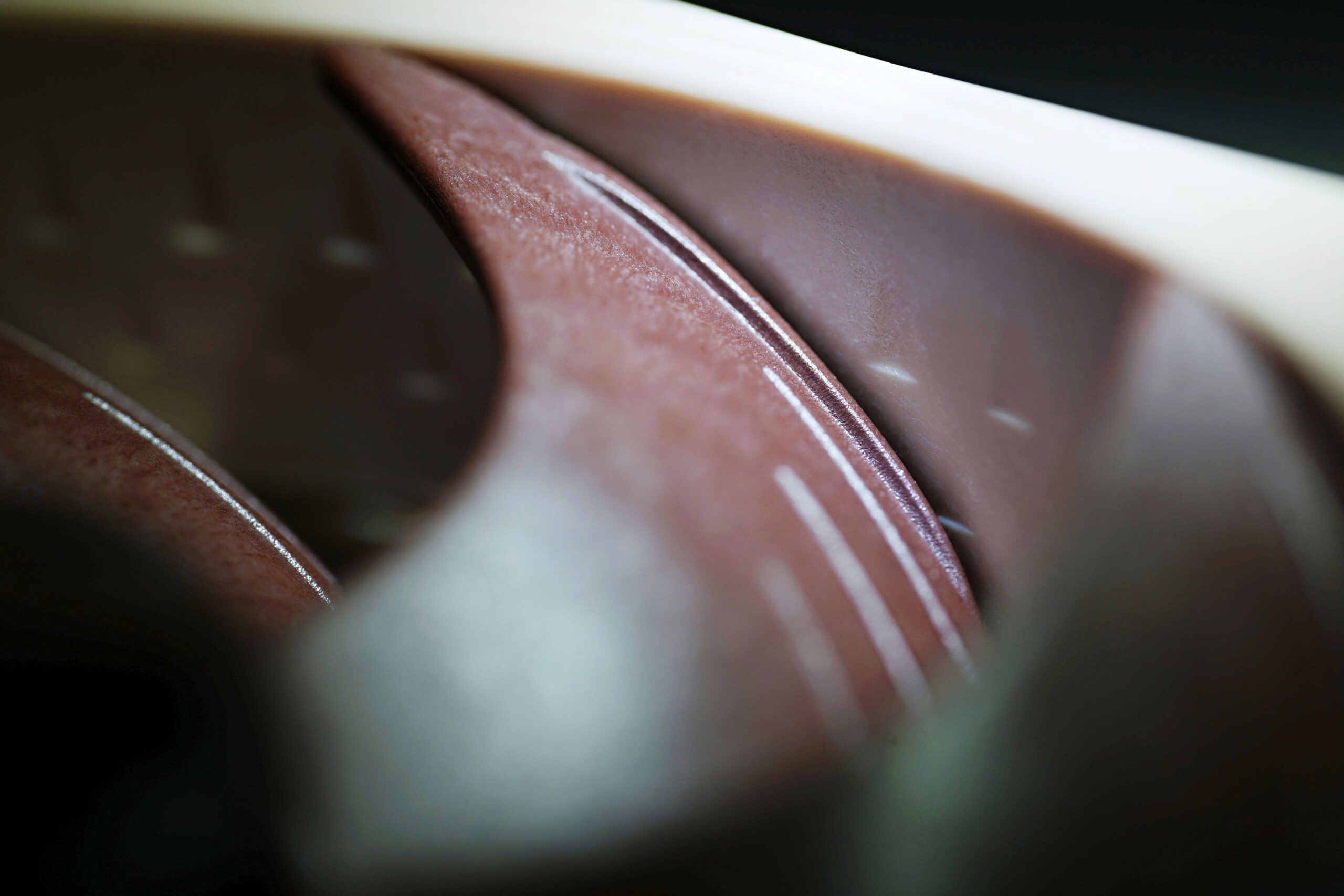
We interviewed a Noctua representative who revealed many details about the direction of this company’s cooling components. Do you already know everything about Noctua fans? Or do you have an idea of how far the cooling performance of pump-less liquid coolers will go? This and much more (hopefully of interest) was covered in the interview. The information that emerged is compiled within this article.
You already know Jakob from Noctua from earlier interviews on topics such as frame deformation in NF-A14x25 G2 PWM fan prototypes or noise measurement techniques. Now we’ll take a bite at something… more general.
HWCooling: Hi Jakob, can you reveal which areas of life Noctua draws inspiration from when designing its cooling components? I understand that a great deal of in-house development is involved and that it’s crucial for well-known elements from other fields to work together properly—but what is the very first thing you look at before you even begin testing a particular idea? It occurred to me that it might be the aerospace industry, where there is probably more room for experimentation (than in the much smaller market for coolers or fans), and of course there is extensive literature on fluid dynamics and similar fields. Could you shed more light on this? 🙂
Noctua: Hi Lubo, the current scientific literature and research definitely form an important backdrop for our R&D. Over the years, we’ve also drawn inspiration from areas like aerospace or turbomachinery as well as from phenomena in nature and wildlife. That said, I wouldn’t say there’s anything like a default field we turn to for inspiration. Many of our product designs and technological refinements have become so specialised that it’s increasingly challenging to get helpful clues from other areas.
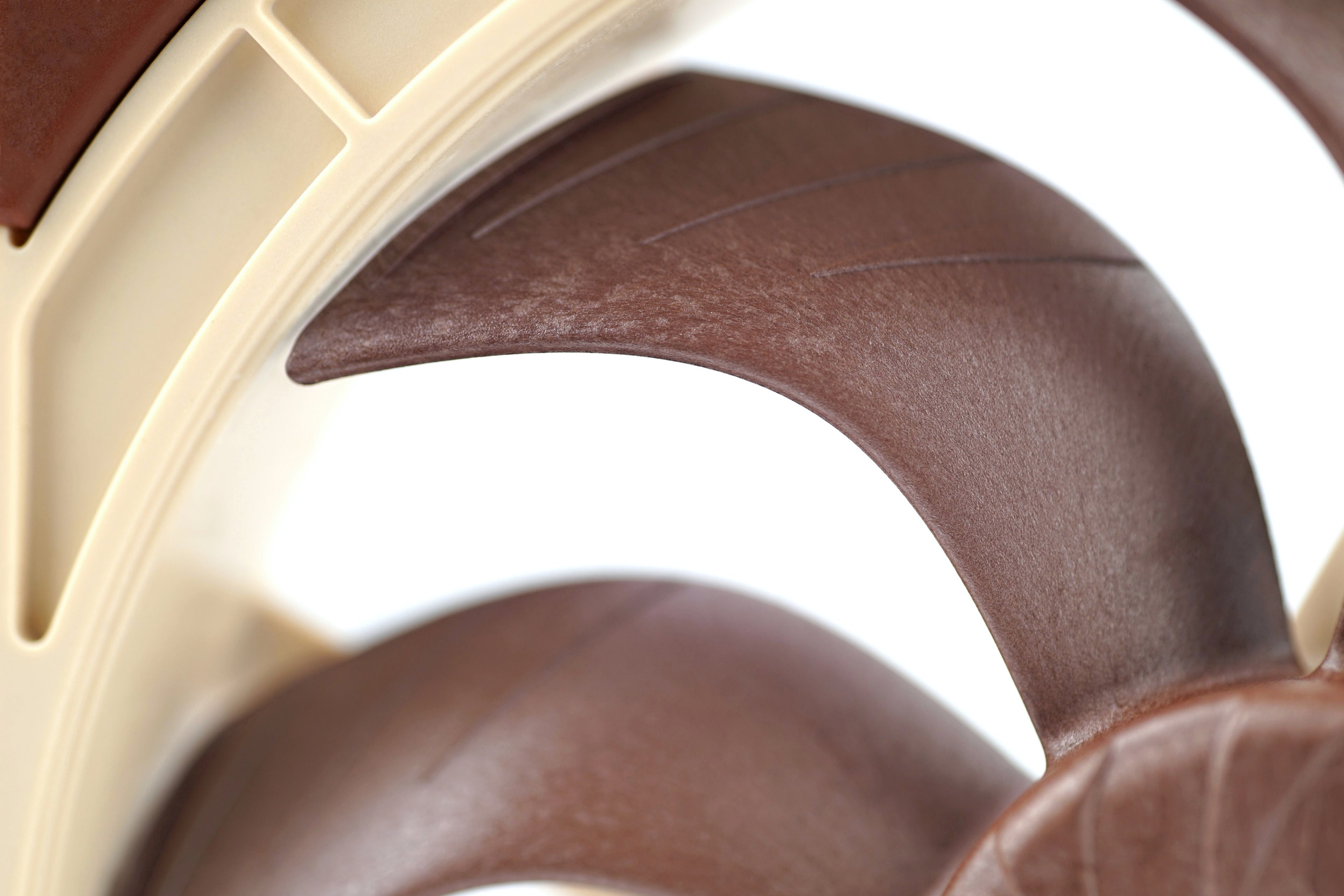
HWCooling: The second generation of “Sterrox” fans introduced the new Progressive Bent impeller, characterized by multiple elements and micro-optimizations—whether it’s the blade curvature or the protrusions on the hub surface (Centrifugal Turbulator). Were other aerodynamic concepts tested internally—perhaps something that ultimately didn’t make it into production for various reasons? Or is there already something you believe could move the fan segment forward, with a good chance of being implemented next time? Of course, commenting on future plans is complicated, and we’re not expecting anything that must appear with certainty. Rather, we’re interested in what you consider possible or impossible. If there are ideas that are clearly unlikely ever to reach mass production (for example due to high costs), feel free to mention those as well.
Noctua: Yes, as you know, the G2 blade design was first introduced with the NF-A14x25 G2 in 2024. And since the project started back in 2015, we explored several alternative design approaches before settling on the Progressive Bent impeller with the Centrifugal Turbulator hub. We actually talked about this process quite a bit at Computex 2023, so you can refer to the news coverage from back then for details. In short, we pursued five main design approaches before we arrived at what ended up being the final design in 2020.
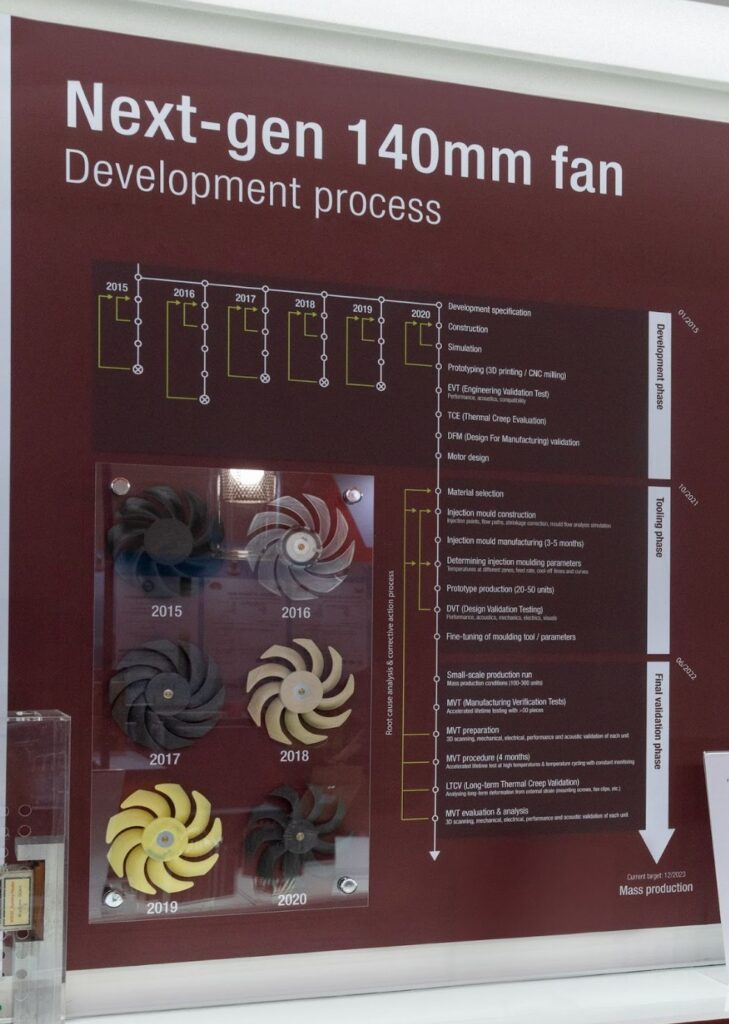
When you look at the photos, you can see that these approaches were quite diverse. We even tried a very unusual 10-bladed design in 2017. The reasons these alternatives didn’t make it to market ranged from not meeting performance targets to not being feasible in mass production due to issues such as thermal creep.
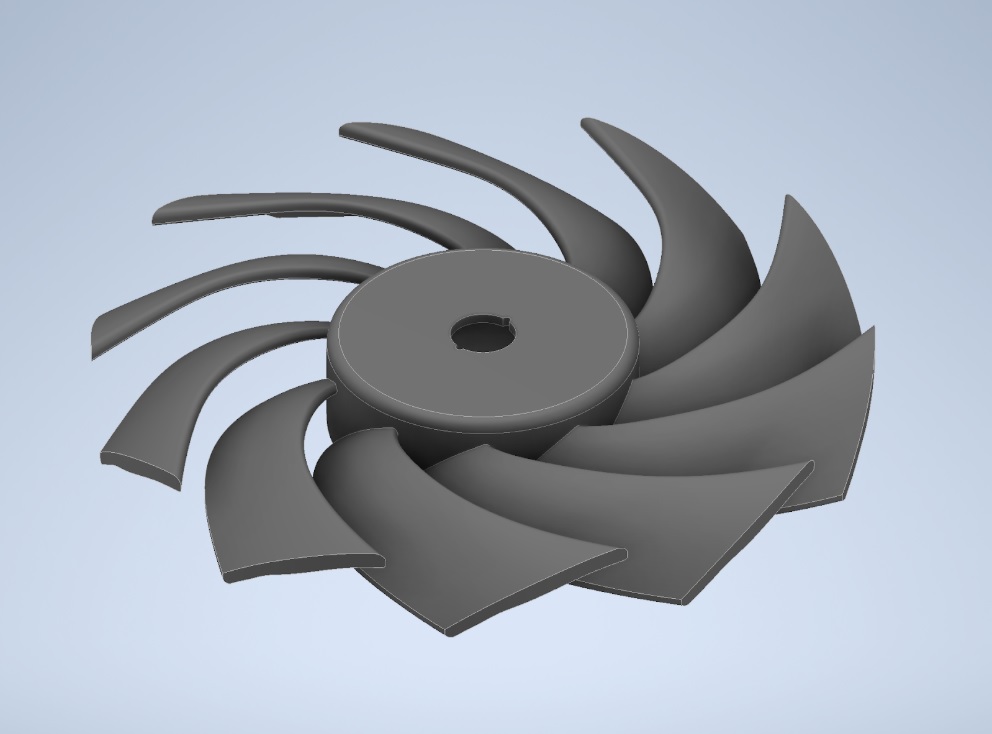
When it came to the second-gen 120 mm design, thankfully, the process was a bit more straightforward. We expected to meet the performance target using the same design approach as the 140 mm and already had high confidence that it would be feasible in mass production, so it was mostly a refinement process rather than trying completely different approaches.
For future developments, I can confirm that we’re already working on new blade geometries and aerodynamic design measures that we anticipate will move things forward. That said, there’s no denying that fan engineering has come a long way, particularly in the 120 mm form factor that has been thoroughly studied and optimised, so squeezing out substantial improvements is becoming increasingly challenging.
We don’t see any potentially game-changing technology on the horizon that we would simply rule out due to cost, so it’s not like there’s a silver bullet for fan engineering that we’re just not using because it would be too expensive. The Active Noise Cancellation system we pursued some time ago had this potential, but it was sort of overtaken by the development towards stiffer materials and tighter tip clearances. Making the tips of an LCP impeller with 0.5 mm clearance move up and down simply won’t work, and settling for a larger clearance and a less stiff material just to be able to integrate ANC wouldn’t really make sense if there wasn’t any net gain.
HWCooling: So it’s not only about fans: What makes Noctua’s cooling solutions specific, and are you confident that competing solutions fall short in comparison in these areas?
Noctua: If I had to pick one thing, I’d say it’s how our products reflect our performance-first mentality, our obsession with detail, and our mantra of going for the 120% solution rather than settling for 95%. I have a lot of respect for other players in the market, so I’d never say they “fall short” in these areas, but I’m confident these traits give our products a unique signature. Other defining characteristics would be longevity – both in terms of lifespan and, in the case of coolers, upgradability via mounting upgrade kits – as well as service quality. Customers appreciate that we provide support beyond the warranty, and that we’ll go the extra mile to send them that missing screw even if their cooler is 15 years old.
Finally, if I may come back to fan acoustics in particular, I think we go to a deeper level of optimisation and spend more engineering time to make sure a fan sounds as pleasant as possible to the human ear across a wide range of operating conditions. We often hear reviewers and customers comment that even in cases where they couldn’t measure a significant advantage in SPL, they prefer the sound signature of our fans – this isn’t a coincidence. We also often hear that while they may have seen similar results with other products in specific applications, ours tend to perform great no matter what you throw at them. Balancing a design so that it achieves outstanding results across a broad range of applications is a very challenging and time-consuming process. For example, building a great radiator push fan becomes a lot easier if you completely ignore intake acoustics. We work hard to avoid those kinds of shortcuts, because we know customers will want to, for example, use the same fans as front intakes where obstacles may be in the way.
HWCooling: First of all, thank you for the excellent answers. 10 blades… I have to stop there for a moment. The vast majority of fans use an odd number of blades (mainly for acoustic reasons?). Can you reveal why, during development, you decided otherwise?
Noctua: Yes, at least when using an even number of stator struts, you normally want to use an uneven number of blades. The reason is you should avoid having a common divisor between the number of blades and struts to avoid matching overlap situations between blades and struts. If there’s no common divisor, the geometric relation between each fan blade and the struts is unique, whereas when you have a common divisor, you will have matching situations. As a worst-case example, imagine having a fan with 4 evenly spaced blades and 4 evenly spaced struts. Each blade will have the same geometrical relation to a strut. When the blades pass over the struts, this creates pressure pulses, and, to stick with our worst-case example, if all the blades produce same pressure pulse at the same time, these will add up and build pronounced spikes in the frequency spectrum. By contrast, blade-to-stator configurations without common divisor tend to have a less tonal, more broadband noise profile because these matching situations don’t occur. The reason why we still attempted to go for a design with ten blades was that it enabled us to achieve better spatial blade coverage, effectively maximising the lift generating surface area, so it was mainly a performance driven decision. The goal was to investigate whether the performance gains might outweigh the acoustic penalties. Sadly, in the end, they didn’t, but since simulations looked promising, we still wanted to explore this option. Just in case you may wonder, the reason why we didn’t go straight to eleven blades was that the chord length would have had to be reduced to make room for even blades and that blade-to-blade interaction would have ended up being too high.
HWCooling: On another topic: liquid coolers. I assume the thermosiphon prototype is still on the agenda and in the development phase. Can the liquid inside the loop move fast enough to bring cooling performance up to the level of top-tier models such as the dual-tower Noctua NH-D15 G2? Or is it realistic to talk about something comparable in terms of cooling performance? I understand it’s still a long way off, but… it’s more about whether that’s the goal and how you realistically see it at this point. 🙂

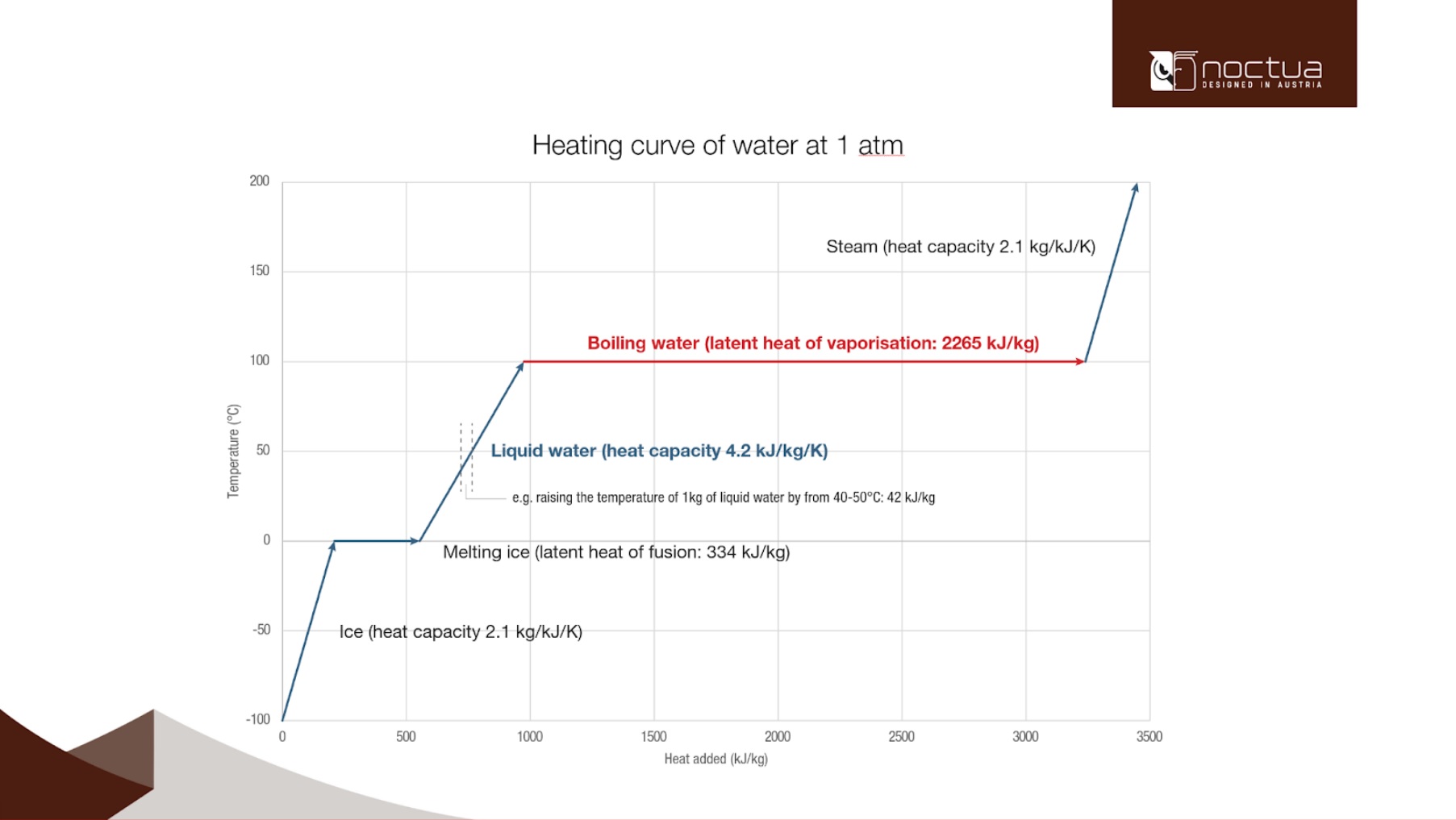
Noctua: Absolutely, we’re working hard on the thermosiphon and will give an update on the project at Computex in June. I think I can already say that we’re very happy with the progress we’ve made since last May. As for your question, the fluid circulation rates inside this system are much lower compared to typical AIO water coolers for example. However, we can make up for this with the much higher heat transfer potential due to the latent heat of vaporisation and condensation. Simply put, we have less fluid circulation, but we can transfer way more heat per cycle. For reference, the energy required to evaporate water is around 50 times higher than the energy required to heat up the same amount of water by 10°C. So even if the fluid circulation rate of a two-phase system is, for example, 10 times lower than that of a pumped liquid cooler, it still has the potential to perform better due to the immense thermal capacity of the phase change process. Reaping this potential is the engineering challenge. So don’t get me wrong, I’m not saying we’re there yet, but this theoretical potential is what makes two-phase cooling so exciting from a thermal engineering point of view. Our current prototypes are already outperforming the NH-D15 G2 and our design goal is to reach a similar performance level as today’s best all-in-one liquid coolers.
HWCooling: How about the noise levels of liquid coolers that use a pump (Asetek)? Are they quiet enough for you to be satisfied with the acoustics? What about regulation to lower speeds—are such options expected? If the pump’s performance is reduced (typically by setting a lower linear voltage or lower PWM duty cycle), does that endanger its lifespan in the sense that it might, at some point over time, fail to overcome the resistance currently imposed on it? How do you address these aspects? It occurred to me that there could be multiple acoustic optimizations with which you might bring liquid coolers to market?
Noctua: Sensitivity to noise is obviously a very individual thing, and the different sensitivity levels among customers is something that we have to take into account when assessing if we find a particular level of acoustic performance satisfying or not. When it comes to AIO pumps, Asetek’s designs have come a long way – the Emma V2 platform runs significantly quieter than previous generations compared at the same performance levels. For our own version, we have also developed a custom noise damping cover that further reduces noise levels as well as an integrated mode switch, which enables you to switch between a quiet mode, a balanced mode and a manual mode that gives you access to the entire RPM range. The quiet mode is pre-selected by default. In combination, these measures make the pump quiet enough for it to be inaudible from outside the chassis for most customers under normal operating conditions. From my perspective, this is a very satisfying result. However, customers that are extremely sensitive to noise or minute vibrations, particularly in the frequency ranges produced by AIO pumps, may still prefer air coolers or our upcoming thermosiphon cooler that will offer the key advantages of AIOs with zero pump noise.
As for PWM speed control, I’ve already mentioned the three different speed profiles, they can be set manually using a switch on the pump and will change the RPM range that can be accessed through PWM control. In all three profiles, customers can set the pump to lower PWM settings and slow it down all the way to 800rpm. There’s no negative impact on the pumps lifespan from automatically regulating it or constantly running it at lower speeds unless the liquid temperature inside the loop exceeds 60°C. Therefore, in all three modes, the pump will automatically and gradually start boosting its speed all the way to the maximum RPM of 3600rpm if the liquid temperature starts creeping over 45°C. This way, we can achieve optimal acoustics under normal operating conditions without risking damage to the pump due to excessive liquid temperature.
HWCooling: With answers this technical, I have to raise a question about greater fan profile thickness. We discussed this some time ago and, of course, the strategy of refining the fundamental aerodynamic design (blade shape, frame, micro-optimizations, and ensuring that everything works together) to technical “perfection”, and only then increasing thickness, makes sense. I don’t want to ask right now whether Noctua is working on fans thicker than 25 mm (you can comment on that, but you don’t have to…), but rather what can be achieved with such a modification. Above all. Naturally there are several aspects, but the main one we have fixed in mind is that with greater thickness the static pressure mainly increases. That means higher cooling performance when combined with an obstacle—for example on a radiator. The reason is that airflow drops to a smaller degree (compared to thinner fans). What do you think about this consideration? Is it off the mark, or are we roughly around the truth? We certainly are not implying that a thinner profile must automatically mean lower static pressure, but to simplify—this is about comparable aerodynamic designs where in one case the fan is thicker. Yes, I understand that it doesn’t work this simply (and “just” increasing fan thickness may not be optimal… because achieving the lowest possible noise at the highest possible airflow requires a certain harmony of all elements), and the goal here is to bring this topic as close as possible to every reader. At least approximately, so they have some basic idea…

Noctua: We’re constantly exploring potential ways to further improve performance-to-noise efficiency. Increasing fan thickness is such a potential way, as it opens new design possibilities that could help pushing the envelope, but it’s not a silver bullet that will magically boost performance to a whole new level. For example, going beyond 25mm thickness for a 120mm fan can facilitate optimising seven bladed designs as the increased vertical space makes it easier to combine large blade surface area with a steep enough stagger angle. In 120x25mm, a seven bladed design would either have to go for a relatively low stagger angle or sacrifice blade surface area. Going for seven instead of nine blades can be interesting because the lower blade count will result in a lower blade passing frequency, so there’s a potential for fans that sound more agreeable at a similar RPM. Due to the possibility of having a longer chord length and larger blade surface area at 30mm thickness without lowering the stagger angle too much, such a design has the potential to perform very well in high impedance scenarios. I would, however, argue that these design options could be used to different ends as well, not necessarily just achieving better performance against high flow resistance. You could also go for a design with nine or even blades, a very steep stagger angle and a longer chord length than a 25mm profile would allow – such an approach could maximise flow at low resistances. Regardless of which way you go though, it will require refined aerodynamic engineering to reap these potential benefits.
HWCooling: Regarding the thermosiphon liquid cooler: We’re looking forward to the materials and new insights from Computex ‘26 (hopefully we’ll manage to travel to Taiwan again this year—we believe so and we’ll see…). The report of a high NSPR value, exceeding Noctua’s current maximum, will certainly please many people. Hopefully this step won’t dampen interest in pump-based designs, because the cooling efficiency of a thermosiphon liquid cooler will already be sufficient, haha. Especially given that the goal is for cooling performance to reach a similar level as pump-based concepts. One thing comes to mind here: if such a design does not cannibalize your own pump-based liquid cooler, can we also look forward to its cooling performance being unprecedented even at low noise levels?
Noctua: Very much looking forward to welcoming HWCooling at our Computex boot again! It will indeed be very interesting to see how the thermosiphon cooler will transform the market for traditional AIOs. We’re confident that the thermosiphon will become the first choice for highly noise-conscious users as well as customers who seek superior reliability. Performance wise, the goal is to achieve similar temperature levels as an AIO at equal fan speeds, so with zero pump noise or vibration and no moving parts that could possibly fail, the thermosiphon would clearly have an advantage. At the same time, there are certain use cases where the thermosiphon cannot replace conventional AIOs, at least not yet. Being a gravity-driven system, the thermosiphon can currently only be installed at the top of a tower case, not in the front or at the side. We also currently don’t plan to go smaller than 360mm, so 240mm AIOs will keep their place regardless of the mounting position. Finally, AIO water coolers have been mass-produced in large quantities for many years now, so the manufacturing processes have become very streamlined and cost-down measures brought the production cost down significantly. By contrast, we’re just starting to prepare mass production processes for the thermosiphon, and it will take quite some time to achieve a similar level of streamlining. This, in combination with the high amounts of copper required for the evaporator units, will result in a significant cost penalty, at least initially. Therefore, we currently envisage the thermosiphon as an absolute premium solution and do expect our AIO coolers to remain attractive for SFF users, front or side mount setups as well as customers who are more cost-conscious.
HWCooling: André also pointed out the low noise of Asetek pumps in a recent interview. Personally, it’s hard for me to fully accept that a top-tier pump could fall below the noise level of a top-tier fan running at low RPM—but yes, as you write, it depends on how each person evaluates noise. And when measures exist (such as your cover, for example) to reduce noise, I have no doubt it will indeed be “quiet”, although again—for some people even 790 RPM on the NF-A12x25 G1 fan is too loud, and that’s perfectly fine. Everyone perceives sound differently, subjectively; some people are bothered by certain frequencies, others by different ones. Liquid pumps usually have different, often higher frequencies than fans. It is great to know that reducing speed does not reduce pump lifespan. In any case, I will try to phrase it differently so we understand each other correctly. I realize that reducing pump speed can have a positive effect on lifespan, but I was referring to something else. Specifically, that when pump speed is reduced, its performance also drops—and after some time it might not overcome the resistance that increases during its use. Besides natural aging (and increased internal friction), I am also referring to the properties of the liquid in which it operates. I know that at least in some cases with AIO liquid coolers, material from the tubing could be released and clog the microchannels in the block, which certainly doesn’t help… I assume you have solved this so that it is not an issue. In any case, 800 RPM is an exceptionally low speed especially for a small pump, at which it will probably be inaudible to most people.
Noctua: Pump noise is a very complex topic. I do agree with André that with the Emma V2 platform, it is no longer a big issue for most users. Especially if you run your fans at higher speed levels, many people will struggle to actually hear the pump. But while the measured SPL levels of the Emma V2 pumps are extremely low, I also agree with you that the sound signature tends to be a bit more high-pitched than a well-designed fan. Vibrations can play a role as well, especially if the system is prone to resonances. In sum, this can lead to situations where a dB meter may not be able to pick up the noise of the pump when the fans are running, yet noise sensitive users might still find it noticeable or even distracting. Thankfully, the additional noise reduction measures that our AIOs will bring to the table will further reduce this concern though. Our pump noise absorber is particularly efficient in reducing the higher frequency ranges in the pump’s noise spectrum, so it will also blend more easily the acoustic profile of high-end PC fans.
As for your question regarding flow resistance, we have been working with Asetek on this for many years now, and even with samples that are several years old, we have never seen issues where flow resistance would increase due to residues, gunk build-up or anything like that. Asetek has been on the forefront of AIO liquid cooling for more than two decades, so if anyone has the expertise to safely avoid this type of issue, it’s them. Their spotless track-record and vast experience in supplying coolers to high profile clients like AMD, Intel, Dell, HP or Lenovo gives us strong confidence in the long-term stability of these units. You don’t need to just take our word for it though, the coolers will also be covered by our usual 6-year warranty.
HWCooling: One more separate question about the pump, so we can break this up a bit: Have you observed any difference in cooling performance between very low pump speeds (around 800 RPM) and high, traditional speeds (around 3600 RPM)? I assume there is some difference (the liquid temperature is higher), but is there anything that manifests negatively on current processors? We know that up to a certain point there is some headroom in this regard with some pumps, and it is possible to reduce their speed without any real impact on cooling performance (flow through the loop remains sufficiently high and the bottleneck lies elsewhere?), but here of course we are talking about a Noctua liquid cooler, where specific characteristics are achieved.
Noctua: Yes, of course, cooling performance will scale with pump RPM, so there’s quite a difference between 800 and 3600rpm. Just like with the fan speed on air coolers, it will depend on your exact system specifications and use case how much higher your CPU temperatures will end up being if you go from 3600rpm down to 800rpm. Frankly, comparing minimum to maximum speed is quite an extreme example though. While the temperature difference between 800 and 3600rpm will be noticeable with most current CPUs at full load, it’s much less obvious between 3600 and 2100rpm, the maximum speed in quiet mode. In this case, the temperature difference will usually be quite small unless your CPU cranks a lot of heat. At the same time, noise levels are significantly lower at 2100rpm, which is why we’re confident that the quiet setting is an excellent choice for noise-conscious users. The 800rpm minimum speed has its place for idle conditions or lower power CPUs, making it possible to go near-inaudible if the system allows.
HWCooling: Why will it not be possible to install the thermosiphon cooler vertically behind the front of the case? Won’t this be a disadvantage in terms of compatibility? I’m referring to the fact that many cases do not have enough space in the top position for such a cooler to fit. With a thickness of roughly 27 mm (the radiator?) + 25 mm (the fan thickness without screws), there may already be collisions with components on the motherboard—for example VRM heatsinks or memory modules. From a physics standpoint, however, it probably cannot be done any other way than with a horizontal orientation?
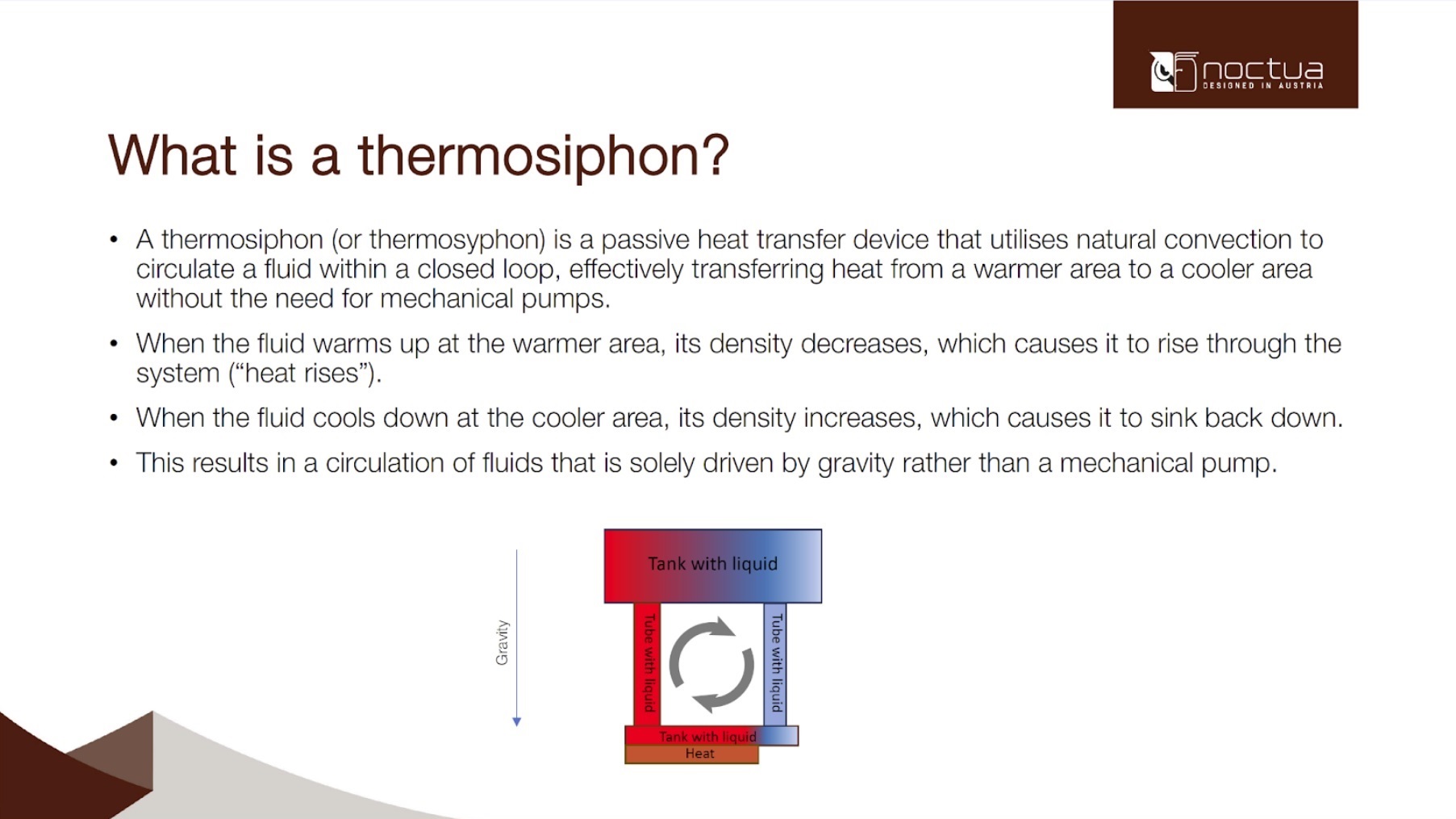
Noctua: A thermosiphon is a gravity driven system. Fluid circulates because of density changes of the working fluid due to temperature differences – hot fluid rises and cold fluid sinks, so the fluid starts moving up from the hot point of the loop, cools off and moves back down. In case of a two-phase system, it also evaporates and condensates in the process, but still, the fluid circulation and heat transfer enabled by it depend on gravity. If the condensator doesn’t sit above the evaporator, evaporated fluid will not rise to the condensator, and without the circulation inside the loop, there won’t be much heat transfer at all.
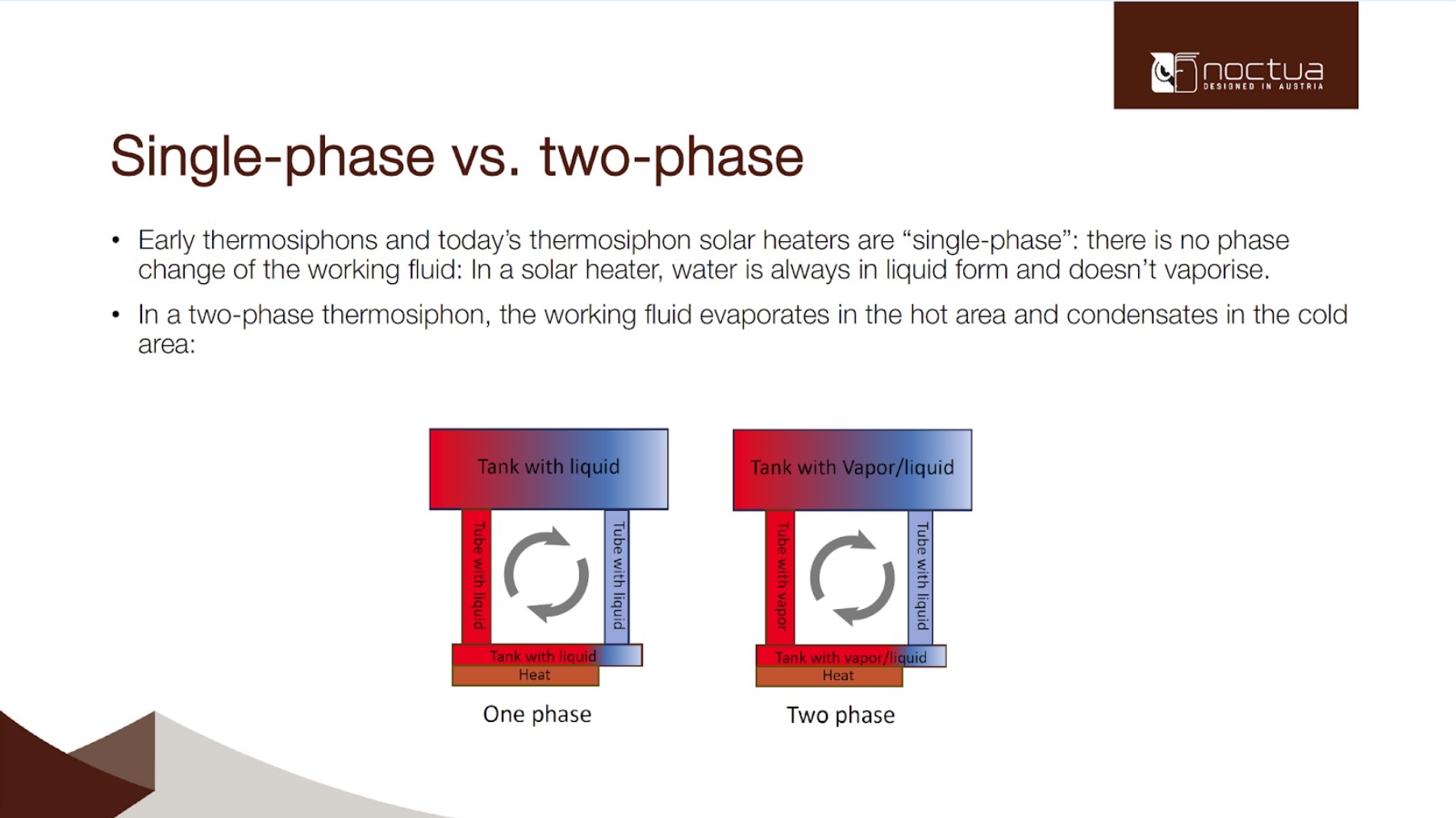
Compatibility wise, I don’t think this is that much of a drawback with modern chassis. Many of them have been developed with top-mounted 360mm AIOs in mind, so we hardly see any collisions with motherboard components when standard 30mm thick radiators are paired with standard 25mm thick fans. The top-mount position also has the advantage that heat is directly exhausted from the system. That said, some customers do prefer front-mounted radiators with AIOs because they tend to give slightly lower CPU temperatures due to fresh air being blown over the radiator, so there’s no denying that AIOs offer more flexibility in terms of mounting positions.
As you’ve said, there isn’t much that can be done about this from a physics standpoint, at least not with the type of system we’re currently working on. While there are means of making passive, non-pumped systems work against gravity, this would introduce other challenges and drawbacks. For example, you can integrate capillary structures to make the system less gravity-dependant, but this will be tricky to combine with soft, flexible tubing. It typically also increases flow resistance, so you may end up sacrificing cooling performance to make the system more flexible in terms of orientation. At least for now, we’re confident that it makes more sense for us to focus on achieving maximum performance and having a working, highly performant product out on the market as soon as possible rather than making the engineering even more challenging and sacrifice performance to enable different mounting positions.
HWCooling: Will you be doing any surface modifications on the cold plates of the liquid coolers to improve contact with selected processors? If so, why? If not, we are again interested in the reason—if you can share it. I’m referring to adjustments like those used on the various variants of the NH-D15 G2 coolers (LBC, standard, HBC), which were later abandoned (due to redundancy?). Probably precisely because offset mounting brackets exist, such as the NM-AMB12?
Noctua: AIO liquid coolers behave somewhat differently than air coolers in terms of contact quality. The main reason for this is that you generally want to make their cold plates quite thin in order to reduce thermal resistance and to avoid unnecessary cost. However, this means that they are much more flexible compared to the contact surfaces of our heatpipe coolers, which use a thicker copper base for optimal heat-spreading as well as an additional aluminium lid above the heatpipes for reinforcement. Due to their flexibility, AIO cold plates are much more forgiving in terms of contact quality. Even if you use a highly convex shape, it will flatten out on flatter CPUs, whereas an air cooler with similar convexity would have poor contact on a flat CPU. Therefore, we don’t see the need to provide different convexity levels for AIO coolers, at least not for current CPUs. Offset mountings, however, are still relevant on AIOs because they make it possible to shift the microchannels to a more favourable position in relation to the hotspot of the CPU.
For air coolers, the situation has changed quite a bit with the transition from LGA1700 to LGA1851: With the RL-ILM used on the majority of LGA1851 motherboards, CPUs deform much less than on LGA1700, so we currently don’t see the need for High Base Convexity (HBC) coolers. On the AMD side, the Low Base Convexity (LBC) version of NH-D15 G2 is still a compelling choice, but the regular version with medium base convexity can typically provide the same performance level when using the included offset mounting. Therefore, we don’t see the need to introduce more LBC models at the moment.
Since we already spoke quite a bit about the thermosiphon cooler, I can already say that this type of system behaves differently again. While at first sight, it may seem as if the situation should be similar to AIO liquid coolers, it’s quite different in the sense that we’re using different cold plate structures and that the whole thing is pressurised.
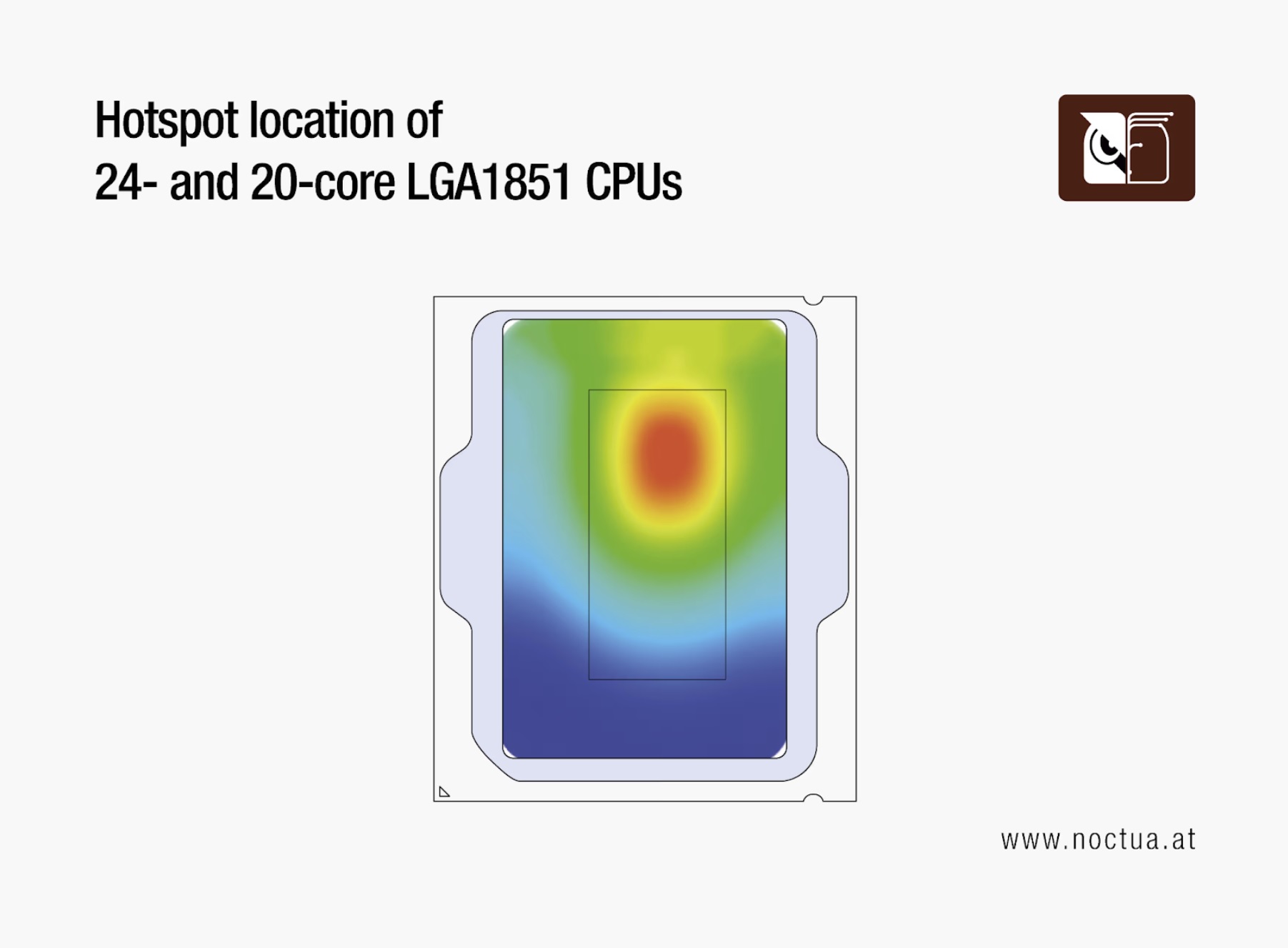
HWCooling: Something else just occurred to me—will similar solutions also exist for Intel platforms? The hot spot of Arrow Lake processors is on the opposite (southern) side compared to Raptor Lake (Refresh) processors. Are any special cooler mounting brackets being prepared in response to this as well? 🙂
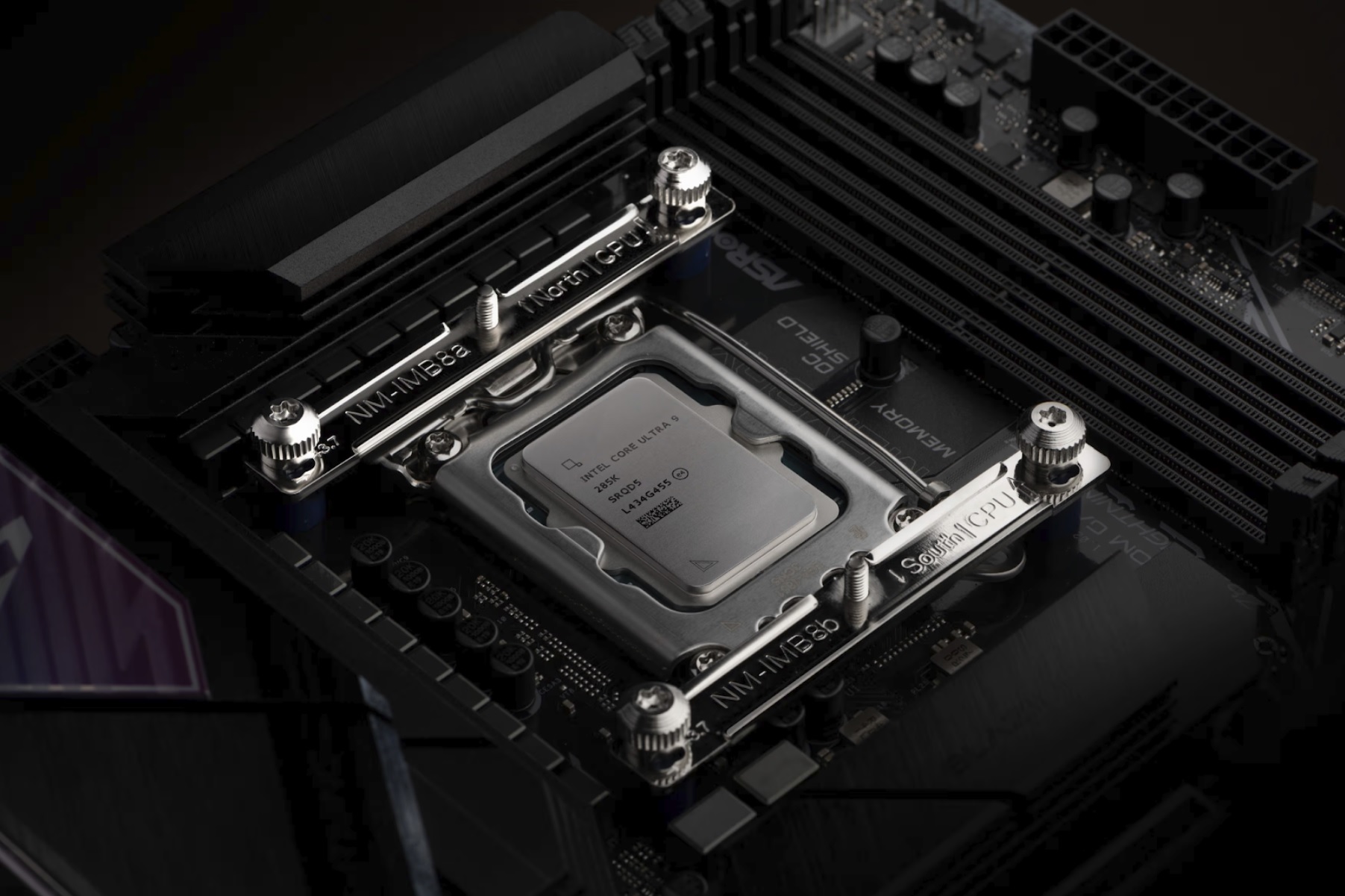
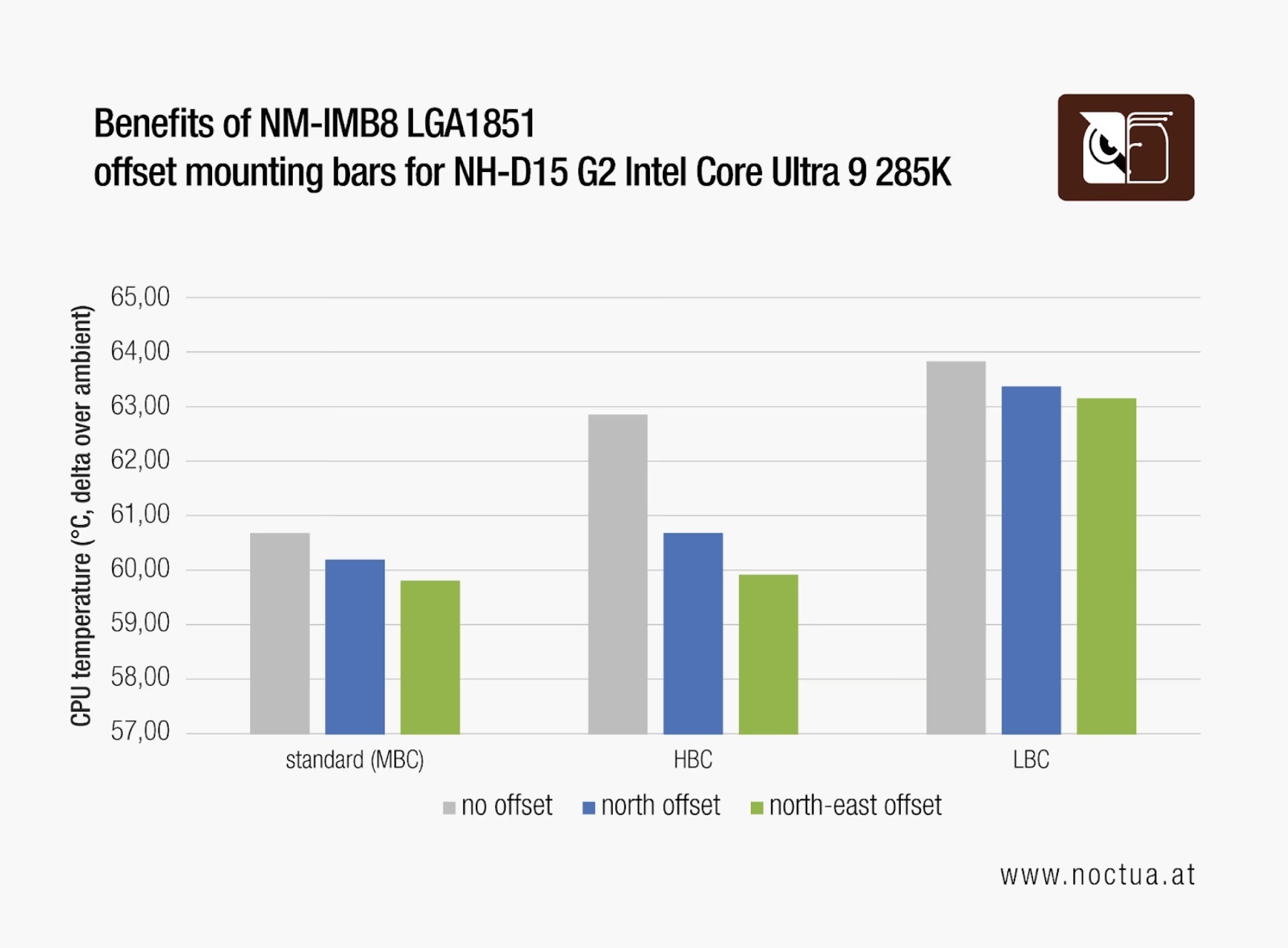
Noctua: We have already introduced our NM-I8 offset mounting bars for the NH-D15 G2 on 24 and 20 core Intel Arrow Lake-S CPUs last May. They are especially beneficial for the HBC model where temperature reductions of up to 3°C can be achieved. For the regular version with medium base convexity, you can gain up to 1°C. The upcoming AIO liquid coolers will also include offset mounting bars for Intel Arrow Lake-S and Arrow Lake-S Refresh CPUs with higher core counts. As I’ve explained, the reasoning behind offsetting the liquid coolers is mainly to have the microchannels cover the hotspot as good as possible rather than optimising contact quality though. Both the higher core count models of ARL-S and ARL-S Refresh have the hotspot towards the north-east side of the package by the way, so we’re shifting the coolers north-east for Intel and south for AMD. It’s also worth noting that AMD APUs and the lower core count Intel LGA1851 models have the hotspot pretty much at the centre, so in this case, offsetting the coolers wouldn’t make sense.
HWCooling: realize it is still early for this, but still: could you somehow illustrate what the difference in cooling performance is between pump speeds of 800 and 3600 RPM? Will the cooler be able to handle current processors even under these conditions (800 RPM), or up to what power consumption? We don’t need to go into too much detail—an approximate idea would be enough. 🙂
Noctua: As always with this type of question, it’s difficult to give a straightforward answer because it will depend on various factors. Not only the usual variables such as contact quality, heat flux densities and ambient temperatures. It will also make a big difference what fan speeds you’re running on the radiator and how much airflow you have through your case. If the fans on the radiator and the other fans inside your case run at full blast, this makes it much easier to slow down the pump without sacrificing too much performance. On the other hand, this wouldn’t really make much sense from a total system noise level perspective. If you want to go quiet, you probably want the fans to be quiet as well, not just the pump.
To give you a rough indication, if we assume that we scale radiator fan and pump speed on the same level, so you e.g. put both to 50% PWM, which would translate to around 2000rpm on the pump and roughly 900rpm on the NF-A12x25 G2 fans, you should still be able push at least 250W in a well optimised setup at 22°C ambient. Even if you drop the pump to around 1500rpm, you should usually be able push at least 150W. I think that’s a very nice result given that this is already extremely quiet by most people’s standards.
If you drop the pump to 800rpm and keep the fans at the same level, you should still be able to push at least 100W on most modern CPUs, but if you go much higher than that, the pump will automatically speed up to keep the liquid temperature at save levels, so as I’ve said, these super-slow minimum speeds are for idle conditions or low-power CPUs. You will have to go for slightly higher speeds to cool higher-end processors at full continuous loads.
HWCooling: I think we are getting close to the end, where we can perhaps move to simpler topics. In the comments under the test of the Storm 120 fan we discussed that they also have a fan (Nova) that is made entirely of LCP (i.e., including the frame). And there are more fans like that: Silent Gale P12, and for example Phanteks also does it. Why does this not apply to Noctua fans (where only the impellers are made of LCP)? I understand that the manufacturing costs outweigh the benefits of an LCP frame, which certainly makes the fan significantly more expensive, but still—what could be the benefit of such solutions?
I have no doubt that you have detailed analyses on this and can therefore evaluate the key technical aspects. It occurred to me that with an LCP frame it might be possible to prevent the frame deformation that occurred with prototypes of the NF-A14x25 G2 PWM fan, and also that when cutting threads with screws there might not be undesirable cracking of the walls. But PBT frames do not seem to suffer from this either—perhaps quite the opposite, I’m not sure… Any information in this regard is welcome. Why does using an LCP frame make sense (regardless of the price)? 🙂
Noctua: The key benefits of using LCP for fan impellers are significantly lower blade creep over time and lower blade vibration due to better stiffness and damping properties. Obviously, both of these factors don’t play a role in frames. As you’ve said, we did consider using LCP frames ourselves in order to combat frame deformation under high compressive loads, but thankfully, we found structural solutions that enabled us to stick with the same ABS+PBT material that we started to use with NF-A12x25. Interestingly, the use of LCP also didn’t make all that much of a difference in terms of resistance against compressive loads. This has to do with the different strength and stiffness parameters engineering plastics have. Many people simply think of LCP as being “stronger”, but this is a simplification. It does offer significant advantages in some parameters, but not so much in others, so when it came to the challenge we were tackling, it didn’t give us all that much of an improvement. I cannot comment on why other brands may be using LCP for their frames, all I can say is that it didn’t make sense for us. Threading self-tapping screws into LCP can actually be rather inconvenient.
HWCooling: Thank you for the comprehensive answers. To keep the article easy to digest in one go (and not overly long), we’ll slowly wrap it up. Yes, the NM-IMB8 mounting bars… I completely forgot about those, even though we issued a report on them, haha. So that’s covered. I’ll ask one of the final questions, a lighter one: Do you see any paths within Noctua that could increase cooler performance beyond the current level and thus enable higher processor clock speeds?
Noctua: Yes, of course we do. Pushing the envelope in terms of thermal performance is at the very heart of our operations, and we’re constantly exploring new ways of achieving that. Heatpipe-based air coolers have been researched and optimised for several decades, and while we do see a potential to further refine this technology, it would be unreasonable to expect significant jumps in thermal efficiency. The situation is quite similar with all-in-one liquid coolers. With two-phase thermosiphons, by contrast, we’re just starting out tailoring this technology to PC cooling, and we already talked about the enormous theoretical potential of phase change processes, so we definitely see the biggest room for further performance improvements in this field.
HWCooling: What do you think are the biggest strengths of Noctua fans and coolers compared to competing solutions? With this, thank you for the interview from our side—I’ll close it here and look forward to everything you bring to demanding users in the future. 🙂

Noctua: I would say the biggest strength of our products is how they combine state-of-the-art performance-to-noise efficiency with class-leading reliability and longevity, as well as how we back up product quality with service quality.
Thank you very much for your questions, it’s been my pleasure going through these topics with you!
HWCooling: Thank you, Jakob! 🙂
English translation and edit by Jozef Dudáš



Liquid based coolers (so in a sense even ones using heatpipes) have many challenges to overcome:
if the liquid boils and drips it needs to do so in portions small enough to remain inaudible, if it flows it needs to pass each fitting and bend in the loop silently
and generally I don’t think radiator based coolers are worth it, they add footprint to the case, you potentially could use 2x120mm, but that rarely can compete with good 140mm tower and it pushed the case towards 260mm length bracket
it would be interesting to see a 260-ish cube with a thick or two layered 240×240 rad using a Halo chip with an mITX or entirely custom board, but having the impedance grow would require fans moving faster… maybe one rad at the bottom, and other at the top?
anyway, that’s an entire system design, and relies pretty heavily on Halo remaining on the market for extended period of time
sure, changing the block for other platforms could work, but HEDT is excluded due to lack of iGP, so probably desktop class i9 and R9 would make some sense when let loose in terms of power draw?
re: performance estimates, that puts the liquid cooler basically in line with D25G2, or even more towards U12A at the low noise level
on the other hand I expect Noctua stating 150W may actually mean sustained 175 or even 200, as usually the coolers are way more capable than old TDP metrics said…
so yeah, hard to guesstimate what it would be actually capable of
Thank you for the detailed and insightful comment. 🙂
We’ll see what Noctua will (or won’t) state regarding TDP in the context of cooling performance. I assume that if such values are used, they will be tied to specific platforms, since dissipating 150 W on platform A is not the same as on platform B.
That’s also why Noctua introduced NSPR, which provides a more consistent way to orient oneself in terms of relative cooling performance. 🙂
yeah, I am aware of that, but it really feels like they were conservative with their prior assessments and the compatibility charts, if we let their coolers go full throttle I’m sure they can do much more than stated, and P1 especially goes higher
and regarding the old TDP metrics, let the chiplet vs monolith ryzen be an example: many coolers were rated good for APU, while bad for chiplet SKUs of the same TDP, likely due to the difference of hotspot location and boost characteristics
the former can currently be offset by the offset mount, but the latter remains an issue, when a single core boosts high enough it can use up even half the entire CPU budget of power and that causes significant heat density
Wait, i understand that pumps have a higher pitch peak but don’t they also emit low freq noise?
Next time you interview them, may i suggest you ask them questions about what they think of the noise profile changes of the G2 fans vs. the previous gen and BeQuiet’s Silent Wings 4 with its patented wave pattern?
Considering the usecase where you put the PC in another room with long cables etc, from hwcooling’s graphs it seems the G2(especially the 140mm version) is optimized to shift the noise profile to subbass frequencies which are much less damped by walls, the previous gen has a more high pitched sound, the SW4 appears to be specifically designed to emit less low freq noise with its wave blade pattern.
Then the question of which actually emit the least amount of noise(dbZ) is worth asking, a-weighting is very forgiving to low frequencies so there’s a bias but the possibility of the G2 still emitting less total noise for the same airflow than other designs is there.
Any additional questions are welcome. We can also pass yours along to Noctua and see what their response will be. It’s perfectly natural that different people are interested in different aspects, and it’s always worth asking.
I don’t expect Noctua to comment on competing fans, but it’s certainly worth a try. 🙂
Yes, we’ll also bring up your second question with their representative—and actually the third one as well (the first point you mentioned, about the character of the pump noise)… 🙂
So, we’ve received responses to your questions from Jakob. They are cited below 1:1:
„It’s correct that pumps emit a complex, broadband noise spectrum that also includes lower frequencies. Typically, the higher frequencies of this spectrum are perceived as more annoying though, which is why damping these frequencies is particularly important.
We have spent a lot of time optimising the noise profile of our G2 models and while perceived noise quality is obviously a very subjective thing, we have seen a very positive response from both reviewers and customers regarding how our G2 models sound compared to the previous generation. With the comparably low SPLs that our fans emit, we don’t see potentially increased through-wall propagation due to lower frequencies as a problem.
I cannot speak for competitors regarding the reasoning behind their design choices, but we are confident that our G2 models represent a benchmark in terms of performance-to-noise efficiency in their respective form factors.“
I’m mainly wondering what the working fluid of that Thermosiphon is.
Incidentally, for a pumpless AIO that might be orientation agnostic, look into the concept of a loop heatpipe – an aerospace and industrial cooling concern known as Advanced Cooling Technologies has a derived technology that may be coming off patent in the next 3ish years, though I don’t know the exact timings. It’s known to work with bog standard water.
https://www.1-act.com/resources/learning-center/case-studies/heat-pipe-loops-hpl/
Hmm, we don’t know what the working fluid is, or what the exact composition of the mixture is in thermosiphon liquid coolers.
We can pass this question on to Noctua, and a response might appear here later. I’m not sure to what extent such details fall under something like “know-how,” but it’s definitely worth asking. 🙂
Below is a response to your question from Noctua’s representative. 🙂
„We aren’t locked on the exact refrigerant yet, but what I can say is that it is going to be a modern, low-GWP refrigerant of a similar type as what you can find in today’s household fridges.“
If it’s not too late to ask:
What do team at Noctua think about air coolers getting bigger? TRIPPLE TOWER POWER!!!!!!!!!!!!!!
Size of air coolers established years ago, around D15’s launch. When such cooling power wasn’t that much needed as today on consumer platforms and even dimensions were more problematic due to common then pc case standard of 160 mm clearance. Today both are opposite – we have i7/9 casually pulling 250W or more and cases like their own Antec Flux Pro Noctua Edition having plenty of space to accommodate something bigger than D15 becoming new standard.
What are the Noctua’s concerns like e.g. weight or maybe anything not that obvious? Have they ever experimented with constructing something bigger? Are bigger heatsinks, more heatpipes and larger and thicker fans the way to go to bring performance of air coolers to the next level or maybe there’re some nuances or bottlenecks like e.g. IHS sizes? What do guys at Noctua think in general?
How about copper heatsinks? Are they forgotten due to aluminum simply being better solution or maybe it’s more complex?
Are there any thoughts about Noctua enriching their portfolio with PCIe drive heatsinks? Here things seem sentenced to get hotter and harder to cool and it’s hard to find a better place for Noctua’s expertise delivering us something great – thought out, size conscious passive solutions or ones smaller with non-irritating fans. Not like my Thermalright HR-09 Pro which is just absurdly big. And btw greetings to the person responsible for D15 G2’s dimensions. It sits literally 1 mm from my HR-09 Pro and even fan clips don’t collide however low I would like to mount a fan, so just press “F” to Pay Respects!
It’s never too late for constructive questions. I’m forwarding your comment to Noctua and when I have a response, I’ll post it here, as always. 🙂
Thank you and forwarding questions to Noctua is a great initiative – there’re so many interesting things about pc cooling and man can suspect that Noctua has it covered like no other, but I wouldn’t want to bother with it their customer support :]
I wouldn’t consider it a nuisance, but everyone has limited time, and if we want to explore things in real depth, it would be more appropriate to consolidate everything into a dedicated article. That way, we can gather all the topics that might interest HWCooling readers and handle them more efficiently—ultimately leading to more useful and comprehensive insights. 🙂
Below is the response to your questions in the form of a direct quote. 🙂
„We have experimented with larger heatsinks than NH-D15 G2 over the years but always saw diminishing returns. Using more than eight heatpipes would lead to poor heatpipe utilisation on today’s desktop CPUs and since the fin stacks are already covering most of the cross-sectional area of the fans, just making the heatsink taller or wider wouldn’t do much either. Splitting the heatpipes up into more fin stacks is challenging too because it’s difficult to route the heatpipes without bending them too much, which would cost performance. Last but not least, there are still practical concerns that come with increased size, for example further increased weight and leverage on the socket. All in all, we currently don’t think it’s worth it.
As for copper, yes, we simply don’t see real performance gains from replacing aluminium fins with copper ones. At the same time, it would significantly increase the weight and the cost, so from our perspective, this wouldn’t really make sense.
We don’t have plans to offer coolers for PCIe drives at this stage.“
Further questions are, of course, welcome, but we’ll include them in a future interview that will likely come later on. Feel free to post them here—we’ll draw from them next time. The only challenge is coming up with questions that will still be relevant in, say, six months, haha. 🙂
Thank you all for replies and about your question below, I would love to see such interviews with other brands.
Which other brands would you be interested in?
I don’t want to name specific ones, but the reason we’ve had multiple interviews with Noctua is also because we have a well-functioning and knowledgeable contact there, which allows us to publish in-depth and information-rich content.
This is certainly possible with other brands as well, but in some cases it’s more complicated. With some cooling-focused companies, we’re not even in contact yet, even though we’d like to be. As always, it comes down to human resources—and the ability to communicate effectively. 🙂
I didn’t want to suggest any, because ones non obvious may turn out saying interesting things. But all time strong players like Thermalright and be quiet! seem having potential. Also Fractal coming all of a sudden with great fans or introducing plenty of noticeably working sound-proofing tricks in Define cases. E.g. Define 7’s front filter – it lowers volume of noise surprisingly much and fans sound smoother with it – you remove the filter and some fans start resonating in some rpm ranges. Or side inlets which don’t exhibit typical for such noise of air being pulled. Or back grill with irregular pattern changing acoustics of exhaust fan according to it’s position on the rails. Fractal is an example of these non obvious ones who could have much to say.
There are plenty of options when it comes to who to approach for an interview. The harder part is actually getting in touch with someone who can provide technically engaging and insightful material. 🙂
It’s unlikely that somebody will ever match Asetek guy 😀
It’s definitely gonna be Coolermaster that brings back triple tower heat sinks.
Things might get Interesting when CAMM2 proliferates mind.
This tripple tower was more of a joke, but it’s hard to say how things will move forward and for sure there will be attempts to do so. Over the years we see increasing number of companies offering top performing coolers and fans what means that cooling in the form we commonly see (120-140×25 mm fans and ~160 mm dual towers) has already plateaued years ago. I’m more likely to doubt that tripple towers are the way to go. Especially there were already such attempts long ago, even Noctua tried tripple tower like fifteen years ago, and we don’t see big players continuing. If my crystal ball shows something, it’s utilizing increased space around the cooler modern cases tend to offer to fill it with just bigger and thicker fans and towers.
The design of triple-tower coolers usually means that one of the towers is relatively thin. At the same time, modern fans are often optimized for high static pressure, which prevents them from fully showing their strengths in this kind of setup.
Additionally, dual-tower heatsinks (with wider fin stacks) can actually offer a larger total fin surface area. After all, how many single-tower coolers are there that have more fin area than dual-tower designs? 🙂
I think that bigger, but relatively thin heatsinks combined with bigger diameter fans are the way to go. Thinner heatsink is easier for a fan, but it’s less surface area, so increasing it demands growing heatsink other dimensions and equipping with adequately sized fan to cover it. Is it right or there’s some catch? I suppose it’s a balancing act in terms of matters above, but maybe there’s something universal.
What also makes me wonder, is it true that the bigger diameter the fan, the harder it gets to make it good at static pressure?
The narrower the fin stack, the easier it is to push air through it—speaking in simple terms. That means the importance of static pressure decreases in such cases.
With larger fan formats, you typically get lower static pressure compared to smaller fans, but at the same time higher airflow. The lower static pressure comes from the fact that larger fans not only have bigger blades (which increase airflow), but also larger gaps in the cross-section. These gaps allow more air to escape, which reduces static pressure.
You can see this clearly with very small fans—they often achieve high static pressure, but their airflow tends to be relatively low (unless they are of the high-speed, extremely noisy variety). 🙂
As for Cooler Master, I’m (perhaps naively) still expecting a successor to the Hyper 212 Plus—or simply something that clearly stands out in some aspect, even in the high-end segment. Not aesthetically, but functionally. 🙂
Would you be interested in a similar interview with a similar brand (to Noctua)?
We could approach it step by step, although structuring it in a way that gives everyone fair and balanced space—so that no one feels left out—won’t be entirely simple. But that’s part of the challenge. 🙂
there is one similar brand that I can think of that has a wider choice of product categories but also interesting approach of using higher fanspeeds in flagships and the also increased the minimum speeds of their fans in the latest generation, I wonder what’s the reasoning behind that, my guess would be “99% users and reviewers find that good enough so we decided to focus on thermals in this range, if you want quieter these are not for you” kind of thing
there are few others, but I’m not sure I’d call them similar brands, but these may also be interesting, in case of Phanteks I’d love to know why the “hybrid” mode stops as high as 50% forcing users to rely on faster modes to slow the fan down further, that’s just counter-intuitive
By similar brands, I meant those focused on cooling components. There are quite a few of them… Phanteks, for example—we can definitely reach out to them regarding this. 🙂
I was thinking of a specialized, silence oriented brand of a bigger company based in Western-Germanic country
what I always had an issue with was the fact Dark Power line always (or as far as I remember, but that’ll be over a decade) had significantly higher noise profile than Straight Power and the latest generation of Silent Wings has a completely different tuning than previous one, and judging by Cybenetics reports 120mm 4 pro has lower performance at 6dBA than both 4 and 3 both in terms of airflow and pressure
and I know, most users will run them at much higher speeds and noise levels, but personally I run my fans even lower than that so this choice makes them not worth it for me
and if you have any contact with NoiseBlocker (are they even still around?) I wonder if a successor to B12 is coming anytime soon, I think it was a neat design that could achieve a lot (the unrestricted airflow is impressive, really!), but the whiny motor at lower speeds ruined it
from different topics, I know it’s time consuming and even less relevant for most readers than the lower noise tests I’d love to see some fanswap tests, for example a dual tower with A12x25G2 (also I read somewhere that some of them can even be mounted with Noctua’s offset mount! that would be an interesting thing! absolute minmaxing territory)
We can definitely reach out to bequiet! regarding this.
As for Noiseblocker, we’re not in contact with them. Even though we do have some of their fans, I personally see them as a brand that, on one hand, offers some very interesting products, but on the other hand has virtually no representation when it comes to media communication. It’s a bit unusual…
Thanks for the testing suggestions as well. We’ll consider all of them (some older ones—like testing at even lower noise levels than our current minimum—are already noted), and we’ll see what we can and can’t realistically implement. As always, it comes down to available manpower on our side. 🙂