


We held a focused discussion not only on pumps, but on AIO liquid coolers from Asetek as a whole—and it revealed more than expected. The pumps, in particular, are more robust—and quieter—than they may seem, making deliberate avoidance hard to justify. And yes, we’re continuing. This information-rich interview answers many questions—and if we missed something, feel free to join in and ask.
An opportunity arose to conduct an interview with Asetek’s CEO, André Eriksen—an offer that simply cannot be refused. Not in our case, given that our focus is computer component cooling. So let’s get started! 🙂
HWCooling: André, where do you see the main advantages of closed-loop liquid cooling of the AIO type? We usually write that it is possible to achieve higher cooling performance than with tower coolers (a stack of aluminum fins on heatpipes), but at the cost of shorter service life (compared to tower coolers). This is mainly because a pump is used. Of course, liquid coolers also offer better compatibility with memory (RAM), for example. The small block does not interfere with them… how do you see it?

Asetek: As you may know no cooler works without airflow to create convection across the fins. That goes both for a radiator in a liquid cooler as well as a tower cooler you refer to. A quality cooling fan typically has a service life of 50.000 hours. Our pumps easily have a service life of +100.000 hours of continuous use (datacenter grade), so I do not agree that Asetek’s AIO systems have any shorter life span than typical heatsink/fan solutions. The market is flooded with low cost/low quality AIOs – I can only speak on behalf of Asetek products of course. We have somewhere between 10 and 20 mio pumps in the field and have solde AIO’s since early 2000’s so we have a pretty good statistical documentation.
HWCooling: Perfect. Let’s move on. Do you see any shortcomings in the technical design that currently limit cooling performance, while at the same time offering a realistic chance of an improvement being implemented at scale? In other words, where is the bottleneck of current Asetek liquid cooling concepts that could be eliminated or at least mitigated in the future to enable the removal of larger amounts of heat from today’s processors? Of course, you don’t have to be completely specific, so that no one gets ahead of you if you arrived at such insights through your own experience.
Asetek: Any (CPU/GPU) cooler is limited by the laws of physics. Conductivity of the materials, airflow, liquid flow, cold plate thermal resistance, radiator thermal resistance, flatness of cold plate, power density of the chip etc. All of this needs to be balanced up against noise and cost (manufactureability). Understanding all these parameters and optimizing them the best way possible is the key. We work closely with our customers to achieve the performance they are after at the same time as working closely with the chip manufacturers to optimize our performance in line with their roadmaps. Therefore you will see some of our coolers perform very well on one chip and perhaps not so much on another dhip with a different die configuration. Other than the laws of physics, that we all need to obey to, I do not see any limitation in Asetek keep innovating and gian performance.
HWCooling: When we talked about lifespan, we were referring to liquid coolers in general—any solution that uses a pump. It is simply an additional component compared to tower coolers, and one that has a finite service life. Fans on the radiator (or heatsink) are present on all coolers anyway. We understand that your designs are known for longer longevity than some others. Is this primarily—or mainly—due to the use of more robust bearings in Asetek liquid coolers, or are there more elements involved? In other words, which factors contribute to the longer pump lifespan—that’s what we’re getting at here.
Asetek: You are correct that the fan is present on all coolers. And that was my point exactly. No chain is stronger than the weakest link and typically in our experience, the fans fail a long time before the pumps. I am not really comfortable sharing why and how we have overcome this issue other than stating that during the years we have supplied to AMD, Intel, HP, HPE, Dell, Alienware, ACER, ASUS, Lenovo, Alienware, Fujitsu and many other OEMs and obviusly as a part of this gone through rigorous qualification processes.
HWCooling: As for optimizations for specific processors, with tower coolers we have typically encountered the use of curvature on the base (cold plate) in areas where, on the target (optimized) platform, the highest heat flux occurs. In short, these areas are shaped to ensure the best possible contact between the cooler and the processor. Have you considered something similar? In the case of liquid cooling blocks, this is probably a somewhat different situation and depends heavily on the structure (and position?) of the microchannels inside the block. Any insight into this topic would be very welcome, so we don’t have to rely on assumptions or speculation, but on real-world experience.

Asetek: As I alluded to above, flatness or perhaps more correctly the shape of the cold plate is important. It has been some 20 years since we made the first curved cold plate 😉 These things are for obvious reasons not something we advertise. That is also why we on certain coolers for certain chips recommend a certain orientation.
HWCooling: We have also repeatedly encountered user concerns regarding galvanic corrosion. To slow it down, additives—inhibitors—are presumably added to the coolant. Are there any data points that could reassure users about the effectiveness of this solution? If the inhibitor were to lose effectiveness after a long period of use, that might not be such a critical issue. However, if concerns about lifespan (and potentially premature galvanic corrosion) are justified, it could represent a real complication. André, could you please comment on this and explain how you approach this issue from a technical standpoint?
Asetek: Galvanic corrosion (along with many other chemistry related issues most people don’t consider) is a big and warranted concern. Many of the imitators do not invest in understanding the chemistry, they merely focus on the mechanics and later down the road run into significant issues. It is pretty recent we saw the latest product recall because of a vendor not understanding these things. As in many other places in life, you typically get what you pay for.
This is just one of the reasons an Asetek based cooler sometimes costs a little bit more. We have spent millions over the last 3 decades understanding and always improving this (as regulations also change) and we still do. We have chemists in the house doing nothing else. When we release new technologies/materials and fluids these things are validated and tested for a very long time before we go to market. We don’t want a major recall and knock on wood, in the history of the company since I founded it in 1997 we have never had one.
HWCooling: As for comparing the service life of pumps and fans—yes, we have no direct experience here, and MTBF figures are often unclear. It probably also depends on which fans we are talking about and at what operating settings. In any case, we do not have failure-rate data for specific fans. If you do, we would of course be very interested. I assume that the cheapest sleeve-bearing fans tend to fail differently—and sooner—than the most expensive fans with FDB bearings. Technologically it is similar, but you know what I’m getting at. Not all fans are created equal.
Asetek: For sure fans come in different qualities – just like pumps do. I am not a fan expert, I only referred to fans as you seemed to automatically assume that service life of an AIO was lower than an air cooler with a fan, which I do not agree with, because often the limit in service life indeed is the fan and not the pump.
HWCooling: A few points regarding the pump. This will probably be a two-part question—or rather one topic with two angles. From testing, we know that when fans on a radiator are throttled down, the pump often becomes the loudest component. It is the element that ultimately defines the lowest operating modes when we normalize settings to a comparable noise level—and below which it becomes necessary to reduce pump performance. That leads to the questions related to this: Could you explain how—by what methods and techniques—you balance the trade-off between pump flow rate and noise? I assume there are many ways to “quiet down” these components. The second question is whether, from a long-term perspective, it makes sense to reduce pump flow below maximum output—12 V or 100%. Are there sufficient margins? We know that reducing the speed of some pumps does not lead to a drop in cooling performance, but then the question is—can an AIO operate like this, with a slowed-down pump, for months or years? For how long, realistically?
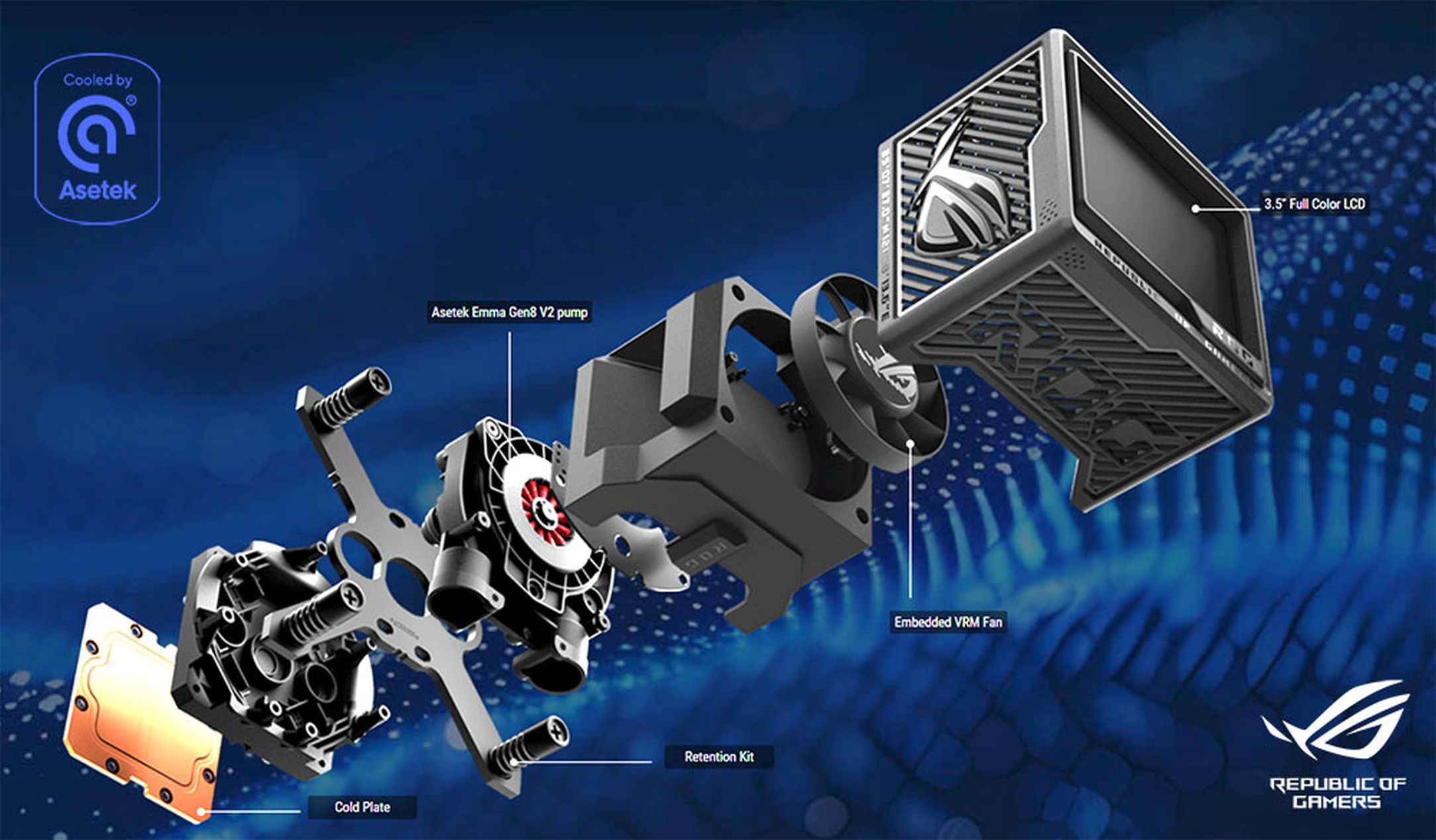
Asetek: You seem to refer to our AIOs as “one pump”. We probably have 20 different pump variants. Some are made to run at 100% duty cycle, some are made to use PWM control, some pumps are made to perform and supply high pressure and flow, where noise does not matter at all (for example in a server) and some pumps are made to be as close to silent physically possible, so unfortunately there is no “one shoe fits all” answer to this. We supply our customers with the pump that fits their requirements the best.
HWCooling: The topic of galvanic corrosion is probably largely exhausted by now—thank you for the detailed response. In short, Asetek loops contain a chemical compound that ensures long-term operation, often well beyond the warranty period. Is there any quantifiable metric that would allow us to at least roughly estimate how long this chemical keeps Asetek AIOs in good condition—specifically in terms of preventing galvanic corrosion?
Asetek: Our AIOs are also used in server/datacenter/AI applications. The requirements there are typically 100.000 hours, which corresponds to roughly 11 years.
HWCooling: You’re right—the question comparing the lifespan of tower coolers and liquid coolers was based on the assumption that the pump has a shorter lifespan. That is, of course, a valuable clarification, and it’s certainly useful that you’re challenging that notion. A liquid cooler still contains more mechanical elements, though (in addition to the radiator fans—which tower coolers also have—there’s the pump itself). Based on what you mentioned earlier, would it be fair to say that Asetek pumps have an MTBF roughly twice as high as fans rated at 50,000 hours? We’re not particularly fond of these MTBF figures either, as they are difficult to interpret properly—but as a rough guideline, is that accurate? Or perhaps you could shed more light on this. Under what conditions is the 100,000-hour lifespan of Asetek pumps specified? Performance level, ambient temperature, and what other parameters are taken into account?
Asetek: It would not be correct to state MTBF of 100.000 hours. The 100.000 hours is a requirement that all coolers have to pass. Not just the average. We have buid up over many years a special suite of tests that we are running, that our customers have faith in (as nobody obviously has time to wait for 100.000 hours to see the result) and it is not something I am comfortable sharing. What I can say though, is that the tests are carried out in the worst possible environment.
HWCooling: How do you view closed-loop systems that operate without a pump? Those based, for example, on the thermosiphon principle. Have you considered something along those lines? Admittedly, cooling performance would likely be lower—perhaps significantly so—but such a solution might appeal to users who are sensitive to the acoustic signature of a pump. Many pumps are exceptionally quiet, yet our readers in particular tend to have bat-like hearing. 🙂
Asetek: It is some +20 year ago we released a Thermosiphon type cooler (https://www.techpowerup.com/review/asetek-vapochill-micro/) I don’t think it has any future for Asetek. And again – you still need a fan, which is typically the noisiest component. Our latest gen pumps have a noise level below the threshold of human hearing, so again I do not believe pump noise is a real issue here.
HWCooling: One question from a long-time reader: Over the past two years, there has been talk about Asetek’s collaboration with Fabric8Labs on an ECAM cold plate solution. Can you share what stage this partnership is currently at, and whether end customers might see a liquid cooler benefiting from this cooperation within the next year or two?
Asetek: All the simulations we did, showed a (measurable) improvement over our “own way” of optimizing and manufacturing cold plates. However, so far even with the latest optimization tools, we have not been able to see any noticeable performanceimprovemento on todays’ desktop CPUs. We have not given up however, and should things change we will for sure pursue it.
HWCooling: Thank you for your responses, André. We are slowly approaching the end of the interview—at least we have exhausted the questions we wanted to ask. Still, one final question: Where do you think the popularity of AIO liquid coolers stems from in terms of their widespread adoption among users? We do not have our own statistics on this, but the level of interest in this type of cooler is also reflected in the output of third-party manufacturers. I would say that liquid coolers are gradually pushing out traditional tower-style air coolers. Or perhaps that is just a “feeling”?

Asetek: You are welcome. When I developed our first AIO back in 2002, there was a need to make liquid cooling palatable – so easy to use, taking the fear of leaks out, making it fit into a standard ATX chassis/motherboard and at a reasonable price level. To this date I still believe these are the primary reasons for the popularity of these coolers.
HWCooling: Is there anything that was not asked that you think the community of users interested in CPU cooling should know about?
Asetek: I would like to personally thank the millions of users out there for buying and using our products and supporting Asetek for 3 decades now. 🙂
HWCooling: In closing, I would like to thank you for the valuable information and for contributing to the broader understanding we strive to build.
Asetek: You are always welcome.
English translation and edit by Jozef Dudáš



Hi, I have few non-technical questions.
1) How has the industry changed since the expiration of Asetek’s patents? Do you feel stronger competitive pressure than before?
2) How do you perceive the rise of Chinese competitors entering the European market, which are often praised for their excellent price-performance ratio? Competitive products are popular and do not suffer from obvious shortcomings. I would cite Deepcool as an example.
3) You are an OEM/ODM. What are your clients’ requirements for new products? Do customers ask for more reliable or stronger (for higher TDP) solutions, or is the current trend “put an LCD and RGB on it”?
4) Who designs the coolers? Do you provide your designs to customers, who then design their own products based on existing solutions (custom cover, leds, etc), or do you manufacture third-party designs using your components?
5)Do you see companies that manufacture components for custom liquid loops as competition, or is it a completely different market segment?
Thanks.
Thank you for your questions.
We’ll forward your comment to the representatives at Asetek and hope you’ll receive answers to everything. André will most likely respond directly in the comments section afterward. 🙂
We’ve received André’s responses, they are below:
“1.) Asetek holds many patents. Also many still covering AIO technology. I think we had a couple of patents expiring lately. It has not really changed anything. For 20 years we have seen competitors come and go. Many have the misconception that Asetek had a patent on the secret sauce, like Pepsi Cola, and that was how we made money and that patent is now expired. We make money for making great technology with great quality and performance at a fair price.
2.) For obvious reasons I do not comment on other competitors. We often see big customers coming back after trying some of the lower cost alternatives. It happened two times just during the last year.
3.) We have many different customers with different asks. As described earlier, reliability is not something we have struggled with for a very long time (never) and no one is really asking for reliability beyond the industry standards. Customs have different desires in terms of price, performance, visuals, form factor and so one. There is no “one shoe fits all”.
4.) Asetek designs the coolers. Always. Some customers then design their own cap, software etc. Some customers provide an ID and we take care of the rest. We do not allow anyone “inside” the cooler.
5.) I don’t consider them competitors as we are not selling what they are selling and vice versa.”