



One of the last reasons for delaying the new generation of 140mm LCP fans was complications around potential excessive frame deformation. But to ensure that users never have to deal with this type of difficulty in practice, Noctua has intervened in the fan prototypes once more. You can find out how, why exactly in that way, and what the satisfaction with the result has been like directly from Noctua, who we asked a few questions on the subject.
Nocuta “Sterrox” fans in 140 mm format are just around the corner. Just before their release, we reached out to the company’s representative, Jakob Dellinger, for a short interview. Through this, you’ll get more insight into things surrounding the recent delays in the release. What did Noctua address and why did everything take its time?
HWCooling: Hello, Jakob. Our readers are well aware of the details surrounding the new generation of 140mm fans, and over time we have written… many articles about them. One thing we haven’t really focused on too much though, as we figured we’d wait and work together to try and shed as much light as possible into why one of the latest delays in the anticipated release of the NF-A14x25 G2 fans, the square-framed variants, has actually occurred. Will you please take on this task and write about what happened and what you have been dealing with around the frame of these fans?

Noctua: Hi Lubo, first of all thank you very much for your interest in our upcoming next-gen 140mm fans! It’s correct that the square frame version will come slightly later than the round frame variant that’s also going to be used on the NH-D15 G2. When we’ve shown the fans at Computex 2023, we explained a bit about the long-term deformation issues we saw due to compressive load from heatsink fan clips and radiator mounting screws. Back then, we envisaged to use Sterrox® LCP instead of an ABS+PBT combination for the frames to avoid this, but sadly, our accelerated long-term tests didn’t yield the desired results, so we had to go back to the drawing board.
In the end we had to implement structural modifications on both frame versions and as we’ve discussed at last year’s Computex, such modifications of the injection moulding tools take several weeks to complete and several months to verify. The modifications on the square frame were a bit more severe and we also required more time to design and validate a supplementary solution for reducing torsional forces on water cooling radiators, so this is why the square frame version is currently targeted for September whereas the round frame variant will come in early July. We would have loved to release all the products earlier in the year, but the big upside with the extra modifications and the supplementary solution is that we could stick to ABS+PBT for the frames – if we had to resort to LCP, the fans and the cooler would have been much more expensive.
HWCooling: Thanks for the punchy introduction to the issue. What are all the risks of critical frame deformation if the NF-A14x25 G2 fan went to market in its pre-adjustment condition?
Noctua: You’re most welcome! We’re using a supper tight tip clearance of 0.7mm with these fans, so the main concern was that after years of running, the frames might deform in such a way that in certain areas, this clearance gets reduced below a critical level. If the fans had gone to the market without the adjustments, we wouldn’t have been able to rule out that, in worst case scenarios, the blades would eventually make contact with the inside of the frame.
HWCooling: Could you please specify what “structural modifications” were involved? I mean it technically – what was changed about the frame build (before, after…)? The more in depth we go, the better.
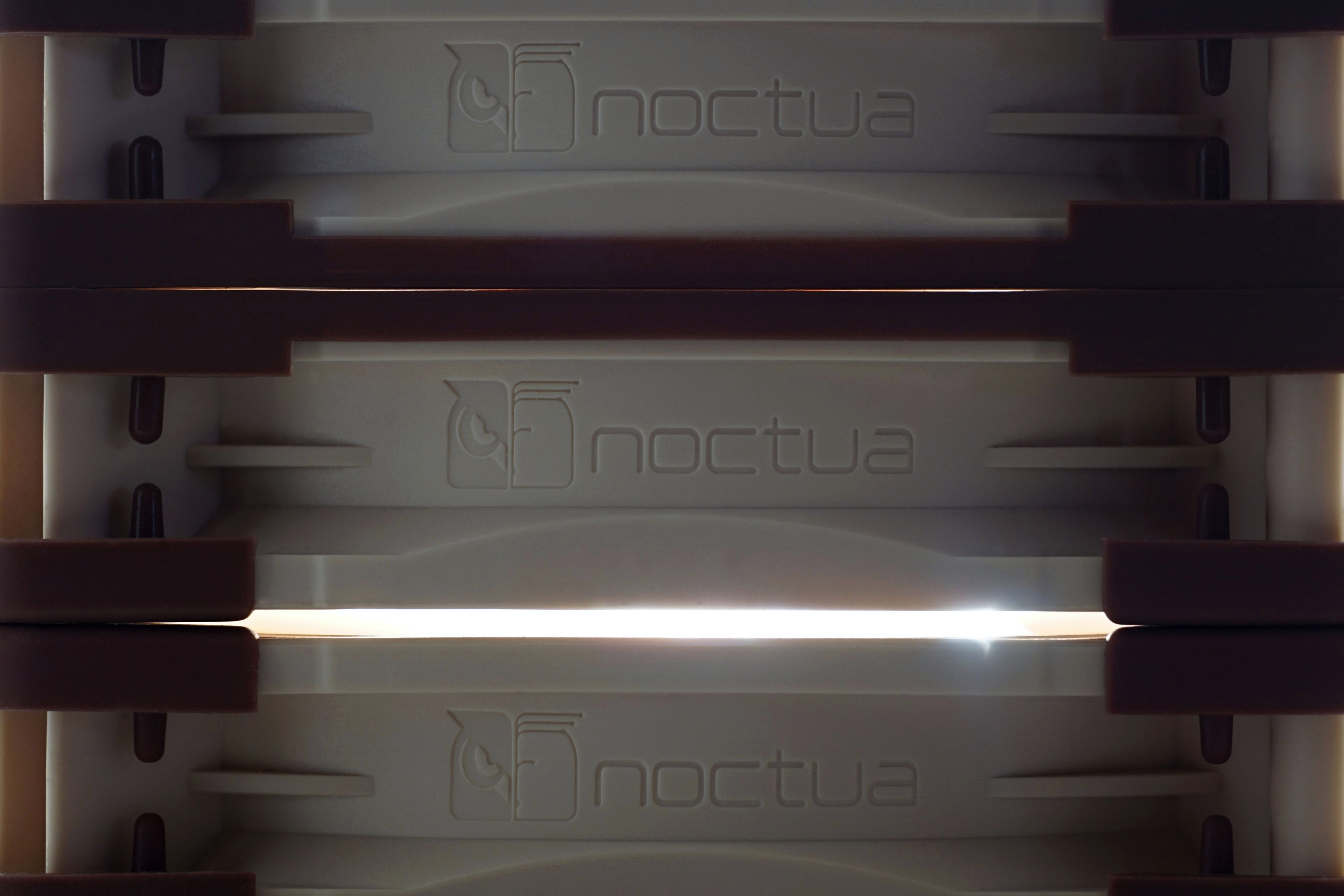
Noctua: As I’ve said, the critical deformations we’ve seen occurred in certain areas of the frames, namely at the sides towards the edge of the inlet side. The reason why we’ve seen deformation in these areas has to do with how the compressive load of heatsink clips and radiator screws acts onto the fan frames as well as with the force transmission within the frames. So the structural modifications were all about reinforcing those parts of the frames that play a key role in this process, for example adding extra reinforcement ribs at the corners of the square frame to reduce a torsional warp moment that would transmit through the frame and cause the sides to move inwards.
I think it’s worth noting that we did not work on the frames alone though, we’ve basically tackled the issue from two sides, one was through strengthening the frames and the other was to reduce the problematic forces acting onto the frame through the supplementary measures I’ve mentioned before. For the round frame, this meant redesigning the fan clip to attach to the lower, outlet side mounting hole rather than the top one so that we have less torsional warp on the inlet side. For the square frame, we have created new types of anti-vibration gaskets and pads that ensure a more even load distribution on water cooling radiators.


HWCooling: Is it somehow possible to compare the final state with the prototype phase, the design of which you eventually judged to be unsuitable? Under what circumstances, or in what applications, did critical deformations of the frame occur and what are the margins in the final fans?
Noctua: Yes, so by comparison, the final state is definitely much more robust, we not only have to be able to give our usual 6-year warranty with confidence, we want our fans to run for a decade or longer. The critical deformations mainly occurred in accelerated long-term tests that combined elevated temperatures with high compressive load from the mounting mechanisms: The higher the temperatures, the more susceptible polymers get to deformation. For the final square frame, we can now specify a maximum operating temperature of 60°C and we can accept a total compressive load of 30kg, 7.5kg per screw. With typical M3 or UNC 6-32 screws that come with water cooling radiators, this will correlate to 0.15 to 0.25 Nm of torque.
HWCooling: Some of the ribs in the corners of the NF-A14x25 G2 fan that go perpendicular to the center of the mounting holes are also on the Computex 2023 prototypes, and I don’t see any difference looking from the outside from this angle compared to what you were show at Computex 2024. But I guess it’s just an incorrect viewing angle? Presumably it will be a matter of reinforcing the rib design that is between the two walls of the fan corners, in the space of the thickness of the profile?
Noctua: Yes, you cannot see much from this angle, the most obvious changes are extra reinforcements in axial direction that can only be seen from the side. Other changes like increasing the thickness of certain structures by a few tenths of a Millimetre will not really be visible on photos at all. It’s also worth noting that reinforcing structures like this in injection moulded parts needs to be carefully balanced because it can be a double-edged sword: Strengthening one area or one side of a structure can lead to undesirable force transfer to other parts as well as to issues with the injection moulding process such as problematic shrinkage or sink marks. So it’s not as straightforward as it may seem, modifications like these can be a difficult balancing act.

HWCooling: Has this new experience shown you any shortcomings with older fans? After all, the NF-12×25 fan also has a very small gap between the blade tips and the frame (about 0.5 mm)… and if so, what does that mean, or what are the recommendations for older fans with respect to the user never having to deal with blade-frame collision. The NF-A12x25 fan has been on the market for over six years now, and there will certainly be many users who have been running it for that long until now.
Noctua: I would say yes and no. The extra research we had to do certainly made us aware of some worst-case scenarios that we didn’t have on the radar such as factory-new water cooling radiators that are severely deformed or greasy screws that can produce excessive amounts of compressive load with relatively low amounts of torque. On the other hand, we don’t consider these scenarios critical with existing products because the NF-A14 has a comparably large tip clearance so that deformations in the range of a few tenths of a Millimetre aren’t critical and 120mm fans like the NF-A12x25 are much more stable structurally. 120 vs. 140mm may seem like a small difference, but from a structural stability perspective, it’s huge, so both the NF-A12x25 and the upcoming next-gen 120mm model are much easier going although the tip clearance is only 0.5mm. 0.5mm with a 120 is much easier to pull off than 0.7mm with a 140mm fan.
HWCooling: But to stay on topic, back to the situation with the NF-A14x25 G2: You mentioned that a partial prevention against unwanted deformations at the new anti-vibration pads for a more even distribution of mounting pressure. Compared to the “old” pads, don’t these new ones create a larger air gap between the frames of the fan and the radiator, which could have a negative impact on cooling performance? If not, is this never the case, even when tightening the fan to the radiator with relatively less force? I assume that any imperfections of any kind should be compensated for by the custom full-circuit gasket that is (again) included with the accessories?

Noctua: No, the load relief rings will get compressed once the recommended mounting pressure is applied and as you’ve said, with the gasket the seal between the fan and the application will be as tight as possible. We have also decided to pre-install the gasket instead of the pads so that customers who aren’t aware of the benefits the gasket can offer will get the best possible performance out of the box without having to change any parts. We still bundle an extra set of pads with load relief structure for customers who prefer the pads over the gasket visually though.
HWCooling: Are you completely satisfied with the result? Now I’m not referring to functionality and I have no doubt that it will be flawless, I’m more concerned with whether the technical implementation would have looked different if you had known about the need for higher robustness of the frame for a longer period of time and it wasn’t a case of “last minute fixes”. Or would the design have looked exactly the same even if the frame had been designed with the required loads in mind from the beginning?
Noctua: I would say we are completely satisfied with the result in so far as we’re confident that it’s going to work great for customers and that’s the most important thing. With that being said, I wouldn’t rule out that just for the sake of simplicity, the end result would look slightly different if we had a chance to approach the entire project anew knowing everything we’ve learned throughout the process. On the other hand, we do not know if what seems like a potentially easier solution from today’s perspective may end up having other drawbacks that we’re currently unaware of.
HWCooling: Is the September release still tentatively valid for the NF-A14x25 G2 fans? Do you see anything now that could theoretically delay the release of the fans and get them into stores later? You don’t have to get specific. It’s just a matter of how certain or uncertain the current schedule is.
Noctua: *Laughs* There’s always something that could theoretically delay a release – from production issues to ships getting stuck or damage in transit. Therefore, I cannot give a guarantee, but I can say that at this stage, we see a very high probability that we will be able to launch the square frame fan in September.
HWCooling: That about covers all the questions, and I thank you for your detailed answers! Some more original and very specific questions may come up in the discussion. HWCooling readers can surprise us with things that don’t even cross our minds. I would then collect these questions and send them to you in bulk for your responses some time later.
Noctua: My pleasure, thanks a lot for the interesting questions and looking forward to answering further questions from the audience!
English translation and edit by Jozef Dudáš





Finally we get to know what’s exactly changed for the frame 🙂 It looks really minor on the outside.
Given that 0.5 mm clearance on 12 cm fans is easier than 0.7 mm on 14 cm ones, I wonder what’s the reason that they don’t further reduce the clearance on the next gen A12 fan. Perhaps there’s not much performance to gain for further tightening the clearance or something?
I think it’s likely the technical limitations of current plastic molding technology.
Thanks for the question.
We’ll wait another week or so to see if more of them accumulate here, or possibly under the SK article, and then I’ll send them to Noctua for a mass response. 🙂
And then there is the question of how much would reducing the gap from 0.5 mm to 0.3 mm, for example, bring to practice. Even at 0.5 mm, the area formed by this gap is very small in terms of the total cross-section… not to mention that Noctua is working with “Inner Surface Microstructures” here. The smaller the gap between the blade tips and the fan frame, the smaller or less deep the ISM. In short, a smaller turbulent layer is required in this space, around the perimeter of the tunnel, to achieve optimum results than for fans with a larger blade tip to frame spacing.
Well, so close to the edge, the number of items that would not pass the manufacturing tolerance would probably grow exponentially, while the practical benefit (flow and pressure) would probably also grow exponentially, but with a significantly smaller value in the exponent.
Hence, the average costs per compliant fan would also grow significantly.
…And, as Ľubo wrote, ISM would probably have to be omitted in such a case => probably higher peaks at specific frequencies.
Further reduction of the gap between the blade tips and the frame is considered risky by Noctua in the current production technology. This is in spite of the fact that concerns about the deformation of the frame have diminished over the recent period. Noctua has more control over this aspect after its reinforcement, but…