


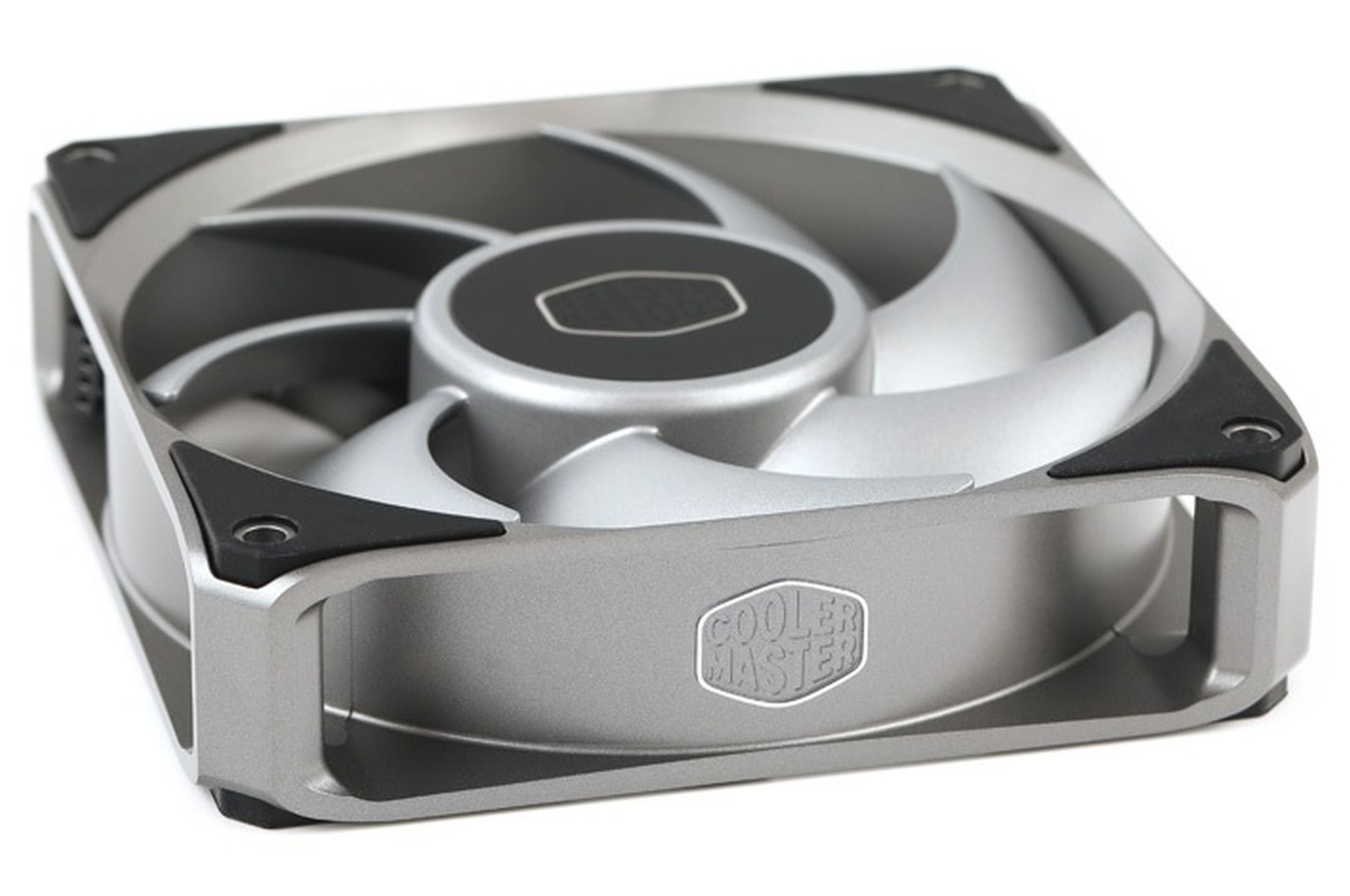
For it to be possible to speak of a fully metallic construction, the basic prerequisite is that the blades are also made of such material. This applies to Cooler Master’s “A” series fans, whereas the lower-end—or cheaper, interpret that however you prefer—model uses aluminium only for the frame. Yes, this can still be described as a metal fan, but it is somewhat of a… “hybrid” design, although one equipped with RGB lighting as well.
We will begin with the less metallic option—namely the fans using aluminium only for the frame (as is also the case with Alphacool Apex Stealth fans)—while the blades are made from liquid crystal polymer (LCP), which is a relatively rigid material. The aerodynamic design with seven relatively larger blades whose leading edges are more aggressively curved appears efficient. Airflow per unit of noise will certainly be higher—possibly top-tier—and above-standard static pressure would not be surprising either. As its designation suggests, the MasterFan M120 ARGB model is in the 120 mm format. But there’s also a 140 mm (MasterFan M140 ARGB) variant.
Fans from the “M” series use metal (aluminium) only for the frame. Naturally, this also creates a premium impression, but it should also be noted that a harder material allows vibrations to propagate more intensely from the impeller, which can be considered a negative because such a frame may ultimately cause anything in contact with it to resonate more strongly. To suppress this phenomenon, however, Cooler Master uses anti-vibration pads—apparently rubber—in the corners of the fan. For example, the Alphacool Stealth Metal with its similarly aluminium frame does not include these. A decorative element of these fans is also the RGB LED light guide surrounding the surface of the stator hub from the front side.
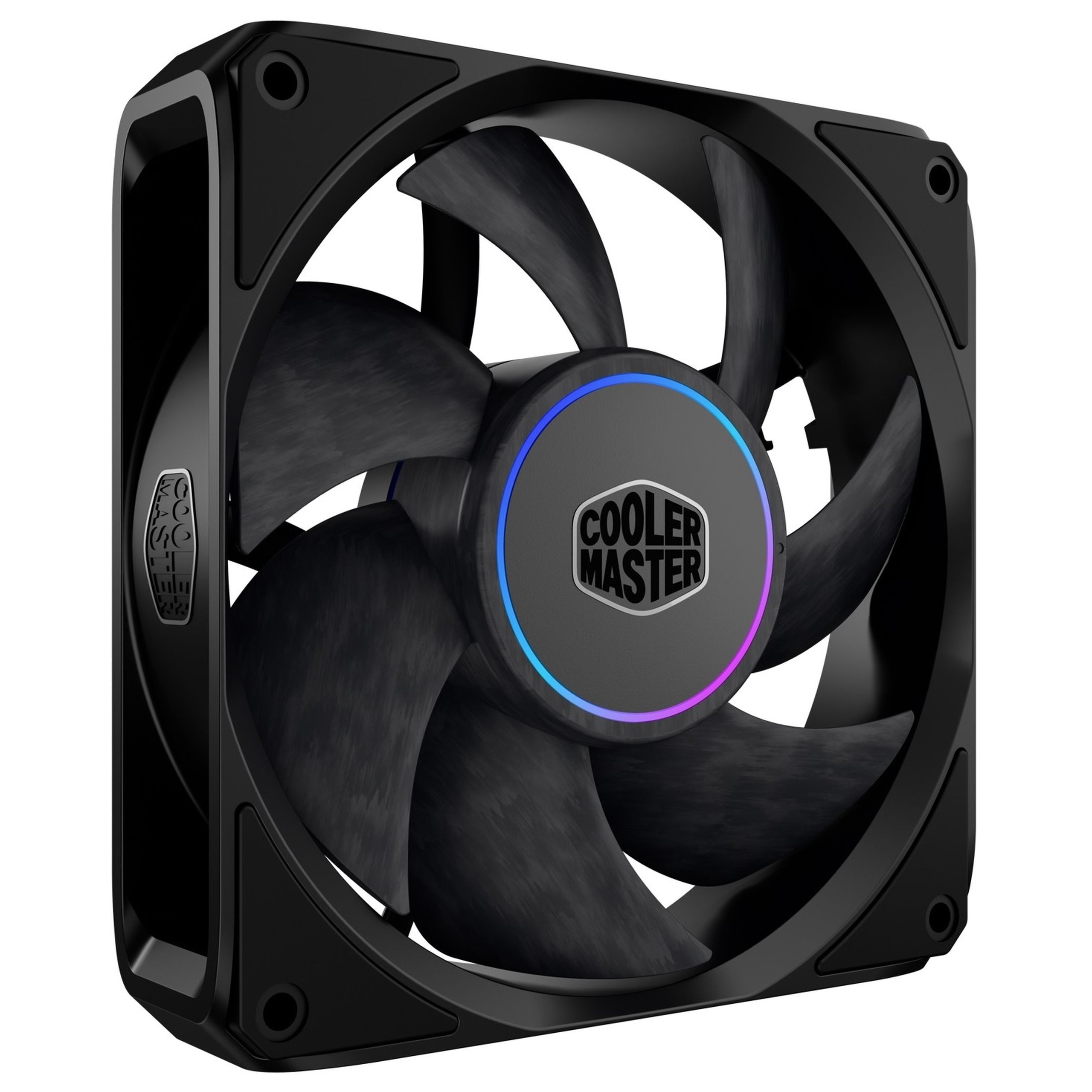
Connection is via a 3-pin connector, meaning digital ARGB LEDs powered at 5 V. The fan motor then uses a 4-pin connector with PWM support. The speed range is specified as 0–2300 RPM (also applies to the MasterFan M140 ARGB). On one hand this means semi-passive operation—with the motor shutting off at low PWM duty cycle—and on the other hand that this is a fan with relatively high maximum speed.
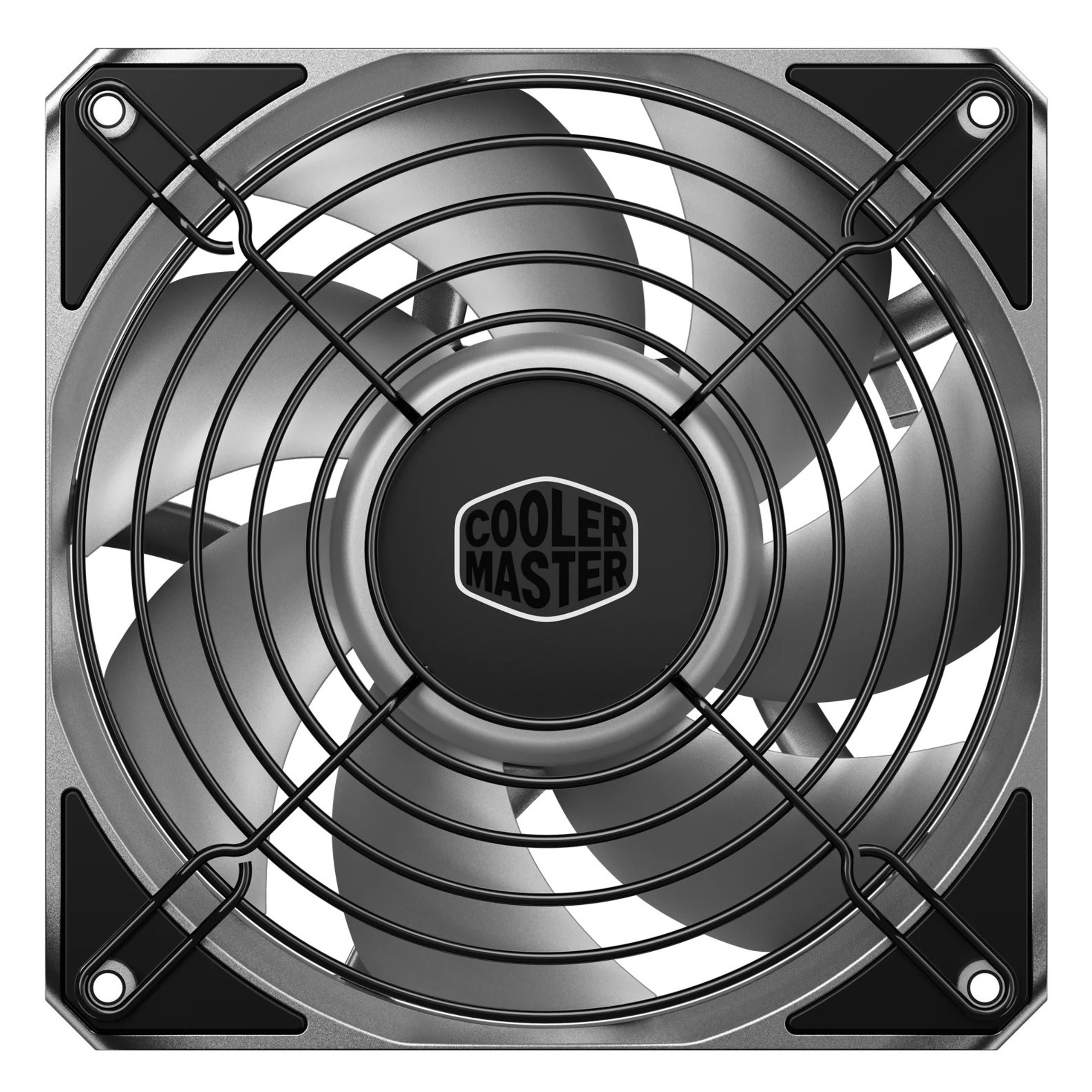
And now to the “A” fans. These are available in four variants: A120 indicates the 120 mm format, while the additional FC designation means that higher speeds can be achieved using a switch compared to the “base” models. In practice this means speeds up to 2500 RPM. Once again the specified range starts at zero, meaning the fan can stop completely, although the rotational speed at which it begins spinning in active mode can only be determined through testing. In the FC variant (MasterFan A120 FC), the maximum rotational speed reaches as high as 4000 RPM. For that, “overclocking” or “turbo” mode must be enabled. Technically speaking, a different motor is simply used, one capable of spinning faster at 12 V (100% PWM). At the same time it is important that the impeller can withstand this—and that the blades do not deform excessively in operation—which is presumably aided to some degree by the aluminium construction and naturally also by the geometric properties.
All fans from the A series feature a circular grille in front of the impeller to prevent unwanted foreign objects from entering the interior of the fan. Given the high rigidity of the blades, fingers could otherwise suffer unnecessary injury. We also expect the fan motors themselves to be truly powerful. Incidentally, the grille is also present on the 140 mm A140 and A140 FC variants, which should achieve the same rotational speeds (i.e. 2500 and 4000 RPM respectively). Even though the blade edges do not appear as sharp as for example on the Prolimatech Vortex fans, its presence is justified.
The CM MasterFan A120 fans have already been tested by Chiphell, from whom we also took several photographs (the featured image in the article header illustrating profile thickness), as well as the graph with results below.

Incidentally, these Cooler Master fans—including the M series—have a thickness of 30 mm, which also increases static pressure and airflow through obstacles. This is beneficial for radiators as well. That is, until the greater thickness causes some form of collision with a nearby component. The motors used are always three-phase designs. Mean time to failure for all fans is specified at 200,000 hours.

The least expensive M120 ARGB models have an MSRP of 17 EUR, while the fully aluminium models are more expensive. In the case of the A120 and A140, the price is 24 EUR, while the A140 FC and A140 FC models cost 32 EUR.
English translation and edit by Jozef Dudáš




Ok, shall we try and request A120 samples from CM? 🙂
The fans are FINALLY on their way to the test lab, haha.
If there’s anything in particular you’d be interested in, let us know and we can give it some extra attention in the analysis. 🙂
For now, just this—a detail of the fan’s blade…
… the tests will come later. In any case, we already have everything we need for them in the test lab. 🙂