


After a series of articles with AIO liquid coolers, I have prepared a change for you today. We will test the new flagship air cooler MasterAir MA824 Stealth from Cooler Master. This cooler boasts impressive specs and promises extremely high efficiency that should rival the best on the market. So I’m really curious about it, but before we torture it on a hot CPU, let’s take a closer look at it.
Measurement methodology
As a test processor and heat generator, I am now using an Intel Core i7-11700K on the Asus TUF Gaming Z590-Plus WiFi motherboard. The entire build is mounted on a Streacom BC1 frame with no fans to provide airflow. Acoustic shielding (acoustic foam on OSB boards) is installed around the test setup to eliminate ambient noise.
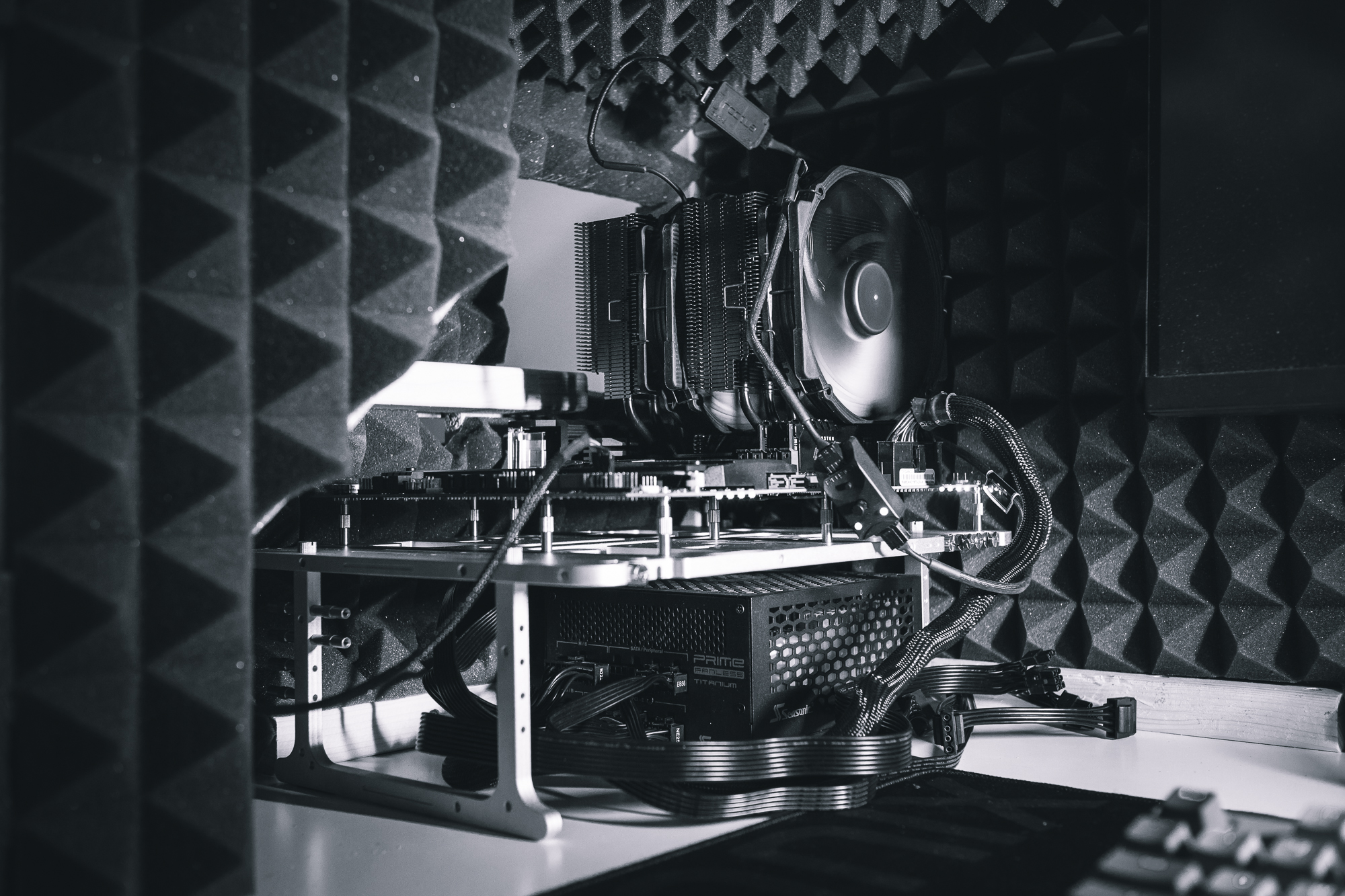
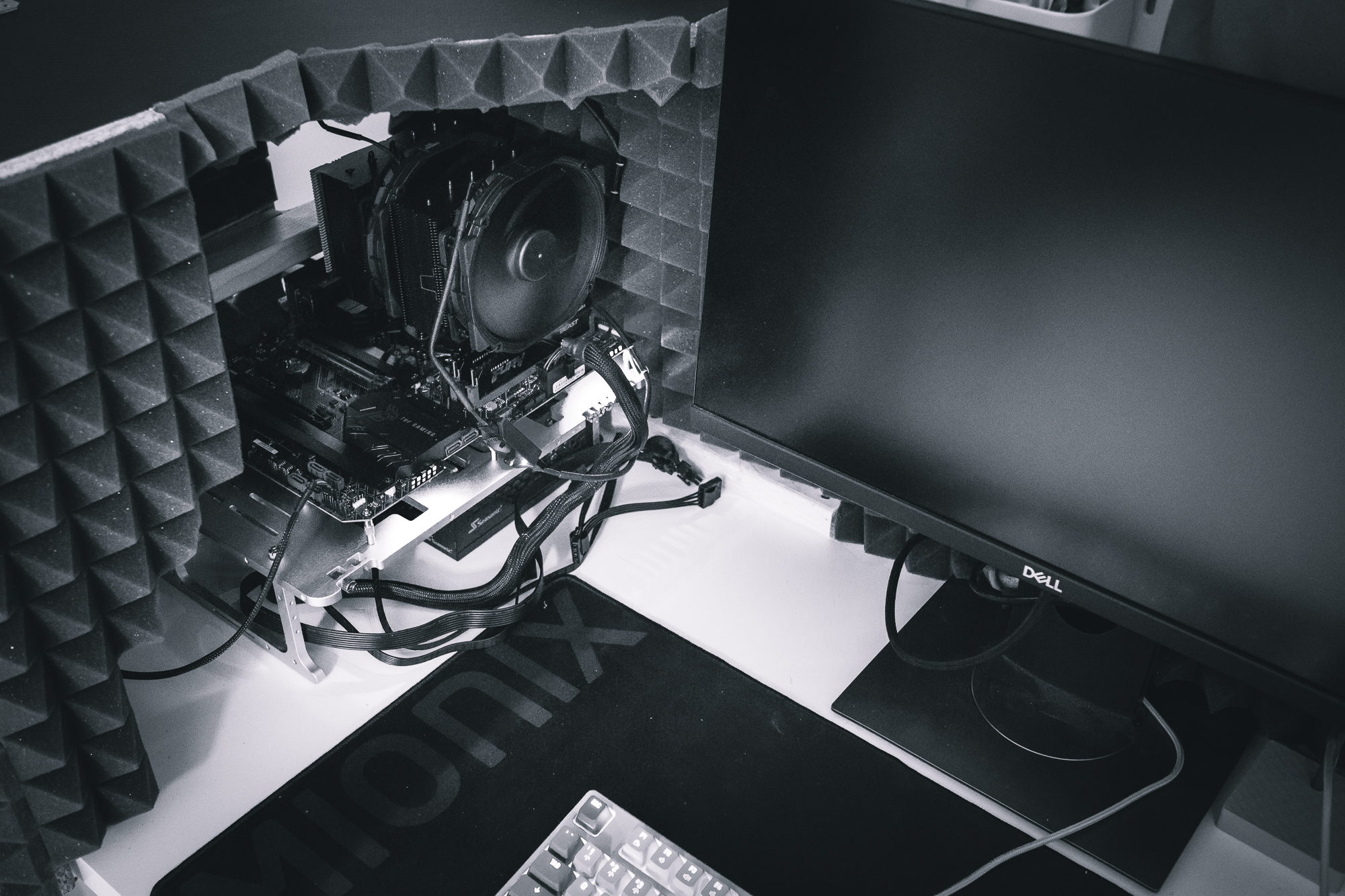
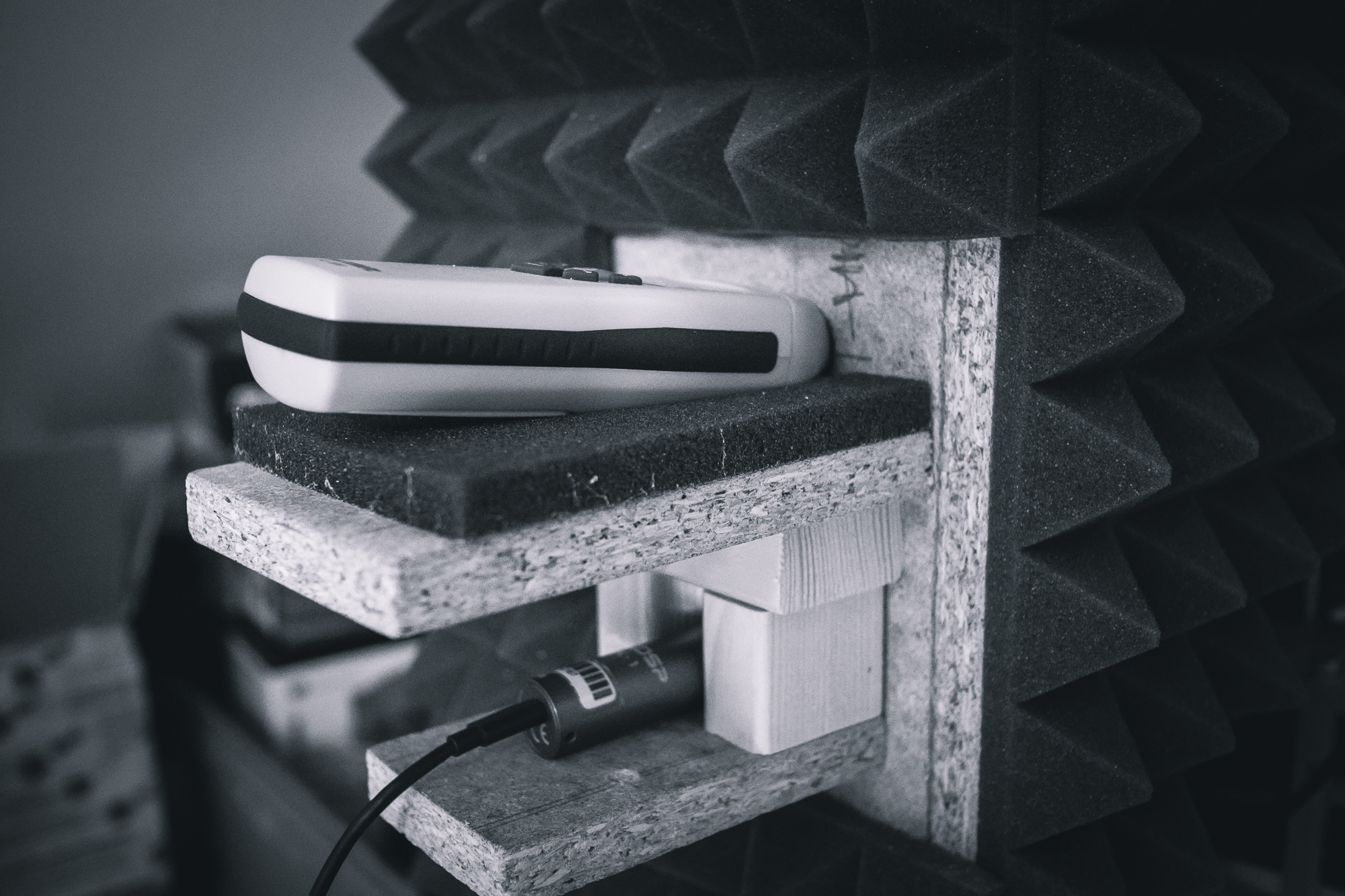
The Voltcraft SL-100 calibrated noise meter is placed perpendicular to the cooler in a fixed position relative to the motherboard at a distance of approximately 35 cm from the processor socket. Stress tests are performed using Prime95 with a duration of 30–35 minutes. The coolers are tested at three standardized noise levels (36, 39 and 42 dBA) and finally at maximum speed. The tests are run in two sets according to the heat output of the processor.
The first set of tests is at 125 W, the PL1 processor’s enforced limit. The second set of power draw is then about 205–210 W (4500 MHz at 1.285 V). However, this second level represents a very high concentration of heat per mm² due to the small size of the chip itself. Thus, not all coolers can be expected to pass this set of tests at all noise levels. At the end of the test, the highest temperature achieved is always recorded.

All data regarding CPU temperatures and heat output are obtained from the HWiNFO64 application. The measured values are then corrected against the room temperature as the resulting Delta T value. Any higher value means a processor temperature over 95–100 °C and a risk of thermal throttling. Therefore, if the cooler does not pass the load with a Delta T value below 75 °C, such a test is marked as a failure.



Are heatpipes soldered to fins?
Hello.
It does not seem so, even after close inspection with macrolens. But it’s difficult to be 100% sure, so I’ll validate this with CoolerMaster HQ, just to be sure. But if the HP were soldered, I would guess that marketing dept. would be boasting such feat on the MA824 website…
The absence of holes in contact with the heatpipes is a big indicator that the fins are not soldered.
That’s not necessarily a bad thing though. From what I have read, good press-fit fins can perform just as good as soldered ones (some examples are this cooler, the recent Deepcool Assassin IV, as well as the older Thermalright Silver Arrow), and are not easy to manufacture either since they require tight tolerances.
The main advantage of soldered fins are their supposedly better durability and performance over time.
Yes, the fin soldering does not necessarily have any impact on the cooling performance.
I once tested the Prolimaltech Megahalems rev. C and Prolimatech Megahalems Basic 81. As far as I remember (it’s been more than 10 years and I’m only vaguely fishing from memory…), the only difference besides the fins surface treatment (they were nickel-plated only on the more expensive Megahalems model) was the different contact of the fins with the heatpipe. The “only” stamp pressed Basic 81 achieved practically the same cooling performance. When I look in the archive of these tests, it was weaker, but only by a hair. In tests on a processor with a power draw of over 200 W, the difference in cooling performance was never higher than 1 °C.