


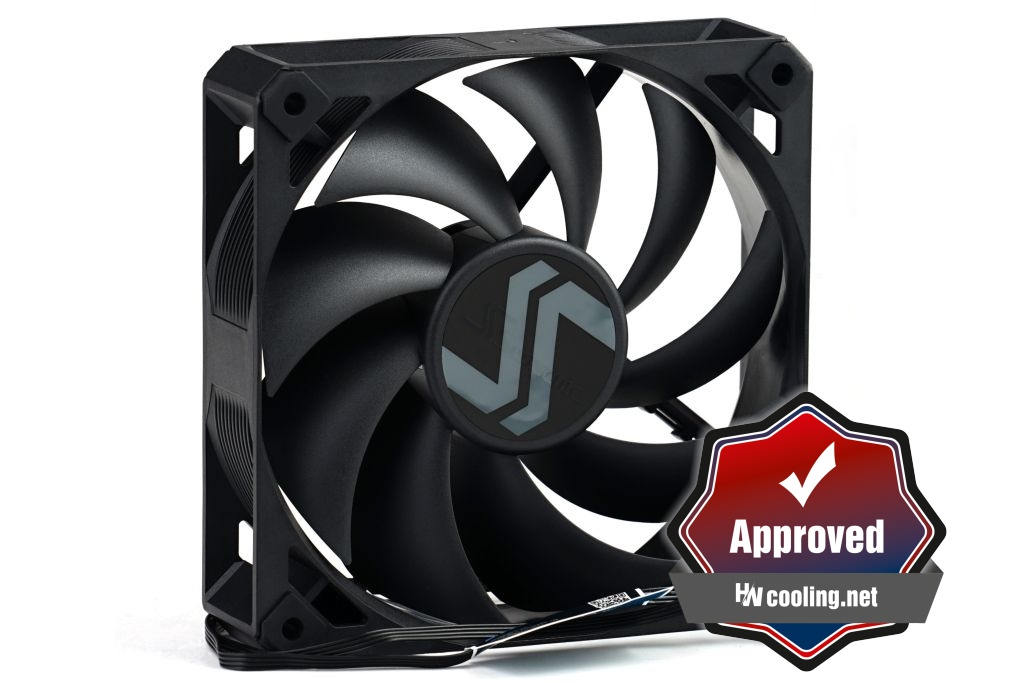
You know the feeling: moderate expectations, and then a surprise. With the MaxFlow fan, a fairly positive one. It delivers excellent results not only at its maximum speed, but also in quieter operation. However, it is weaker with obstacles, where it has to overcome higher resistance from the surrounding environment, and it should also be noted that, as with the Phanteks T30 and Sudokoo Mach120, its thicker profile means poorer compatibility.
Evaluation
Despite being an excellent fan with an attractive price-to-airflow ratio, don’t get too excited just yet. In practice, against obstacles, things are worse, or rather, airflow through obstacles (and consequently cooling performance) is weaker. It somewhat resembles the situation with the BioniX F120, although the MaxFlow fan often still comes out ahead. Even against obstacles.
Airflow through radiators is… judge for yourself. With dust filters (nylon or plastic), however, it is no longer enough for the top positions. Nor on a grille. On radiators (thin as well as thick), however, the results are tolerable. Given the price, it is difficult to find a rival. But again, compatibility is worse here because of the greater thickness. Sometimes, in certain situations, this may be an issue; at other times, it may not.
Fan vibrations are exceptionally low even at exceptionally high airflow. This not only demonstrates the precise workmanship of the sensitive components, but also indicates that torque ripple is minimal. In other words, the blade geometry is such that vibrations are negligible even at the blade tips. Of course, the rubber pads in the fan’s corners also damp some of them, but that is more or less only “cosmetic”.
Acoustic profile: Higher tonal peaks occur around 360 Hz, where operation is particularly disruptive at around 900 rpm. This does not mean that these peaks are smaller at other speeds, but here we can speak of something like “critical rpm”, indicating a significant difference compared with the noise at other frequencies. In plain terms, the MaxFlow fan is excessively “humming” here, even though its airflow is more modest, if we put it that way.
Overall, we have to praise the exceptionally wide speed range (400~3300 rpm), although we were unable to slow the fan down to the quietest mode. Therefore, if you are looking for something you will barely hear, it is more sensible to avoid this model. If noise is not particularly important and airflow is the priority, it can be a good option. This is also true at “medium” speeds, although it performs best without an obstacle, while attractive results are also achieved on liquid cooler radiators. Especially considering the purchase price.
The motor is exceptionally powerful as well. The fact that there is a very high maximum speed is also associated with high operating power consumption, but the headroom here is genuinely substantial. So much so that at times we even wondered whether it would be advisable, for safety reasons, to supply such a fan with a grille in front of the impeller.
Another strong point of the Seasonic MaxFlow fans is the genuinely long cable, allowing installation even in large cases. Again, however, be careful that the greater thickness does not cause unwanted collisions with surrounding computer components.
| Seasonic MaxFlow |
| + Suitable for any application |
| + Cooling efficiency (airflow/pressure per unit of noise) at a very high level |
| + Attractive price-to-airflow ratio |
| + Exceptionally wide speed range |
| + Exceptionally low, negligible vibrations (even at higher speeds) |
| + Extremely powerful motor |
| - Noisier operation around 360 Hz, particularly annoying at lower speeds |
| - Greater airflow drop caused by restrictive obstacles |
| - Potentially poorer compatibility due to above-standard thickness |
| Approximate retail price: 22 EUR |


