According to the latest reports, we will be waiting for RDNA 5 cards largely until 2028 (although one of the GPUs may arrive sooner, as early as 2027). At that time, however, RDNA 5 will come only to discrete GPUs and hopefully to the “Halo” Ryzen AI Max processor of the 500 generation. Ryzen processors for laptops and their integrated GPUs will remain on RDNA 3.5 for several more years and will receive the new graphics architecture even later.
Leaker Kepler_L2, one of the proven sources when it comes to various information about upcoming AMD GPUs, has now said that RDNA will reach the integrated GPUs in APU processors apparently only in 2029. And it will apparently be in a somewhat updated version of the architecture, which has the internal designation RDNA 5+.
The Plus version could have various improvements over the first version of RDNA 5, which will arrive in the discrete AT0, AT2, AT3, and AT4 GPUs. These will probably be relatively minor tweaks, similar to how the RDNA 3.5 architecture was improved over RDNA 3, rather than a leap corresponding to a full new GPU generation. That should come only with the RDNA 6 architecture, whose release date we do not yet know.
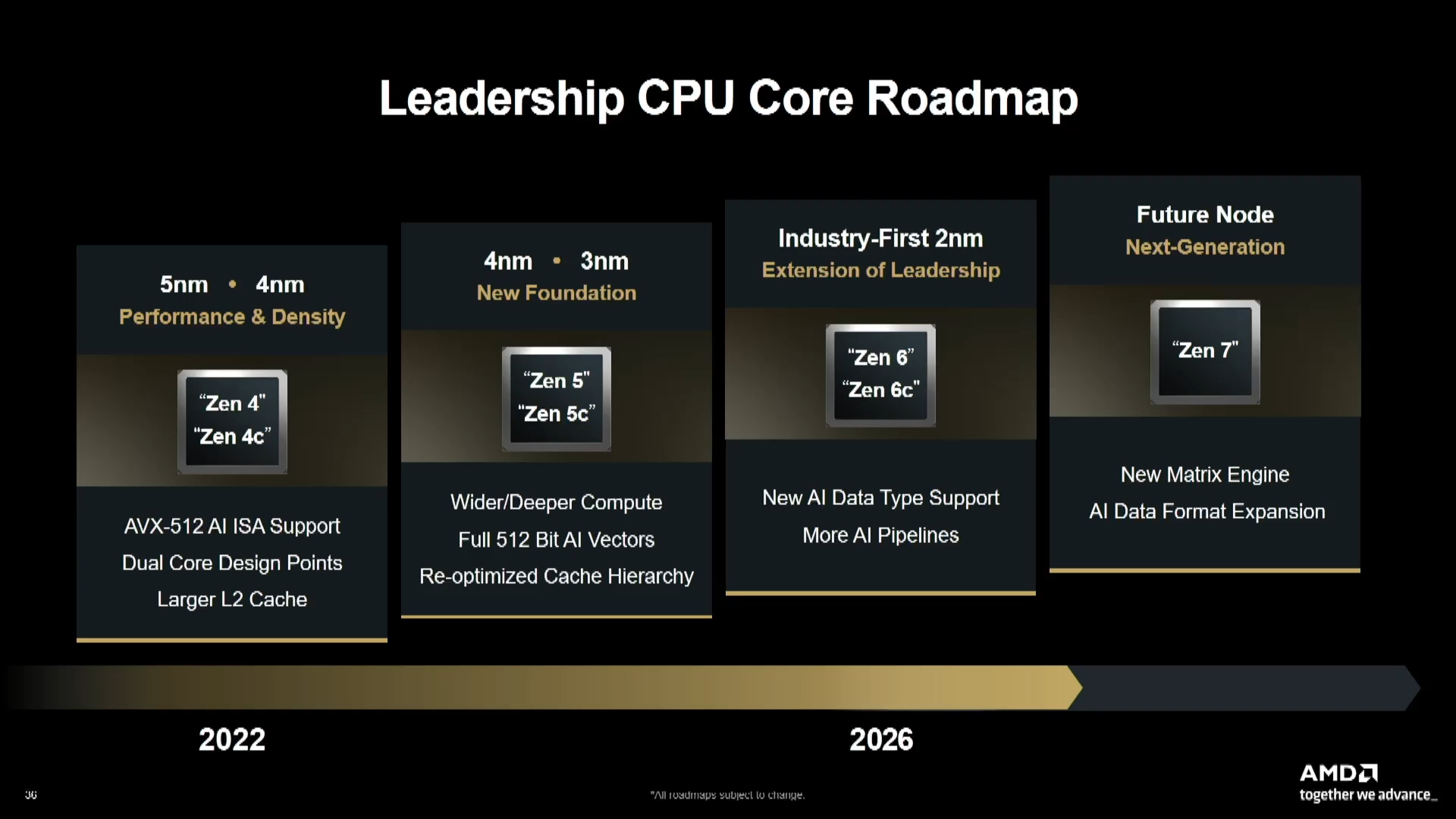
According to Kepler_L2, RDNA 5+ will reach the market with Ryzen processors/APUs codenamed Grimlock. That should already be a generation with the Zen 7 architecture. AMD’s official roadmap lists Zen 7 as an architecture due on the market in 2028, but that may concern only more powerful desktop CPUs for the AM5 socket, or even just server processors, which now have priority because of the AI boom. It therefore seems that Zen 7 for laptops (Grimlock) will be on the market only the following year.
Some preliminary information about the Grimlock APUs has already leaked earlier, according to which they are, for example, to use chiplets. How many RDNA 5+ compute units their integrated GPUs will have, or similar details, is not yet known.
It looks as though, before these Grimlock processors with RDNA 5+, there will be no fundamental architecture upgrade in the integrated GPUs of Ryzen processors/APUs for laptops (or desktops). The new generation of Ryzens, “Medusa Point” or “Medusa,” with Zen 6 cores, which is arriving now, should still use the aging RDNA 3.5 architecture carried over from the Ryzen AI 300/400 generation with Zen 5 cores. Or, more precisely, it should hopefully be a further improvement of it, which AMD could reportedly designate RDNA 4m.
That will not, however, be a variant of the newer RDNA 4 architecture, which will apparently not make it into laptops. It is to be an evolutionary improvement of the RDNA 3.5 architecture, consisting mainly of improved AI acceleration, for example by adding FP8 calculations. This will make it possible to use the new AI game rendering technologies from the FSR4 package, but outside of AI, the performance of the compute units will probably not be as good as that of RDNA 4 in the discrete Radeon RX 9000 cards.
Earlier RDNA 5 Only in Halo Processors
Between the Medusa and Grimlock APUs, however, there could be one exception where the RDNA 5 architecture (still in its original version without the Plus) might appear. This architecture could reportedly already be used by the new generation of “Halo” Ryzen AI Max processors with the Zen 6 architecture. Until now it had been discussed under the codename Medusa Halo, but according to Kepler_L2, AMD has meanwhile changed the internal designation to something else that is not yet publicly known.
According to older reports, unlike all the other APUs of the Medusa generation, this processor could still have a better GPU with the RDNA 5 architecture, possibly with up to 3,072 shaders (48 CUs). We will see whether this is confirmed. This probably also means a later release, though. Regular “Medusa” laptop Ryzens could be launched as early as the beginning of 2027, but the Halo processor probably only later in the year, much like the first discrete GPU based on RDNA 5 (the AT2 chip).
Unfortunately, the properties of Halo processors (support for a wider memory bus and high RAM capacities, along with performance for acceleration) have now predestined them for use in AI acceleration, and together with expensive memory they have made them a product that is unaffordable for most ordinary users. A Ryzen AI Max with an RDNA 5-based GPU will therefore probably not mean much for gamers, and, for example, gaming handhelds will get only Medusa chips until the time for Grimlock comes in 2029.
Sources: VideoCardz, Kepler_L2 (1, 2)
English translation and edit by Jozef Dudáš