


While AMD is preparing its next-gen Zen 6 CPUs, Intel is also approaching the launch of a significant next-gen CPUs codenamed “Nova Lake”. With 2nm process and a new architecture, it could improve the competitiveness of Intel’s chips after the somewhat disappointing Core Ultra 200 “Arrow Lake” generation. The first functional and running Nova Lake chips have now apparently emerged, revealing these CPUs for the first time.
The Nova Lake processor does not appear to have leaked into any benchmark database yet (unlike Zen 6), so we still have no indication of what kind of performance to expect from its new Coyote Cove (large P-Core) and Arctic Wolf (E-Core) architectures. However, a record of testing Nova Lake samples, apparently directly at Intel, has now surfaced. These are Linux boot logs that have leaked through the open-source infrastructure surrounding the development of GPU drivers for Linux—in previous years, records of previous upcoming CPUs have surfaced this way as well, so we know this should be a legitimate source.
The logs now show desktop Nova Lake processors apparently running on a test platform (rather than a retail motherboard) identified as Nova Lake Client Platform/NVL-S, with DDR5 memory (in desktop DIMM slots) and firmware from mid-July. The processor is probably an ES, or engineering sample, which does not yet run at clock speeds corresponding to the final CPU. The system identifies it only as “Genuine Intel(R) 0000” (with CPUID family 0x12, model 0x1, stepping 0x5).


24-Core and 28-Core Models with APX and AVX-512
More precisely, two different samples have appeared in the logs: one with 24 cores and one with 28 cores. The latter should represent the full version of the standard desktop Nova Lake processor with a single CPU chiplet containing 8 P-Core and 16 E-Core cores, while the processor’s SoC chiplet also contains four LP E-Core cores as part of the low-power enclave (“low power island”). Intel also plans processor versions with two CPU chiplets, which should have 16+32+4 cores, but these versions will most likely go on sale later, meaning their engineering samples may also appear later.
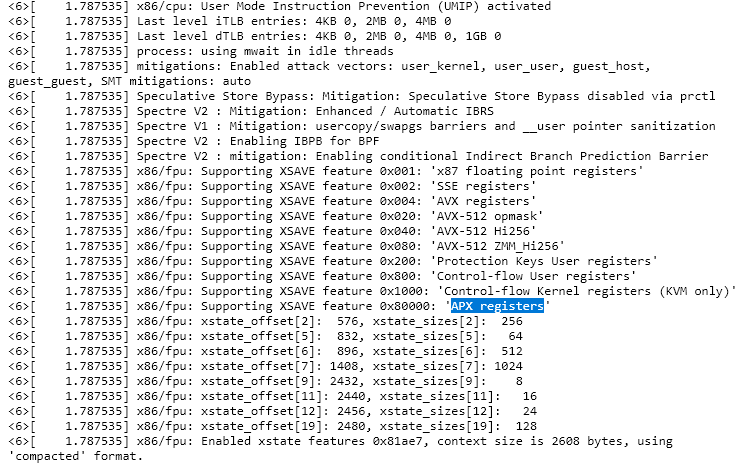
This finding confirms, firstly, that desktop Nova Lake processors are already functional to at least some extent and that Intel can run the Linux operating system on them. However, it also reveals some significant details.
The logs confirm that the processors support 512-bit SIMD AVX-512 instructions with ZMM registers (under the AVX10 designation). The Linux boot log also confirms that Nova Lake supports the APX instruction extension. There probably will not be much software making use of this at launch, but in later years it could be a source from which Nova Lake processors can gain additional performance in optimized software.
What Clock Speeds to Expect From Nova Lake?
It can be assumed that Nova Lake will increase per-MHz core performance (so-called IPC) by a significant percentage, but we do not yet know whether Intel will manage to increase clock speeds when moving to TSMC’s 2nm process, or by how much. The samples in the logs have clock speeds of 3.2 GHz for the 28-core model and 3.4 GHz for the 24-core model. These are base clock speeds, and unfortunately we do not know the more important maximum boost clocks.


If these are not the base clock speeds of the E-Cores but rather the P-Cores, then they would be lower than what Intel currently achieves with Arrow Lake processors—for example, the Core Ultra 7 270K Plus has a P-Core base clock of 3.7 GHz (and 3.2 GHz for the E-Cores). However, the base clock listed in the specifications may already take into account the fact that Nova Lake supports AVX-512 instructions. The “worst-case” power consumption scenario (with intensive use of 512-bit FMA instructions and similar operations), according to which the base clock is determined, could be higher for Nova Lake due to AVX-512 and the lower base clocks could just reflect that.
In addition, it is important to remember that ES processors commonly have clock speeds nowhere near as high as final retail models. Unfortunately, this leak therefore does not yet give us any indication that Nova Lake will achieve significantly higher clock speeds than Arrow Lake, although it does not rule this out either.
Intel has not yet officially disclosed the release date of Nova Lake processors. The company previously stated that the first models could reach the market as early as this year, but this will probably apply only to laptop versions, if any. The latest information suggests that the more common single-chiplet versions of the desktop processors (i.e. those with up to 28 cores) are scheduled for release in the first quarter of 2027 (January through March). Versions with two CPU chiplets and up to 52 cores will most likely not arrive until the third quarter. Desktop Nova Lake processors will use the new LGA 1954 socket, so they will require new motherboards.
Source: InstLatX64, Intel (1, 2)
English translation and edit by Jozef Dudáš
⠀


