


We have a colleague attending Taiwan’s Computex trade show, one of the highlights of the PC and hardware calendar, where manufacturers showcase their biggest innovations. We visited Asus, and we picked out a some interesting highlights the company is presenting. Asus, too, showcased motherboards with hidden connectors, along with one improvement that addresses the issue of GPU power cables. There was also a hub for wireless fan control.
Falcata magnetic keyboard
Asus introduced this split keyboard, which will be sold under the name ROG Falcata. Besides being usable as a single unit or ergonomically split into two halves that you can use with more natural arm angles, what makes it particularly interesting is the use of magnetic switches. These allow you to configure the actuation depth – the point at which the keypress is registered. It also supports adjustment of how quickly the keyboard can register the next keystroke (Rapid Trigger mode). The polling rate reaches up to 8000 Hz.

Peripherals in the style of Vocaloid
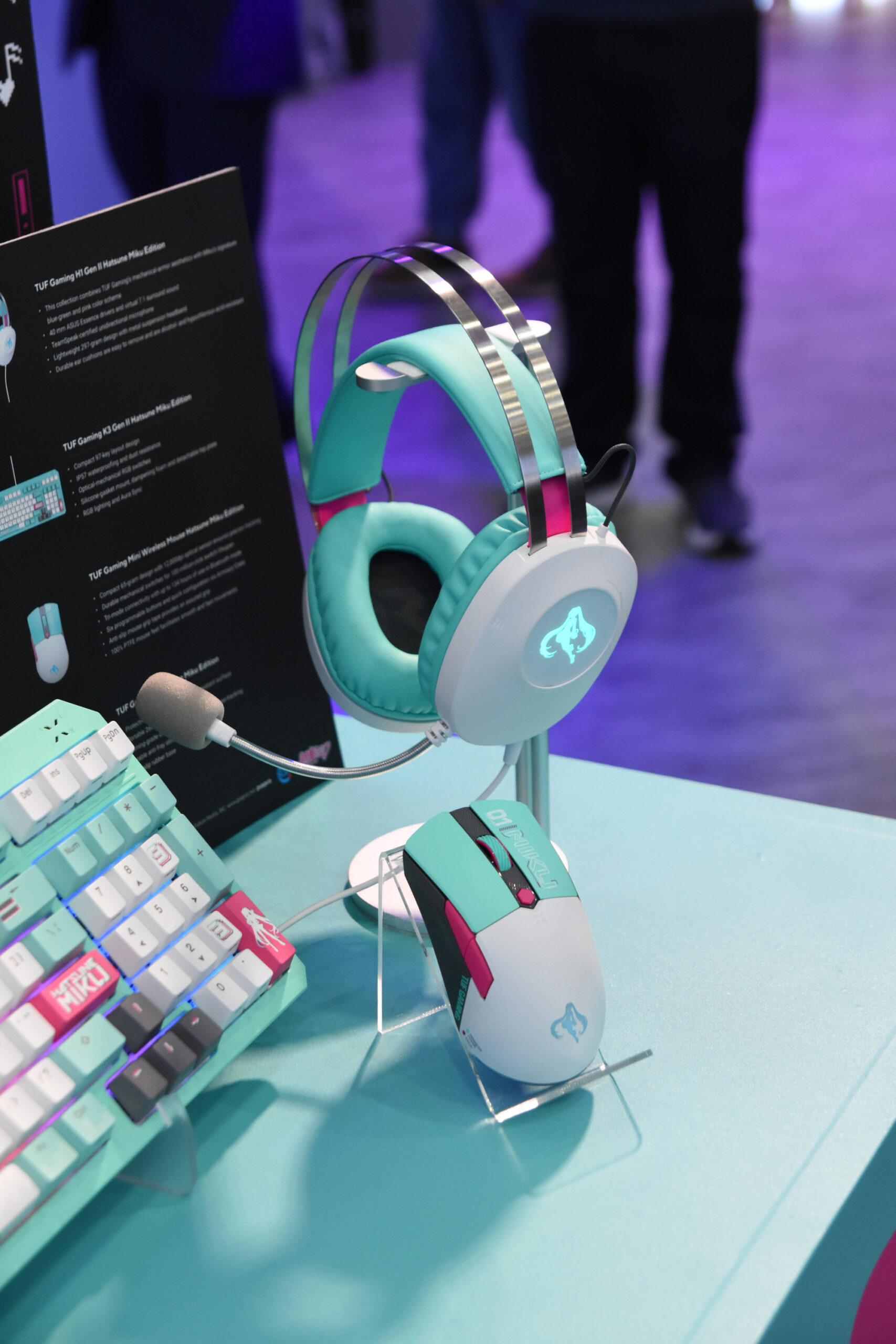
For fans of Japanese pop culture and anime-adjacent media, Asus recently launched TUF series hardware themed around Hatsune Miku. She’s the mascot of a voice synthesis program called Vocaloid, around which the Japanese have built a surprisingly large “moe” fandom.


At Computex, a mouse, mousepad, headphones, and keyboard with special prints from this peripheral line were on display. Asus is also marketing Hatsune Miku styled case, graphics card, and mATX motherboard in Asia – so anyone sufficiently obsessed with Vocaloids can build an entire setup around the aesthetic. According to Asus, the peripherals will also be available in our european market.

Graphics cards: Doom and Noctua edition
A crossover from a different realm is the ROG Astral GeForce RTX 5080 Doom Edition, launched in conjunction with the new Doom: The Dark Ages game. The hardware is based on the standard Astral model, with the main difference being its visual design. Asus also showcased a Doom-themed case (ROG Hyperion GX701).


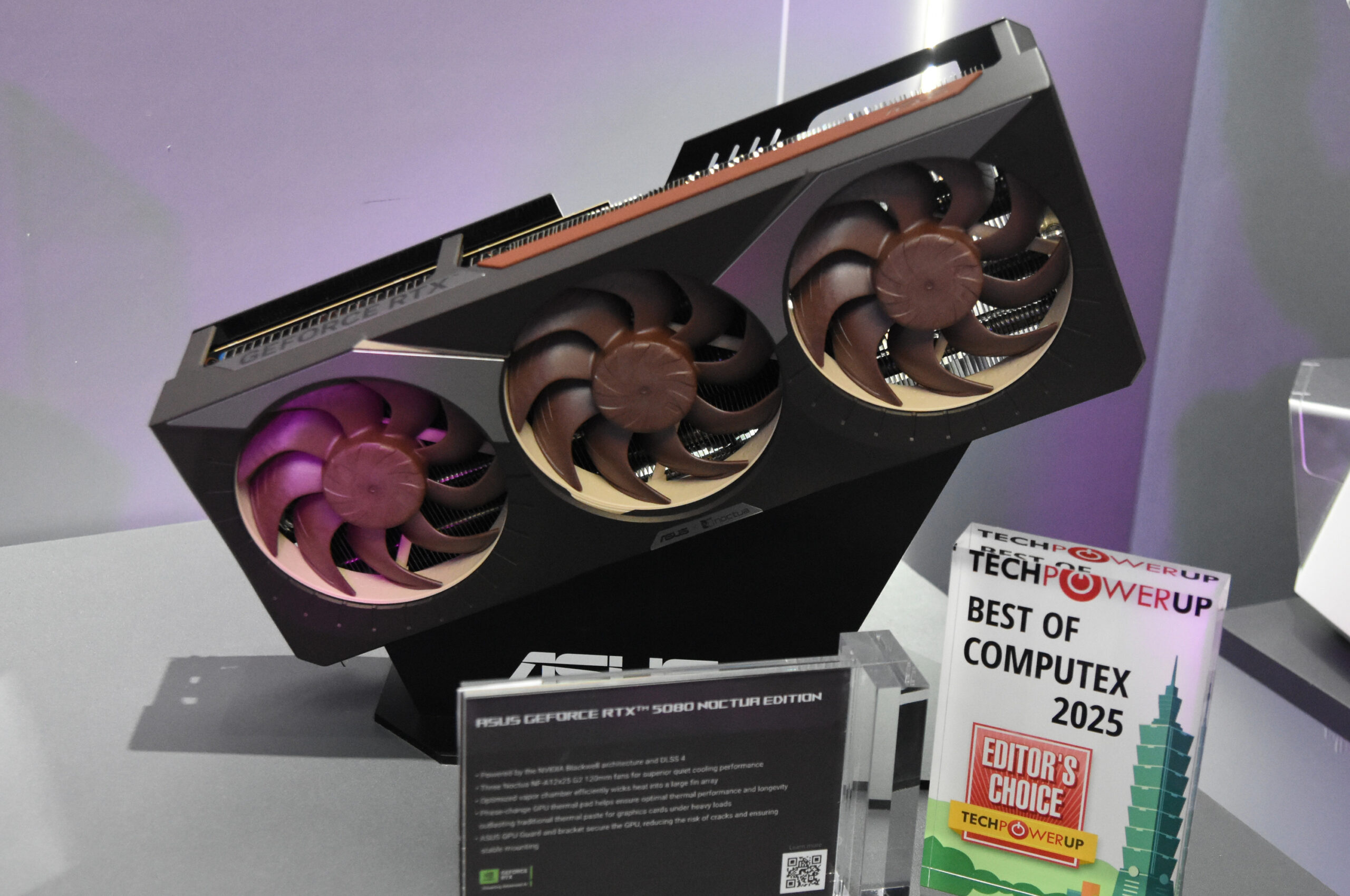
Conversely, the Asus GeForce RTX 5080 Noctua Edition is a purely practical collaboration (as it seems not everyone appreciates Noctua’s distinctive fan colors), making use of the top-notch acoustic properties of the new-generation NF-A12x25 fans. This collaboration that was already going on in the previous GPU generations now continues into the RTX 5000 series.
ProArt
Asus also showed off its ProArt hardware line, which is also very design-oriented – but in the kind of aesthetic that wouldn’t look out of place in any environment. In addition to motherboards and graphics cards, Asus offers a ProArt case combining black elements with wood accents. It’s arguably one of the most elegant cases currently on the market.


At first glance, the following item seemed to be an external GPU enclosure – but no, it’s a full-blown XIKII Industry FF07 PC build with a Mini-ITX board (ROG Strix X870-I Gaming WiFi), a Ryzen 9 9900X, and a ROG Astral RTX 5080 OC graphics card. Power is supplied via the ROG Loki SFX-L 1000W Platinum PSU.

Back To Future motherboards
Asus also has its own line of BTF (Back To Future) motherboards with hidden connectors located on the rear side of the PCB. These boards feature a special connector for powering the graphics card – but you’ll need a special GPU model that supports this connector. It includes large contact pads for current transfer and is expected to be reliable, unlike Nvidia’s problematic 12+4-pin connector. Perhaps its issues actually might be part of why manufacturers are exploring alternative designs like this, but the main goal is to eliminate visible power cables inside the case.

However, such specially equipped cards can cause compatibility issues in regular PCs. At Computex 2025, Asus showcased a revised design where the power connector is removable – you can see it here. The module must be plugged into another connector of the same type within the card.


One concern with this setup is that it still requires up to 600 W of power delivered through a 12V-2×6 cable from the PSU. But in this case, it’s plugged directly into the motherboard– meaning a failure could damage the connector on the board itself. What’s more, on BTF motherboards, this connector is hidden behind the rear panel of the case, so damage might not be noticed right away, and the area isn’t well ventilated, which could worsen thermal issues. Still, the 12V-2×6 connector is not Asus’s choice, the blame for it being on Nvidia—so there’s not much the company can do about it.
AIOs with displays
AIO coolers with displays were everywhere at this year’s Computex. Pictured here is the ROG Ryuo IV SLC 360 ARGB, featuring an OLED display that wraps around two sides of the water block and pump. The PC case is also by Asus—ROG Strix GX601S White.


Wireless fan control
Here’s a demo featuring the ROG Ryujin III 360 ARGB Extreme cooler. There’s also another display on the ROG Crosshair X870E Extreme motherboard, placed in the the rear I/O and VRM heatsink area.

The demo also highlights a fan controller positioned off to the side. It connects to the fans via cable, but the motherboard connection to the motherboard is handled wirelessly. The goal seems to be reducing the cable clutter inside the case.

This could be particularly handy when you’re removing the motherboard for cleaning or other purposes – though that’s not something you do often (and you’d still have to unplug other cables anyway).
Sources: Self
English translation and edit by Jozef Dudáš
⠀


