Alphacool SL-15 PWM: Low profile does not equal low airflow

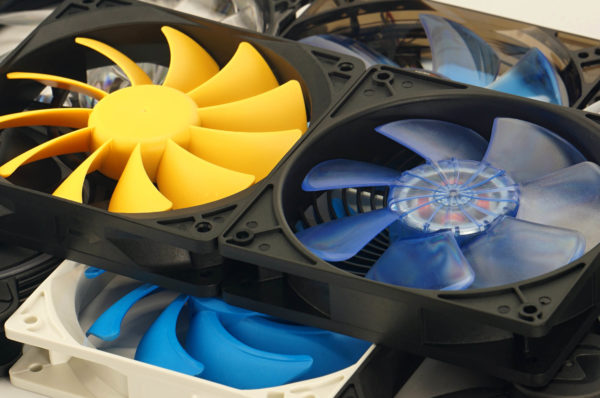
There are situations where standard 25 mm fans will not fit. Even the 120 mm format therefore offers lower alternatives. The first thing that naturally comes to mind is that such fans mean a trade-off in cooling efficiency. However, this may not be true and the hassle of thinking about how to fit a thicker fan inside may even be quite unnecessary. A well-designed rotor can achieve fully-fledged results when compared to a thicker rotor, even if it is slimmer. Read more “Alphacool SL-15 PWM: Low profile does not equal low airflow” »

Arctic BioniX F120: The efficient fan that loses to obstacles

We watched the Arctic BioniX F120’s behaviour during tests with our jaws dropped. First of all, because in some situations it really has top efficiency, and at a low price of around ten euros. But that’s how it excels in theoretical applications where nothing stands in it’s way. When it works with a filter, grille or radiator, the magic of the BioniX is gone. Such a significant turnaround is unique and fascinating. Read more “Arctic BioniX F120: The efficient fan that loses to obstacles” »

We cut the grille out of the Air Penetrator. Better than the original?

Every SilverStone Air Penetrator series fan includes an aerodynamic grille on the exhaust. This is firmly attached to the frame, but can be forcibly removed. The AP123 fan has gone through such a process and we will demonstrate the benefits of this grille. Whether it is good or bad cannot be noted briefly, but the way SilverStone communicates it to the public is again a bit unfortunate and misleading. Read more “We cut the grille out of the Air Penetrator. Better than the original?” »

Akasa metal filter beat the “plastics” in tests by a good chunk

We have tested a dust filter that combines the best features of plastic and nylon filters. It has high mechanical resistance, is easy to clean and yet also has low restrictiveness, so it does not significantly change the sound of the fan and does not increase its noise level. Compared to plastic filters, it does not even “hiss”. This addition thus extends the database of results with the latest type of dust filter, one with a metal grille. Read more “Akasa metal filter beat the “plastics” in tests by a good chunk” »

The AP123 or how SilverStone’s been fooling people for years

A harsh headline, but a fair one. We always try to find mostly good things when testing, but sometimes it’s tricky. That’s the case here, where SilverStone is misleading its customers. The grille doesn’t significantly increase noise? We have no sympathy for hoaxes like this. Especially when it’s all “well thought out” and staged. Such practices do not shed a good light on the combination of three different blade shapes, which actually has something to it. Read more “The AP123 or how SilverStone’s been fooling people for years” »

Noctua NF-P12 redux-1700 PWM: Not every low-end is the same

In this test, we’ll take a look at Noctua’s anticipated first representative and how it ranks next to other fans. We’ll start from the bottom with the most affordable one from this Austrian company. It should be noted that Noctua views this class of fans slightly differently than other brands, and has the base perched very high. However, there is one BUT, which is rather insignificant, but still “lifted some people out of their chairs”. Read more “Noctua NF-P12 redux-1700 PWM: Not every low-end is the same” »

SilentiumPC Fluctus 120 PWM: “Miracle” fan from the Fera 5

SilentiumPC presents the Fluctus 120 PWM as its very best fan. But, to beat the whirring Sigma Pro 120 PWM and the obviously sketchy Sigma Pro Corona RGB 120 is relatively simple. The company’s marketing, however, talks about psychoacoustic optimizations. And while there’s no reason to smirk (psychoacoustics is a legitimate scientific field), there were some imperfections that the Poles didn’t avoid. Read more “SilentiumPC Fluctus 120 PWM: “Miracle” fan from the Fera 5″ »

MSI MEG Silent Gale P12: A dominant all-rounder for a price

While the Silent Gale P12 isn’t the first fan in MSI’s lineup (like the Strix XF120 from Asus), it beats anything previous from the company by a mile. This is by the efficiency of the rotor, which is suitable for radiators as well as for a case, but also by the overall robust design. There’s a big, powerful but quiet motor, and you won’t even know about the hydrodynamic bearings. Read more “MSI MEG Silent Gale P12: A dominant all-rounder for a price” »

Asus ROG Strix XF120: An excellent fan, but only in some ways

The first and still the only Asus fan that is on sale individually may be a good choice. But you can also get burnt. It depends on what you want to use it for. In the right context, it gives attractive results, and the impression of a very decent fan is spoiled mainly by pointless design details or sugar-coating the specs. Anyway, you can see that compared to the more ordinary fans from the last test, the Strix is a bit of a different class. Read more “Asus ROG Strix XF120: An excellent fan, but only in some ways” »

Big test of 120 mm fans. We known everything about eight of them

To write that we have something mapped out to the last detail is perhaps too bold, but after proper preparation, few pieces of hardware are as easy to evaluate as fans. Of course, this had to be preceded by long preparations, developing a methodology, but you already know the story. What you don’t know yet is the first fruit, or rather the results of Akasa, SilentiumPC, SilverStone, Xigmatek or more exotic Reeven fans. Read more “Big test of 120 mm fans. We known everything about eight of them” »

We tried a DIY silon dust filter instead of traditional nylon. Result?

Socks, stockings or tights made of silon also attract uses other than on our legs. Enthusiasts can use the material to make, for example, a dust filter for a PC fan. It’s effectiveness then depends on the thickness of the silon fibre. However, tests show that whatever type you use, it is a rather unsuitable solution. And it’s also difficult for robbers who don’t worry too much about the mask and just need a visit to the drugstore before the job. Read more “We tried a DIY silon dust filter instead of traditional nylon. Result?” »

The Akasa GRM120-30 foam filter works better than it seems

After analyzing the nylon and plastic dust filter, we now add a test of the “foam” dust filter. The latter has a slightly more complex construction. It consists of several parts and is kind of like a jigsaw puzzle, the elements of which even improve the aerodynamics in some ways. We go through everything in detail, and although we approached this type of filter with a bit of a bias, it comes out in a good light in the end. Is a foam dust filter better than a nylon one? Read more “The Akasa GRM120-30 foam filter works better than it seems” »

Analysis: a hexagonal grille is no match for a circular one, in any way

Why do cases and PSUs almost always have impractical cut-outs in the grille in front of fans for air passage? Whether this is due to indifference to an all-round honest product or ignorance of how inefficient a solution it is, remains a mystery. But we have devised a comparative test which refers to drawbacks of the hexagonal grille. Compared to the non-restrictive circular ones made of wires, the differences are significant. Read more “Analysis: a hexagonal grille is no match for a circular one, in any way” »

Test: Nylon vs. plastic dust filter. Which restricts fans less?

The vast majority of computers use two types of dust filters – a fine nylon one and a coarser plastic one. The fact that the plastic filter lets more through and is less efficient in this respect is already apparent from the eye, as it has a coarser mesh. But do you know which one degrades the performance of the fan more and by how much? One even “wheezes”, which is nicely indicated by a detailed noise analysis at 240 sound frequencies. Read more “Test: Nylon vs. plastic dust filter. Which restricts fans less?” »

Complete analysis of the final wind tunnel for fan testing

The introduction to this article has been rewritten several times. The original versions resorted to describing the adverse events that caused the long-announced fan testing to be so dramatically delayed. But the text was always dreadfully boring… the important thing is that everything managed to make it to the start. But before the starting gun, come take a thorough walk around the track where the measurements will take place. Read more “Complete analysis of the final wind tunnel for fan testing” »