



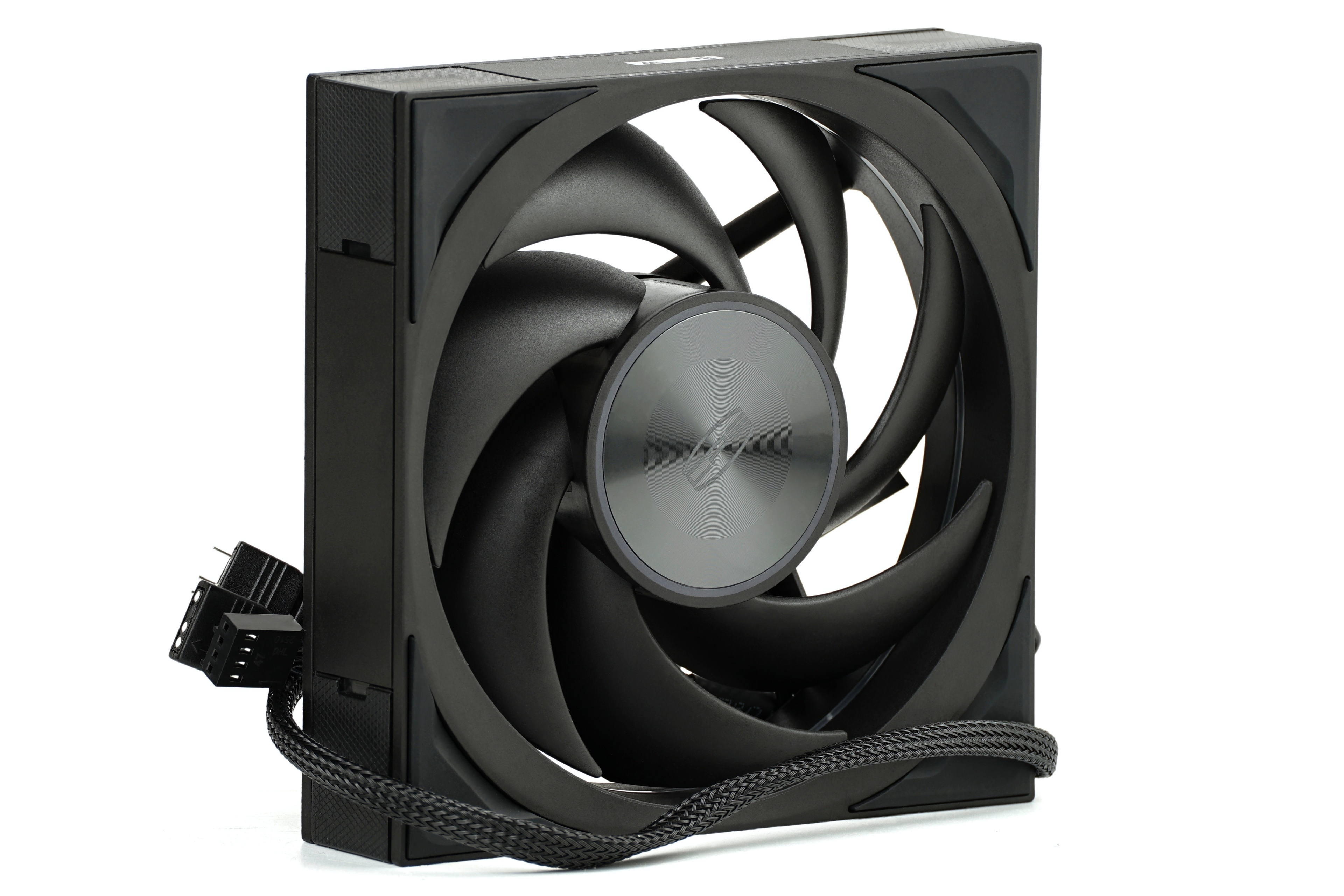
It is possible to illuminate the impeller even when black blades are used. This is demonstrated by the F7 X120 fans, where CPS PCCooler achieves illumination in a different way than usual. The result is impressive – not only in terms of ARGB LED aesthetics, but also regarding cooling efficiency. Also elegant is the daisy-chaining of multiple fans side-by-side (or stacked vertically) using a single cable connection.
Evaluation
It’s really true. On radiators, at medium speeds in noise-normalized modes, the F7 X120 performs at the level of the Phanteks T30. In some cases, it even outperforms it. But the differences are small enough to be negligible.
Nonetheless, the CPS PCCooler fan holds a remarkably strong position. That is, on thinner radiators with higher FPI. These radiators resemble traditional designs (in terms of thickness and fin density) commonly found in real-world setups. On thicker and less dense radiators, the F7 X120 starts to lose ground, but it still ranks among the top performers. Even though fans like the Phanteks T30, Noctua NF-A12x25, and Nidec Servo Gentle Typhoon D1225C slightly edge it out in terms of cooling performance/airflow in noise-normalized tests.
The key comparison here is with other illuminated fans – the F7 X120’s true competition. And the verdict is clear: nothing in the extensive database of results comes close on radiators. Sure, the DeepCool FC120 sometimes yields “better” numbers, but that’s typically in other scenarios – no obstacles or with dust filters. On both nylon and plastic filters, the F7 X120 usually delivers lower airflow compared to DeepCool FC120. But these are different use cases. Each fan excels in its own way – and CPS PCCooler F7 X120 dominates on radiators. Unequivocally. Still, it performs well in all tested scenarios, including with the hexagonal fan grille. Even there, it leverages its high static pressure to great effect.
The acoustic profile of the F7 X120 includes pronounced tonal peaks in the 120–250 Hz range (with higher RPM corresponding to higher frequency), which may give the fan a more “boomy” character. This is somewhat subdued when used on radiators, contributing to its outstanding airflow performance among illuminated fans. Nonetheless, that boomy acoustic quality is a notable trait of the CPS PCCooler F7 X120.
Measured vibrations are consistently relatively low, even at maximum speed (with exceptionally high airflow), although not entirely negligible. We did register some vibrations, particularly at higher speeds. A potentially even stiffer blade material (stronger than thick PBT) would probably reduce vibrations further, but even so, production tolerances are remarkably tight, and the manufacturer clearly focused on mechanical precision. Simply put, considering the airflow achieved in these modes, vibration levels are well above standard.
On the other hand, the motor’s output is exceptionally high. With over 16 watts, we’re likely talking about an extreme, which is a good thing. It provides ample overhead for future wear (due to increasing friction as the fan ages), and the average power consumption remains moderate. The (average) airflow per watt of power draw is also middling. Lighting makes things “worse”, with draw exceeding 7 W (at maximum speed with LEDs at full brightness). Despite that, luminous output remains relatively low, at least when measured methodically the way we do. But that’s to be expected – the material used in the fan doesn’t transmit light very well, it mostly reflects it. This is essentially what creates the “halo” effect, and that’s the intended aesthetic. The LEDs behind the light guides are quite strong and sharp, but never overly distracting. Again, it’s a matter of preference – everyone likes something different, and the F7 X120 fan offers one of those options.
Overall, we must rate the CPS PCCooler fan very positively. Not only in the category of illuminated models does it feature a very impressive cooling efficiency profile, especially on liquid cooling radiators. And it’s particularly powerful at maximum speed. There are always some drawbacks, and for some users, one of them may be the fact that even at the lowest PWM duty cycle, the F7 X120 fan does not shut off and remains active at all times (bottoming out around 600 RPM).
With DC control and sufficiently low voltage, the fan can be turned off – but that’s not the norm for everyone. The more commonly used PWM control doesn’t allow passive operation at all, which is a bit of a shame. Then again, maybe that won’t bother some users at all – who knows.
English translation and edit by Jozef Dudáš
| CPS PCCooler F7 X120 |
| + Suitable for all types of use |
| + Cooling efficiency (airflow/pressure per unit of noise) is at a very high level |
| + Due to above-standard fan blades, it sometimes achieves truly top-tier airflow |
| + Exceptionally high airflow through liquid cooler radiators... |
| + ... in this discipline, it’s quite hard to find a direct competitor |
| + High airflow even through other, more restrictive obstacles... |
| + ... such as a grille, where this fan also stands out among other illuminated models |
| + Wide speed range |
| + Quiet motor and bearing operation |
| + Extremely powerful motor (~16 W) |
| + Illuminated impeller... |
| - ... but with relatively lower brightness. However, some may appreciate soft light diffusion |
| - Naturally more boomy sound in the 120–250 Hz range |
| - Higher minimum speed (~607 RPM)... |
| - ... and it doesn’t support passive mode, doesn’t “shut off” at low PWM duty cycle |
| Approximate retail price: 40 EUR |


We’re gonna be seeing more of this style of ARGB solution with these aluminum fans in the pipe, or mixed with LCP.
To be honest, Phanteks should have gone this way for the D30 series, they’d have performed closer to the original T30.