


The Adata Vento Pro PWM fans face a tough challenge ahead. They associate themselves with the legendary Gentle Typhoon D1225C fans, claiming to address the major shortcomings of the older GT models. And you probably know what those are – extremely high vibrations. These should not affect the XPG fans. The aerodynamic design they’re built on is excellent in the best sense of the word, and there’s no need to debate that.
And in fact, they really are Gentle Typhoon (D1225C) fans, as revealed by the label on the motor housing. Just like it was in the past with Scythe, these fans are once again manufactured by Nidec. Adata has become the bearer of the popular Gentle Typhoon brand, now under its wing. But that also comes with a big responsibility, because expectations for these fans are extremely high – not only from a technical standpoint, but also in terms of logistics, availability, and sufficient stock for retailers, among other challenges the Adata XPG Vento Pro 120 PWM fans will face.

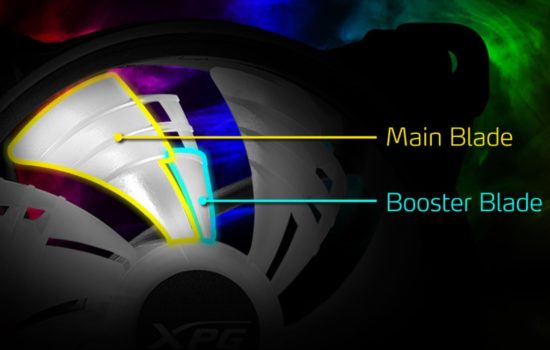
The blade shape corresponds to the original, or rather the older GT D1225C design. It’s identical, which is a good thing considering how impressively it performs. This nine-blade design with highly curved edges has proven successful and even inspired fans like the Noctua NF-A12x25. The impeller is slightly different, with its blade tips featuring a specific rounding, and a different material is also used. At this greater thickness, however, the PBT with glass fiber is exceptionally rigid.

The gap between the blade tips and the stator tunnel is also very narrow – around one millimeter. This parameter supports the fact that the thermal expansion of the material during operation remains minimal across the entire speed range. Such a design (with blades tight to the frame) naturally impacts performance as well – it allows for larger blades (which means the potential for higher airflow) and also makes the fan more resistant to back pressure (less air escapes through the smaller gap under resistance), which ultimately results in higher airflow when mounted on restrictive surfaces. And the Vento Pro 120 PWM fans are indeed aimed at such obstacles – even something like liquid cooling radiators.


Excessive blade deformation should not occur even at higher speeds. However, as you may recall, this design has historically been known for producing very high vibrations. These vibrations likely originate at a different level than the blade mechanics, and here too, the Vento Pro 120 PWM faces a significant challenge. We assume that over the years, Nidec has managed to balance the impeller to achieve lower, more competitive vibration levels even at maximum speeds around 2150 RPM.
The torque ripple might also be mitigated by weights beneath the impeller hub, similar to what’s found in the Phanteks T30. Still, that alone wasn’t the reason why the Gentle Typhoon D1225C experienced such high vibrations. Whatever the cause, they should now be substantially reduced – a claim supported by our test results.

Some vibrations are also absorbed by the rubber pads at the corners of the fan, although these mostly serve cosmetic purposes rather than effectively dampening severe vibrations transferring to the frame. After all, fans are often mounted with metal self-tapping screws, and through these, impeller vibrations are transmitted to the frame and then to the case regardless of whether the fan is in partial contact with the rubber pads or not.

The method of connecting the fan to the motherboard (or a fan hub) is also more modern than it used to be. A 4-pin connector was present on the Gentle Typhoon D1225C fans years ago, but back then, the cable was simpler (with individual wires loosely separated from one another), whereas now, the insulation of the wires is bonded together. The end features two connectors – one traditional for connecting to the controlling device, and a second one for daisy-chaining another fan. Because of this, the cable is fairly short, only 110 mm (+7 mm male). However, included in the package is a 450 mm extension cable, which is long enough to reach even across large full-tower cases.

The Adata Vento Pro 120 PWM fan uses dual ball bearings and has a rated mean time between failures (MTBF) of 250,000 hours – at 25 °C. At 60 °C, that number drops significantly to 60,000 hours.
Please note: The article continues in the following chapters.



Or maybe the Vento Pro 120 PWM deserved the “Top-notch” award? We did consider it, but in the end – given a few compromises and the low official price – we decided differently from an HWCooling editorial standpoint. 🙂