


You’ve already seen the tests of the Endorfy Corona 120 fans, and now we’re adding results for the “reverse” variants. The aerodynamic design is essentially the same—just… reversed. The emphasis on visual appeal is therefore even stronger. The colorful lighting is complemented by an element intended to make the result even more striking. You won’t see the stator struts interfering with the appearance.
Evaluation
First of all, it should be noted that the Endorfy Corona 120 Reverse fan aims to appeal to the user primarily through its appearance—for example through its ARGB LED ring‑style lighting.
Its aerodynamic properties across all scenarios are weaker to weak—in open air, with dust filters (nylon, plastic), on a grille, or on radiators (thin, thick). In these disciplines, practically all in‑house fan models perform better in relative ranking (in tests normalized to comparable noise levels). At a similar price point, there is the Fluctus 120 PWM (non‑RGB), and among cheaper options the Stratus 120 PWM and Stratus 120 White ARGB if illumination is required. A different approach (lighting the entire impeller), but still often a requirement.
Among measurable characteristics, the main advantage of the Corona 120 Reverse fans lies in their low vibration levels, though this comes somewhat at the expense of cooling performance. For cases where the fans are integrated as part of other components (such as Endorfy Aquarius cases), this is “good enough.” Of course, there are more efficient options (in terms of airflow per unit of noise), but we do not see these fans as candidates for replacement. They deliver weaker‑than‑great performance, but they fulfill the role of system cooling at low noise, as their speed goes exceptionally low, down to around 118 RPM, where they are silent.
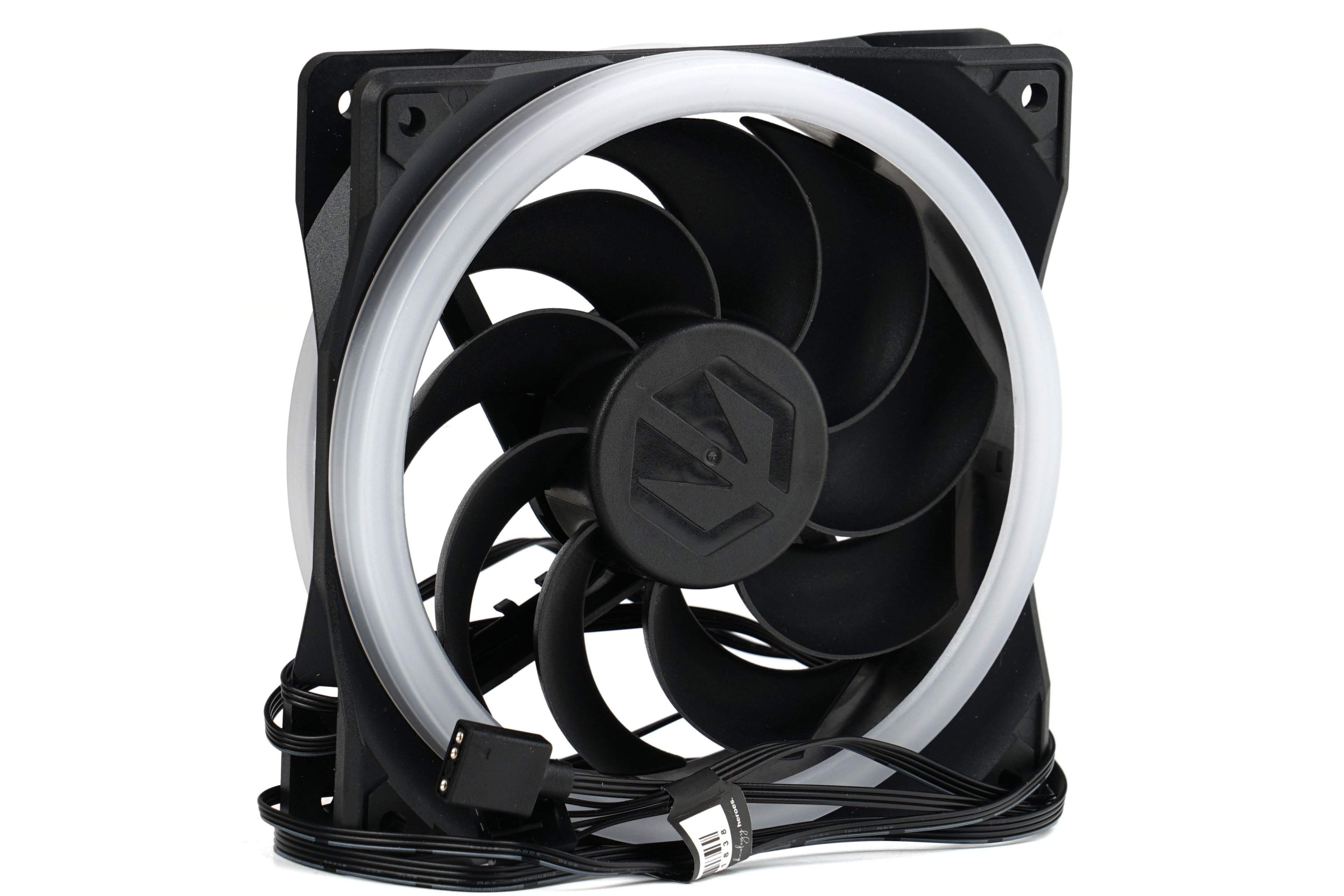
For comparison with competing models: at a similar price (around 13 EUR), the Asus Prime MR120 ARGB achieves higher cooling efficiency, but at the cost of lacking motor shut‑off at low PWM intensity (Endorfy fans support semi‑passive operation). It’s a trade‑off.
You can also break down the acoustic profile or the already‑mentioned negligible vibrations. For most people, these differences won’t be dramatic, and the fans can be placed in the category of “similar performers.” This applies also to the brightness intensity. Whether it makes sense to buy these fans separately is individual—it depends on expectations. The price‑to‑performance ratio (or the cost per cubic meter of airflow) is average—slightly above average for illuminated fans.
So if these fans make sense for you, we won’t try to talk you out of them. As for the award, we end up at “Approved”—they work and have no major technical shortcomings.
English translation and edit by Jozef Dudáš
| Endorfy Corona 120 Reverse |
| + Suitable for any use |
| + Practically silent bearing and motor operation |
| + Negligible vibration levels |
| + ARGB LED lighting |
| + Lower price compared to typical illuminated fans |
| + Very low possible speeds (stable from approx. 118 RPM) |
| + Pleasant acoustic profile with no major tonal peaks |
| - Relatively weaker aerodynamic characteristics... |
| - ... lower airflow (per unit of noise) even compared to designs with a light guide around the impeller |
| Approximate retail price: 13 EUR |
PC fans are also available for purchase in the Datacomp e-store



Spectrograms of „45 dBA“ without obstacles:
The reverse model is already “acting up” here too (on some obstacles, those tonal peaks are even higher), but the standard variant, in exchange, has more noise distributed across other sound frequencies. 🙂
Could you also note the RPMs alongside the sound normalization tests? That would be helpful so we can determine whether if fans reached the RPMs where vibration increases.
First of all, thank you for the suggestion. Logging fan speeds on obstacles would certainly be useful, but I have to repeat what I mentioned somewhere before: due to capacity constraints, we simply can’t manage it. At this point, it’s beyond our means to further increase the time demands of the testing process. Sorry about that. :/