


After some time, we’re returning to tests of larger PC cases – those capable of housing an ATX motherboard and larger tower-style CPU coolers. The first case we’ll review is the FD North XL. Yes, we’ve covered this model before, but this time we’ll provide results using our updated testing methodology. But first, we’ll zoom in on some details – essentially a look at what this large Fractal Design case has to offer.
Fractal Design North XL with installed components
Given the large size of the case, it supports large components, including big or tall CPU coolers. For testing, we’re using the NH-D12L chromax.black cooler – one of the shorter tower coolers (we need compact ones for case testing to ensure compatibility with narrower models). In this case, however, it fits with plenty of room to spare. Fractal Design states that the North XL Chalk White TG Clear supports tower coolers up to 185 mm in height, which should comfortably accommodate virtually all currently available air coolers on the market.
If you’re considering a liquid cooling setup, the top panel supports radiators up to 360 mm in length, including models with extra thickness – up to 70 mm. Even radiators that are 38 mm thick are supported. Combined with standard 25 mm fans, the dimensions still work out well for top-mounted liquid cooling setups. If you prefer installing a liquid cooler in the front, there’s room for even larger units – up to 420 mm in length and 84 mm in depth. That means even oversized radiators and extra-thick fans can potentially be installed together. The Fractal Design North XL is built to accommodate such configurations.
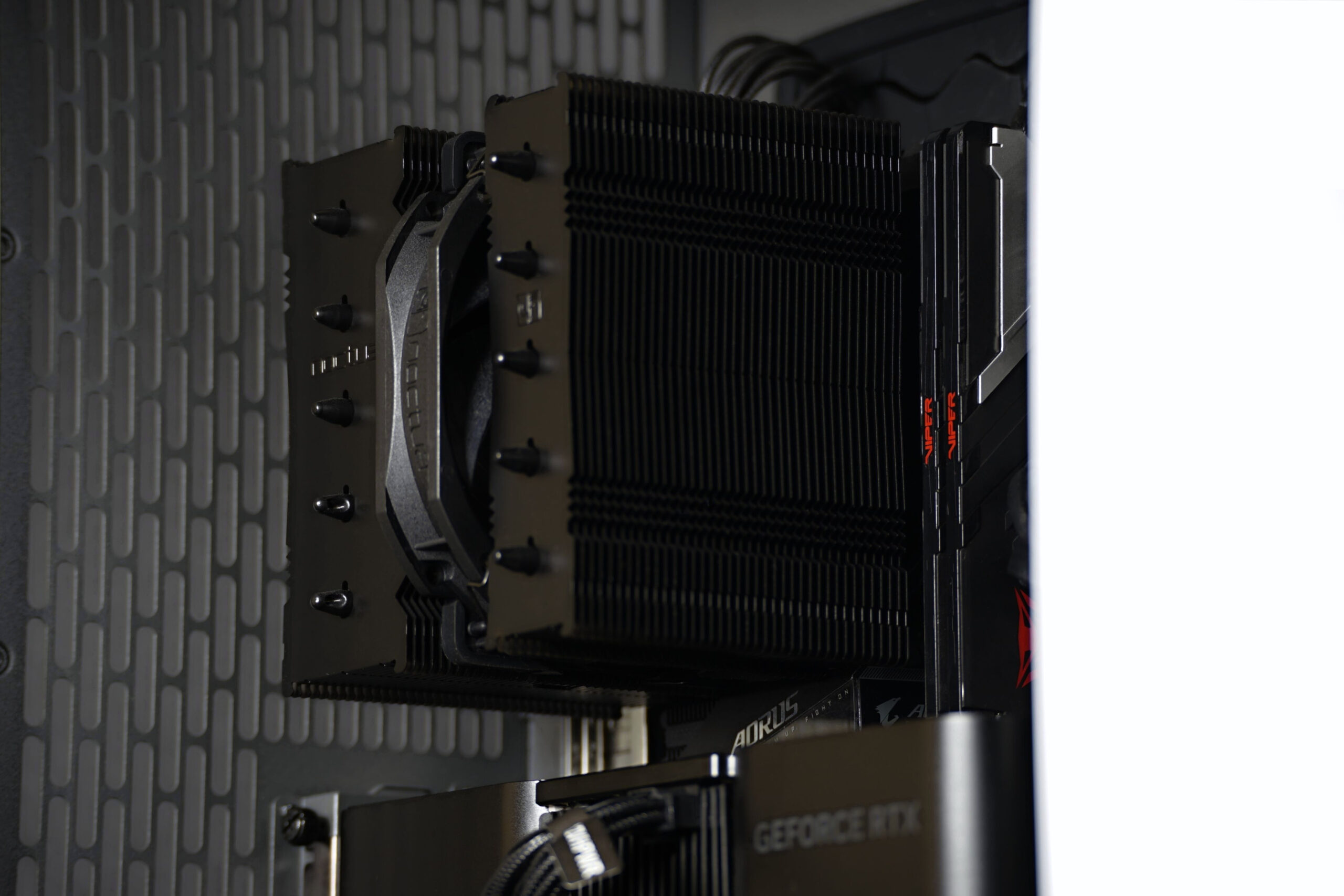
Graphics cards are supported up to 413 mm in length – longer than any existing graphics card on the market. This figure includes clearance with the front fans pre-installed. There are no constraints on GPU thickness either. The North XL includes up to seven PCIe slots, meaning that it can handle even the thickest graphics cards with ease.
We’ve already mentioned support for oversized E-ATX motherboards. It’s worth noting, however, how cleverly Fractal Design has adapted the cable grommets for them. The second row of grommets, closer to the front intake fans, accommodates motherboards up to 330 mm in width. Even PCBs this width don’t obscure the grommets – their placement is just right. The first row of grommets is laid out to fit ATX-standard widths (244 mm). Smaller motherboards, however, fare worse in terms of grommet alignment.
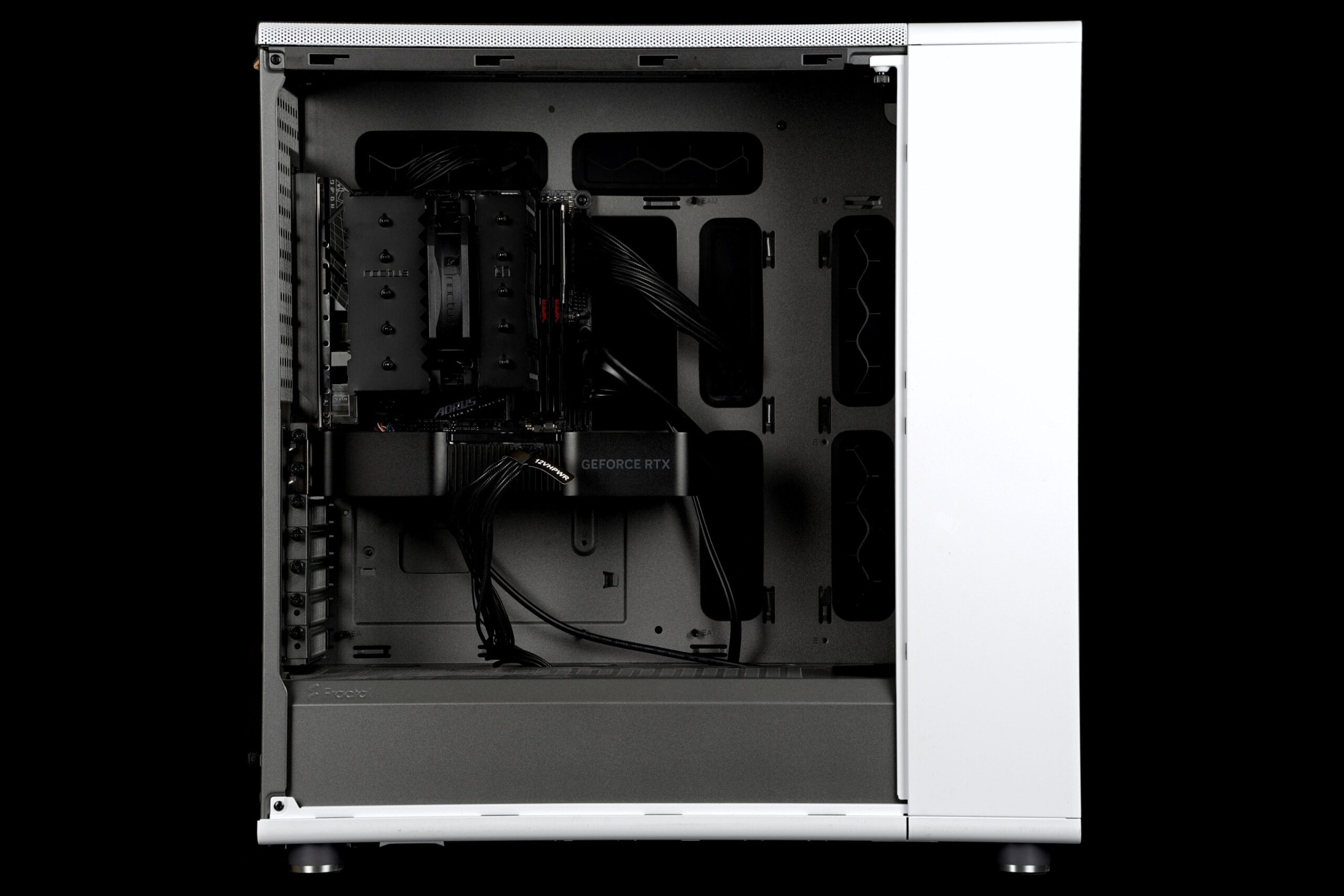
Although the case officially supports Mini-ITX boards, certain details – such as the length of the front-panel button cable – can be problematic. It may not reach the internal motherboard header in some Mini-ITX setups, particularly in cases where the board sits high inside the case (as Mini-ITX often does). For larger motherboards – the ones this case is primarily designed for – there are no such issues.
There’s plenty of room in the rear of the case for cable routing. Space won’t be a limiting factor – there’s a generous amount. From the tray to the side panel, there is 25 mm of clearance. Bulkier cable bundles might start pressing against and bulging the panel, but with tidy cable management, this shouldn’t be a problem.

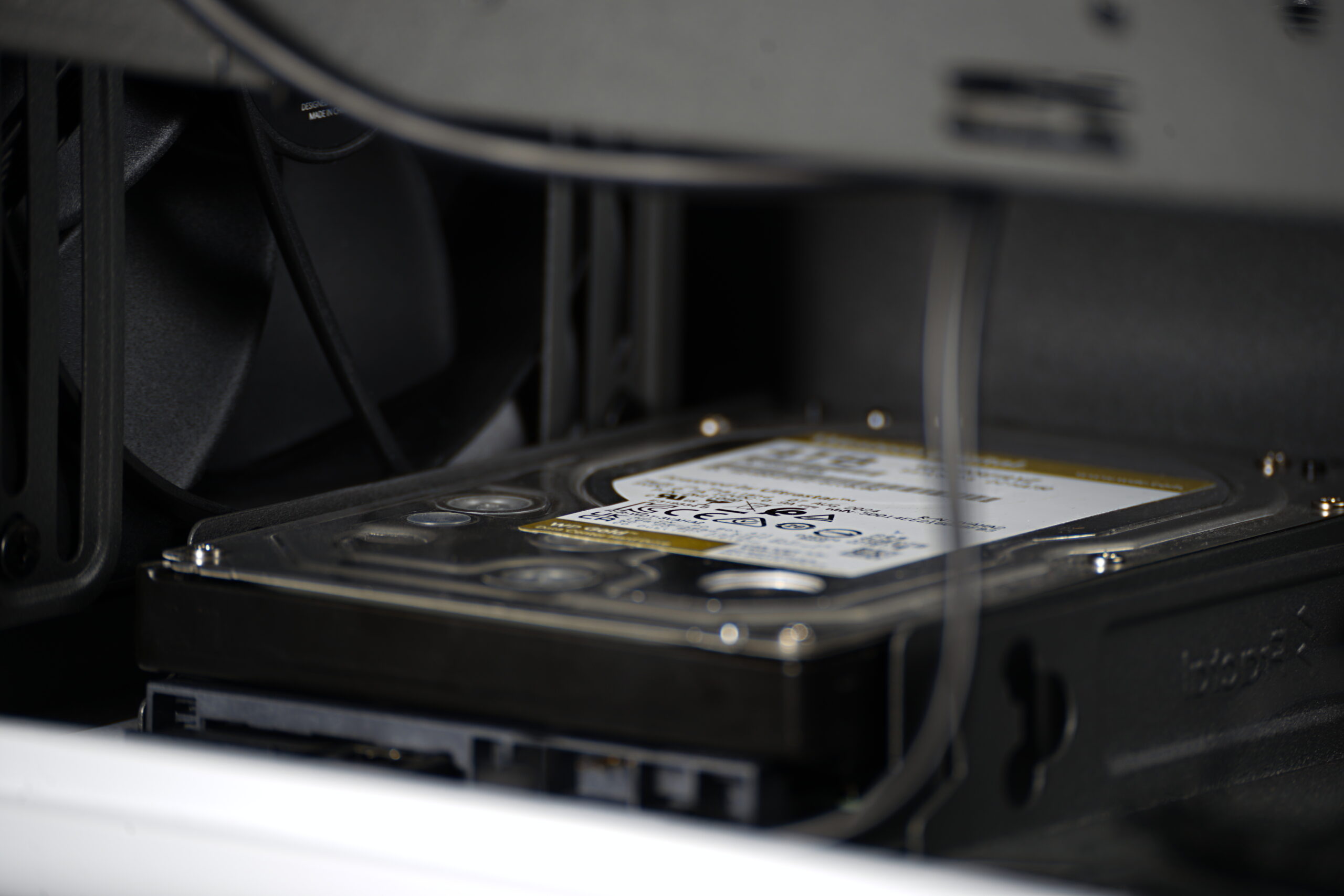
There are two 3.5″ drive trays located behind the front intake fans. This placement optimizes both space near the power supply and cooling efficiency for the HDDs or SSDs. These trays (or sleds, if you prefer) can also hold 2.5″ drives. They can even be used simultaneously with 3.5″ drives, as long as the 3.5″ unit (typically an HDD) is mounted using the upper mounting holes, creating room beneath for a 2.5″ drive (typically an SSD). Additionally, two more 2.5″ drive mounts are located on the rear of the motherboard tray.
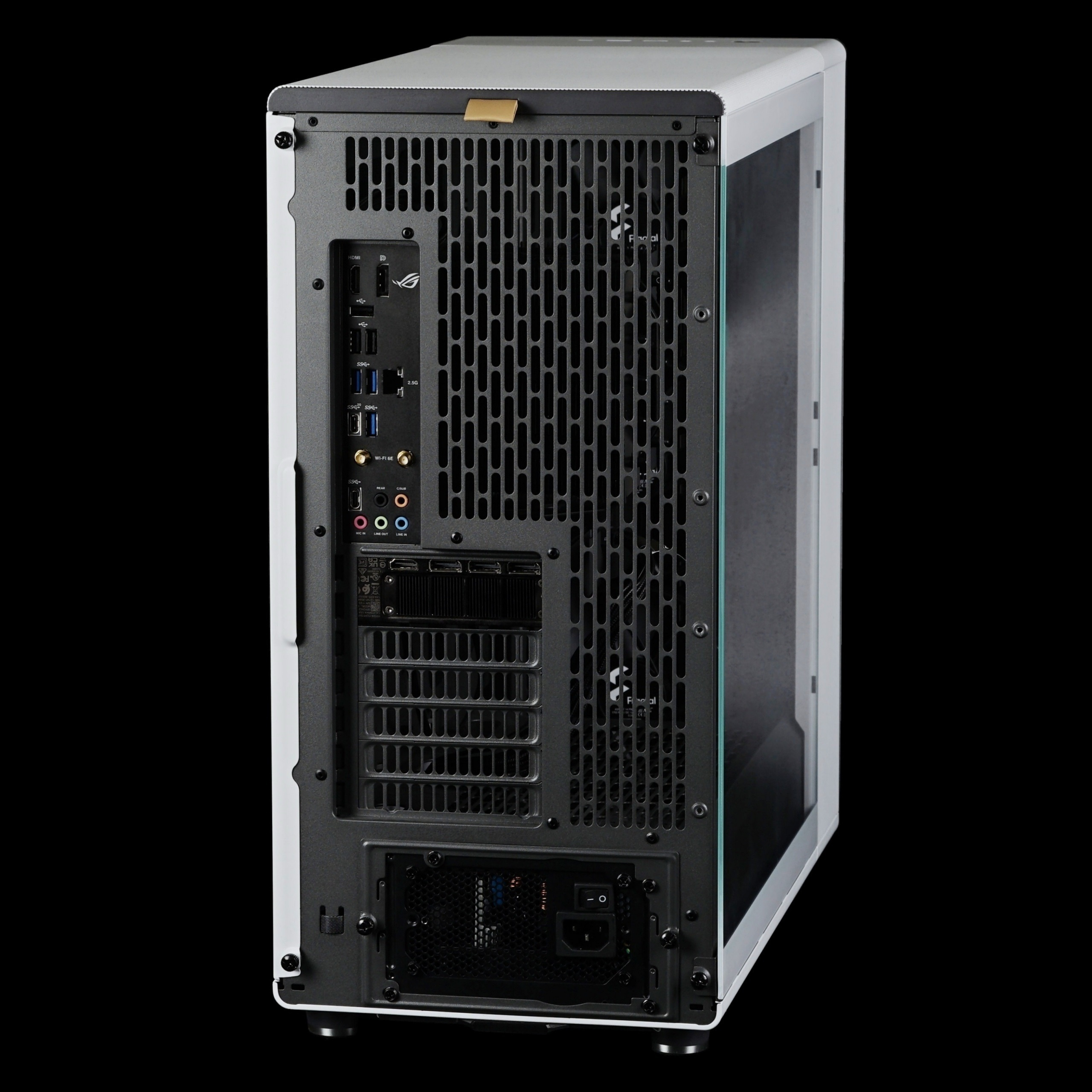
Finally, here’s a rear view of the fully populated Fractal Design North XL. Notice, for example, the power supply. It’s installed using a custom mounting bracket included with the case. In our setup, we also used a second bracket – a reverse adapter from the smaller SFX format to the standard ATX – because our standard testing methodology uses an SFX PSU, which the case doesn’t support natively.
You can look forward to the test results soon. For now, in this first part, we’ve focused solely on the design details and build features of the Fractal Design North XL.


This looks to be a very nice series of PC cases reviews. Do you plan to review the Fractal Design Define 7 PC case as well?
Thank you for your comment regarding the Fractal Design Define 7 case tests. Within our available capacity, we’re generally aiming to ensure test results are as diverse as possible – covering a range of brands and new models. We don’t rule out the possibility of testing the Define 7 at some point, but honestly, it’s not very likely. We’ll see…
Thank you your reply and I’m looking forward to reading the results of your testing of PC cases.
Some cases, as you very well know, have issues with intake turbulence due to obstructions in front of the fan(s) and sometimes a simple modification like adding a fan inlet can help, so perhaps you can test at what inlet depth the noise is reduced significantly? Sometimes a simple modification like that is very useful while not requiring using a dremel potentially reducing the stability of the case, voiding the warranty or just made no difference in the end.
For my own Fractal Design Define 7 I replaced the front fans with Noctua NF-A14x25 G2 but had to add more than the 5 mm Noctua inlet for reduced noise. So I hollowed out the Define 7 140 mm fans I had no use for and used them as fan inlets, with much less noise. Since I already had the Noctua inlets I added them as well, so now I’ve 25+5 mm fan inlet for three fans in the front.
Yes, the farther the front side of the fan is from an obstacle, the smaller the impact that obstacle can have on the overall acoustic characteristics. Your adjustment (with a 5 mm offset for the NF-A14x25 G2 fans) makes sense, and I believe it works very well in the Define 7 case.
To ensure we still have time for other things, we can’t significantly expand our standard testing methodology for cases. Some aspects will likely be tested separately in extra articles, but our standard testing approach for cases will follow what’s described in this article. I’d love to experiment with all kinds of combinations, but it just wouldn’t be manageable timewise.
It already bothers me that so much time has passed since our last fan test. That’s purely because we haven’t been able to get to them due to other priorities – like case testing, for example. It’s just not technically feasible to have such detailed test methodologies for everything. We’d need more people/testers for that – which, unfortunately, we don’t have.