


If you’re looking for illuminated fans without compromises that also deliver high cooling efficiency, the FD Momentum 12 RGB may be the right choice. These fans strike an excellent balance between visual appeal and performance. Their efficient geometry and exceptionally rigid blades are complemented by circular lighting. The Momentum 12 RGB fans are so far the only illuminated fans we’ve given the “Top-notch” award.
Evaluation
Fractal Design has done an exceptional job with the illuminated Momentum 12 (RGB) fans. We’ve previously written about the high aerodynamic and cooling efficiency of this new design, with the Momentum 12 fans. That still holds true—only now, ARGB LEDs are added to the list of features of these fans.
Among RGB-lit fans, the Momentum 12 RGB stands out, as not even in our extensive database are there illuminated fans that consistently rank at the top across different scenarios. RGB fans usually lag behind top-tier non-RGB models, but the Momentum 12 RGB is a clear exception. Its airflow-to-noise ratio is elite, particularly in scenarios that simulate system fan use. In open-air setups, these fans rank in the top five, and in configurations that specifically suppress tonal peaks, they even place second overall—on par with the Noctua NF-A12x25 G2 PWM. That’s clearly an impressive feat.
With dust filters installed, the Momentum 12 RGB fans drop slightly in relative rankings—particularly when using plastic filters—but their performance remains above average and superior to most competing fans with ARGB lighting. The generational leap from the Aspect 12 RGB PWM is often significant—beneficial for any PC case outfitted with Momentum 12 RGB fans. That, undoubtedly, was one of FD’s goals: to build uncompromising case fans. And among illuminated models, Momentum 12 RGB fulfills that brief entirely. Thanks to LCP (Liquid Crystal Polymer) construction, the impeller blades are exceptionally rigid, leading to exceptionally low vibration.
Granted, at the upper end of the speed spectrum, vibration does become significant. But at speeds typical for system fans, vibration is negligible. In other words, once regulated to lower or medium RPMs, the Momentum 12 RGB is highly unlikely to be a source of secondary noise (such as through case resonance). It won’t be. These fans also produce highly attractive results when paired with the hexagonal grill.
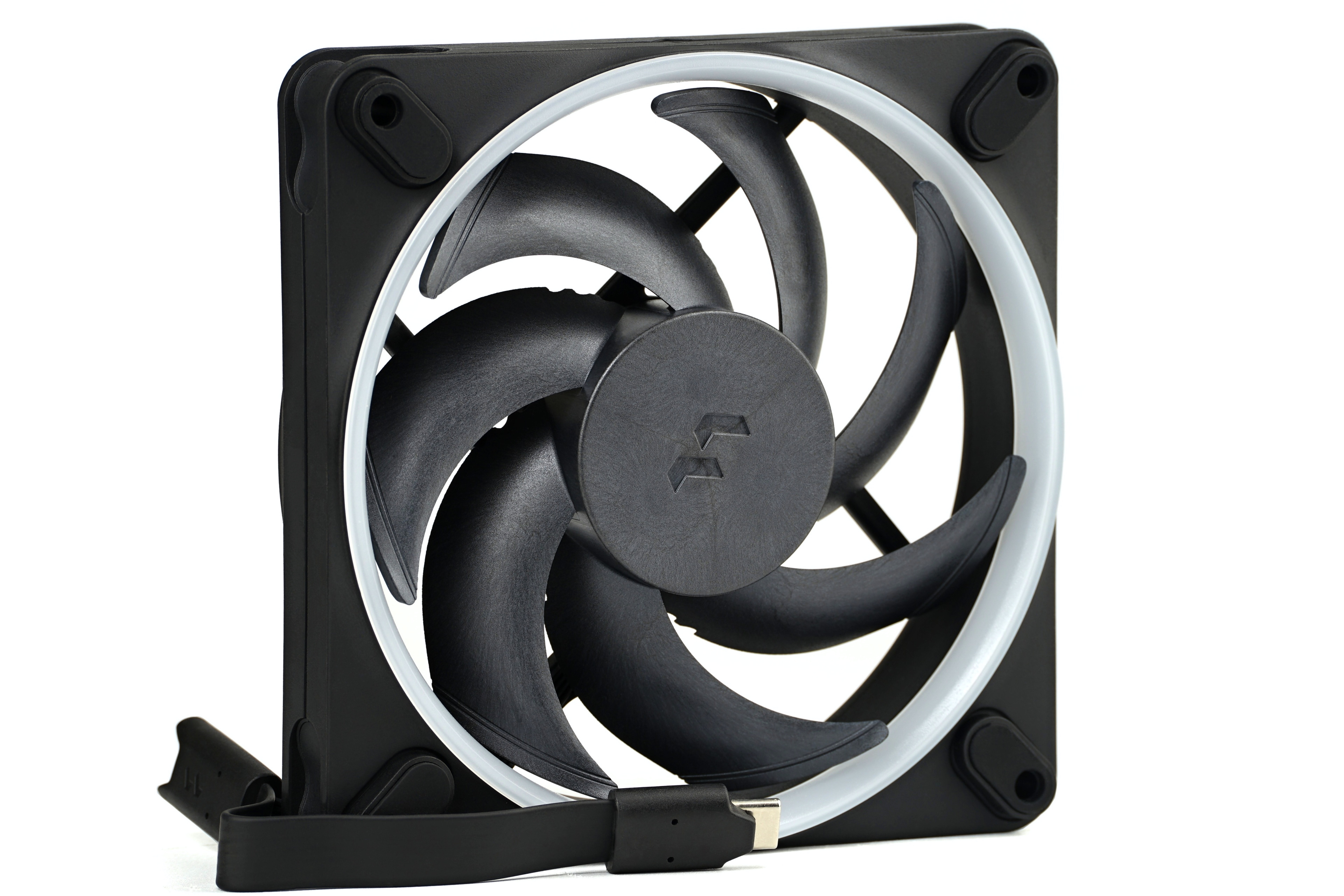
Yes, even in this case (FD Momentum 12 RGB), we must point out somewhat “weaker” performance on radiators. However, it’s important to note that even then, the Momentum 12 RGB outperforms fans like the DeepCool FC120. In fact, it’s difficult to find a more efficient RGB-lit fan for radiator use.
We could bring up BeQuiet! Light Wings, for example, but even those fall short of the Momentum 12 RGB. So yes, these new Fractal Design fans are suitable for radiator duty. As system fans, the Momentum 12 RGB is practically unmatched, and on radiators they’re “only” among the elite. That’s across the board—even compared to non-RGB fans. Among illuminated fans, Fractal Design’s Momentum 12 RGB ranks number one in every usage scenario.
Especially when factoring in the acoustic profile and operating them at medium or lower speeds. Besides a wide RPM range, they also offer low minimum and start-up speeds, and even support semi-passive operation. At low PWM duty cycles, the fan motor stops entirely and the impeller no longer rotates. Simply put, it’s hard to find any valid drawbacks to the FD Momentum 12 RGB fans.
Some users might object to the lower brightness of the lighting, but that’s the trade-off for everything else that’s been praised above. If you’re looking for premium RGB fans with no glaring shortcomings, this is it. And what better time to award a top editorial award to RGB fans than now? The “Top-notch” badge is absolutely well-deserved.
English translation and edit by Jozef Dudáš
| Fractal Design Momentum 12 RGB (Black) |
| + Suitable for every usage |
| + Cooling efficiency (airflow/pressure per unit of noise) at a very high level... |
| + ... especially in environments suited for system fans |
| + High airflow and static pressure, even through restrictive obstacles... |
| + ... overall exceptionally high aerodynamic/cooling efficiency for the standards of illuminated fans |
| + Above-standard efficiency even at lower speeds |
| + High build quality |
| + Wide speed range |
| + Low speeds possible (stable from cca 346 RPM) |
| + Quiet bearing and motor operation |
| + ARGB LED lighting |
| + Exceedingly low, negligible vibrations... |
| - … except at maximum speed, where the vibrations are higher |
| Approximate retail price: 30 EUR |




The RGB variant, despite having a smaller rotor size to work with, outperforms the black variant the vast majority of the time. I suspect the RGB variant was designed first, which is then stretched outwards to form the black variant’s motor… If the 14 cm variants are designed the same way I suspect we’ll see relatively worse results.
Anyway, excellent job from Fractal.
In terms of unobstructed flow, they are similar, but with increasing resistance, the flow of the RGB variant increases. Ľubo and I thought, that the paradoxically shorter blades, which probably lead to higher RPM, probably contribute the most to this behavior. And secondarily, perhaps the less conical inner frame 🙂