


If you’re looking for illuminated fans without compromises that also deliver high cooling efficiency, the FD Momentum 12 RGB may be the right choice. These fans strike an excellent balance between visual appeal and performance. Their efficient geometry and exceptionally rigid blades are complemented by circular lighting. The Momentum 12 RGB fans are so far the only illuminated fans we’ve given the “Top-notch” award.
Everything changes with obstacles
So far, we have described how static pressure and airflow measurements are made under conditions where the fan has no obstacles in its path. In practice, however, fans do not usually blow into an empty space, but have a filter, grille or radiator in front of or behind them, the fins of which need to be pushed through as efficiently as possible.
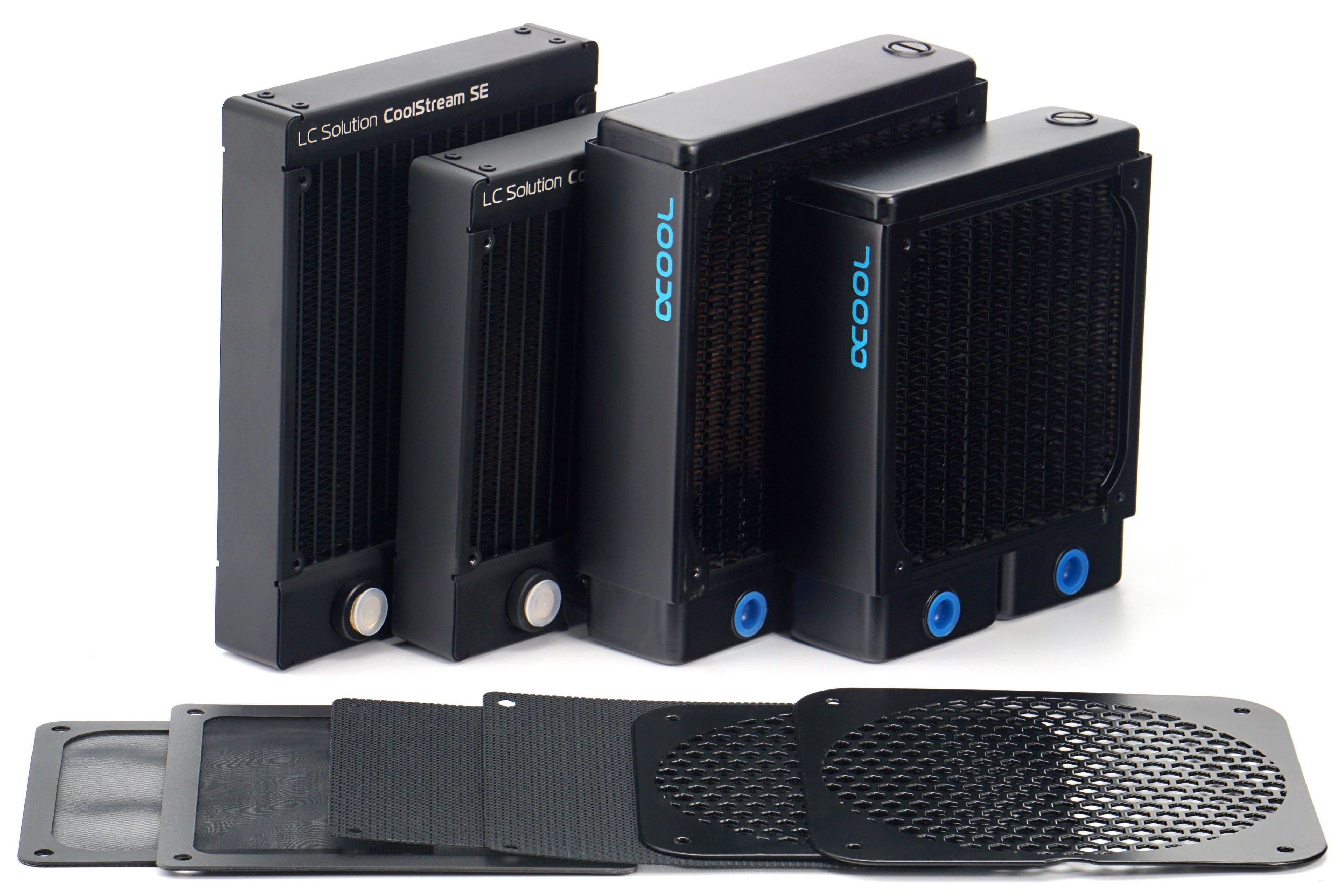
We will also measure both airflow and pressure through practical obstacles for the reasons stated above. These include two types of filters that are usually used in PC cases. One fine – nylon and the other plastic with a thinner mesh. One other obstacle is the hexagonal grille perforated at 50%, on which the vast majority of fans – intake and exhaust – are installed. In some cases, we measure the effect of the obstacles on the results at positions (behind or in front of the impeller) that are used in practice. All obstacles are both pushed through to detect pressure drops, but also pulled through, which in turn speaks to the impact on airflow.

We use two radiators that differ in thickness and fin density. The EK CoolStream SE120/140 is 28 mm thick and the FPI is 22, the Alphacool NexXxoS XT45 v2 is thicker (45 mm) but with less FPI. CoolStream’s fin disposition is also similar in parameters to AIOs. The results on the NexXxoS will again be attractive for those who build their own water cooling loops, where the fans should work well even at low speeds – hence the lower fin density.
These obstacles and especially the radiators, but also the grilles, increase the mechanical resistance in front of the fan, resulting in higher noise levels. However, we will still tune the fan speeds to the specified noise levels of 31 to 45 dBA. Naturally, the speeds will always be lower than when testing without obstacles, but we will maintain the noise levels for clarity. The different noise levels with and without obstacles will only be at maximum power. In this mode it will also be nice to see how the fan design works with the obstacle and in which case the noise level increases more and in which less.




The RGB variant, despite having a smaller rotor size to work with, outperforms the black variant the vast majority of the time. I suspect the RGB variant was designed first, which is then stretched outwards to form the black variant’s motor… If the 14 cm variants are designed the same way I suspect we’ll see relatively worse results.
Anyway, excellent job from Fractal.
In terms of unobstructed flow, they are similar, but with increasing resistance, the flow of the RGB variant increases. Ľubo and I thought, that the paradoxically shorter blades, which probably lead to higher RPM, probably contribute the most to this behavior. And secondarily, perhaps the less conical inner frame 🙂