


If you’re looking for illuminated fans without compromises that also deliver high cooling efficiency, the FD Momentum 12 RGB may be the right choice. These fans strike an excellent balance between visual appeal and performance. Their efficient geometry and exceptionally rigid blades are complemented by circular lighting. The Momentum 12 RGB fans are so far the only illuminated fans we’ve given the “Top-notch” award.
Many illuminated fans share a common drawback that affects their performance: overly flexible blades. Fractal Design mitigates this issue in the new Momentum 12 RGB by using an extremely rigid material for the impeller. It is made from liquid crystal polymer (LCP), which, due to its higher stiffness, suppresses vibrations even on longer blades—resulting in potentially quieter operation of even fans like this one.
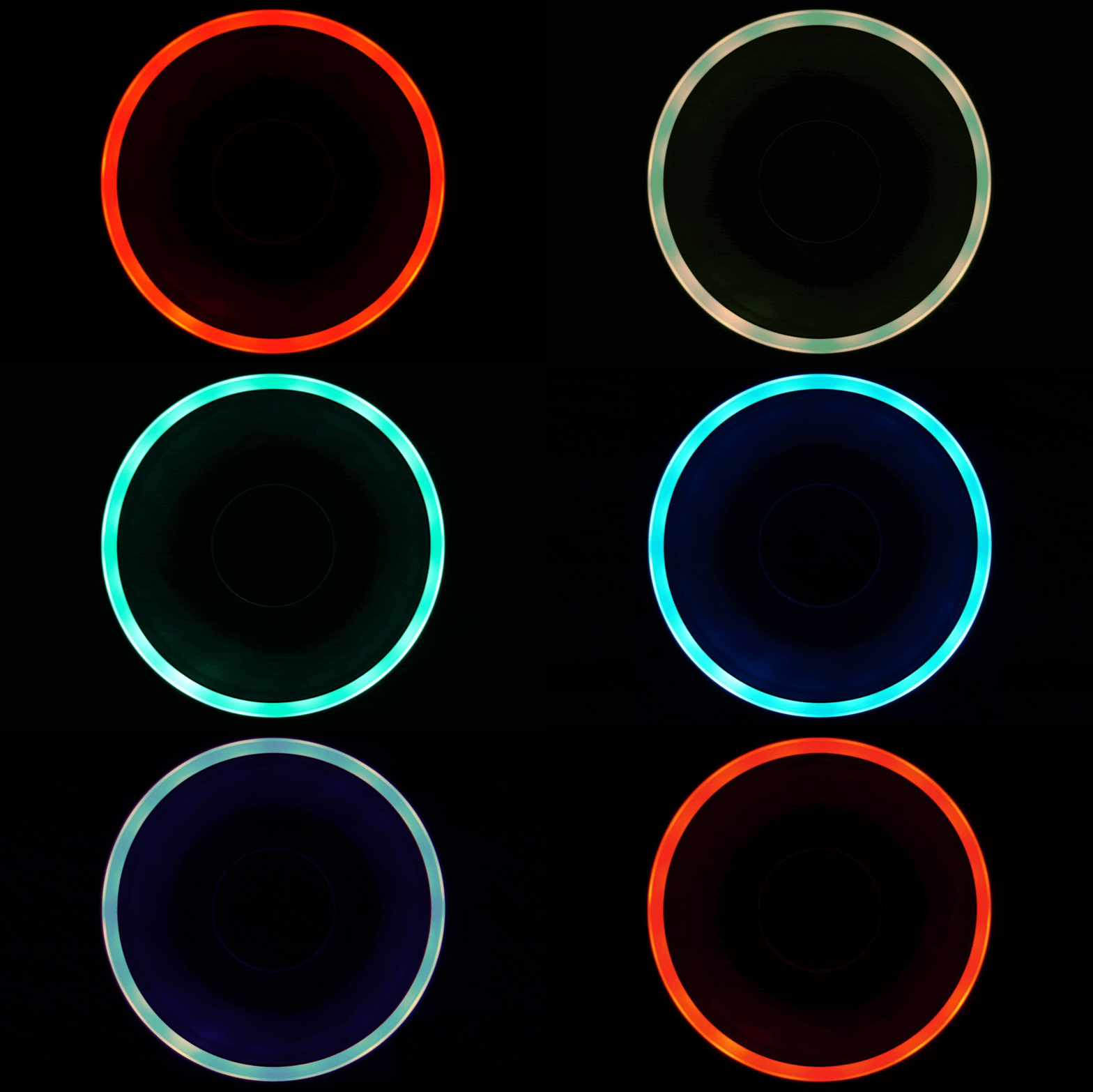
Lower noise levels in acoustically normalized modes also mean higher achievable fan speeds, which in turn increase airflow and available cooling capacity. This accurately describes the Momentum 12 RGB fans, which feature a light ring surrounding the impeller, which itself is dark and has low light-conductive properties. Well-light-conducting materials are usually transparent or light-colored and inherently less rigid than in this case. To maintain structural rigidity, the ARGB lighting is projected onto other parts of the fan instead of the impeller, with the light guide encircling the impeller.
The impeller blades are noticeably curved, a design that our tests have consistently shown to be effective, offering a favorable airflow-to-noise ratio. This is especially true when, as in this case, the blades are exceptionally rigid. This is due not only to their relatively thick profile but also to the use of liquid crystal polymer (LCP), from which the blades—and in fact, the entire impeller—are made.
It’s also worth noting that the blade tips have a slightly raised form—Fractal Design’s take on winglets. Just like with the Momentum 12, there are small notches on the trailing edges of the blades near the impeller hub. These can have a positive impact on acoustics and, in some scenarios (with specific obstacles), may even make the fans theoretically quieter. This is due to the suppression of tonal peaks that might otherwise arise without the notches.

Unlike the non-illuminated Momentum 12 fans, the blades here are slightly shorter (by approximately 1.5 mm), which is why Fractal Design lists slightly lower airflow, static pressure, and noise levels in the specifications. And that’s exactly the case—our measurements confirm that all of these metrics are indeed somewhat lower. The shorter blades are necessary to accommodate the light guide built into the frame. This light guide requires a certain thickness and clearance around the impeller to prevent undesired contact, so trimming the blade length is a natural response to the design constraints of the Momentum 12 RGB. That said, Fractal Design has handled this challenge well, and the differences in blade length across the various Momentum 12 fan variants (illuminated vs. non-illuminated) due to the inclusion of a light guide ring are minimal. They are smaller than what you’ll find in some other fans—consider the BioniX P120 A-RGB versus P12 models, which share the same aerodynamic design but have a more noticeable difference in blade length.

Seven. That’s how many blades the impeller of the Momentum 12 RGB fans has. The spacing between the blades is relatively wide, which suggests “lower” static pressure. However, this doesn’t necessarily make the fan unsuitable for use on more restrictive obstacles. Yes, in zero-flow conditions (extremely high environmental resistance), static pressure is lower—but in real-world scenarios, no obstacle applies such extreme back pressure as in the static pressure testing environment. While the drop in airflow compared to other fans (with higher static pressure) may be more pronounced, it’s nothing drastic—and frankly, we’ve probably delved into this topic more than necessary.


You can also get a general idea of the blade thickness relative to other components (proportionally, for example) from a front view with a close-up from the rear.

In addition to traditional connections, Momentum 12 RGB fans also offer USB-C connectivity. Through this single connector, both the motor and lighting operate. This only applies to the triple-pack, where daisy-chaining is expected—or possibly usage with the new Fractal Design Adjust Pro fan hub, which also features USB-C connectors. However, it’s always possible to use the included adapter (for 4-pin PWM and 3-pin ARGB).
Please note: The article continues in the following chapters.




The RGB variant, despite having a smaller rotor size to work with, outperforms the black variant the vast majority of the time. I suspect the RGB variant was designed first, which is then stretched outwards to form the black variant’s motor… If the 14 cm variants are designed the same way I suspect we’ll see relatively worse results.
Anyway, excellent job from Fractal.
In terms of unobstructed flow, they are similar, but with increasing resistance, the flow of the RGB variant increases. Ľubo and I thought, that the paradoxically shorter blades, which probably lead to higher RPM, probably contribute the most to this behavior. And secondarily, perhaps the less conical inner frame 🙂