





Arctic’s new BioniX fans, which adopt a seven-blade geometry, just like the “base” P1x A-RGB models, are nearing release. Based on the results of the older BioniX “P” fans, it can be assumed that aerodynamic efficiency will be higher this time. Alongside the fans, Arctic is also preparing a fan hub to which they can be connected. The method of daisy-chaining one fan to the next is innovative as well.
The aerodynamic redesign, which increases the number of blades from five to seven, will soon extend to the Arctic BioniX fans as well. In fact, they already exist, although they have not yet been released. They are, however, on their way to consumers. Arctic already showcased these fans at Computex 2026.
To avoid revealing more than is appropriate at this stage, we’ll mention just two things. The first concerns the impeller and the expectation of a noticeable increase in cooling efficiency. More specifically, at a similar noise level (and hopefully with lower tonal peaks at critical speeds—the seven-blade design was ultimately created with that goal in mind), the fans should deliver higher airflow through various types of obstacles. Naturally, that remains to be verified in testing, and we should also receive review samples in the HWC test lab. So whether expectations become reality is something we hope you’ll learn from the front row.

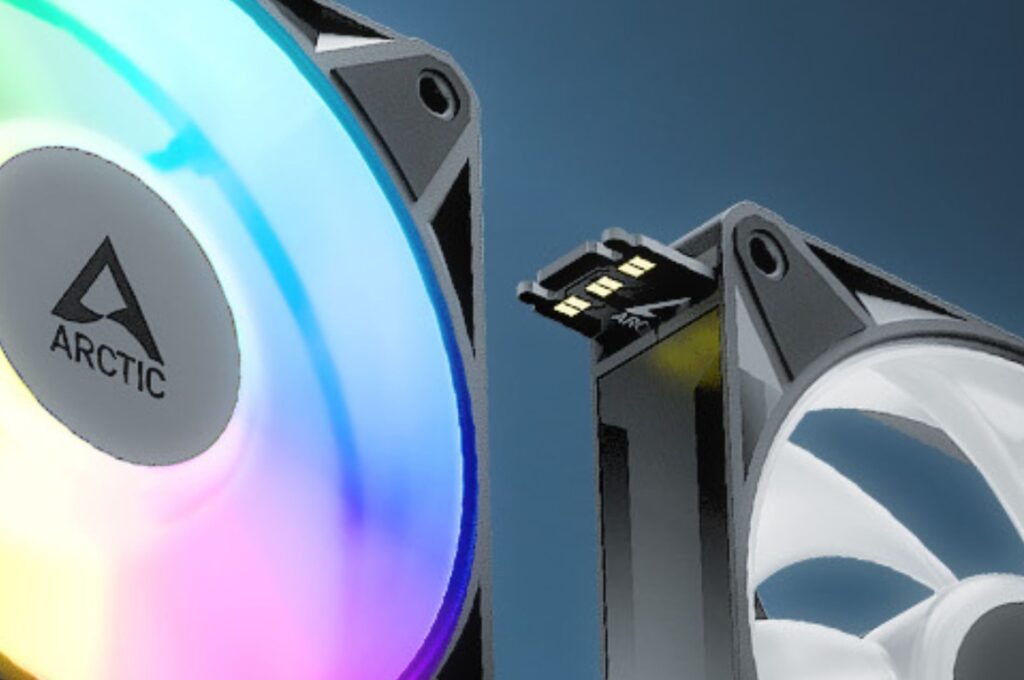
The fans will be available in two sizes (120 mm and 140 mm), with each size offered in two color variants (black and white). In addition to being sold individually, they will also be available in the familiar “value packs” (3-packs) Arctic customers are used to. That brings us to the second point we wanted to mention: a new, more elegant way of mounting multiple fans in sequence. The fan frames are expected to incorporate connectors that make this possible.
Instead of the traditional PST (Power/PWM Sharing Technology) approach, which uses two connectors each for the motor and lighting, Arctic’s new BioniX fans will handle it this way instead. It remains to be seen how this will affect the load per header, as power draw of these fans will likely be higher. This is also due to maximum operating speeds of up to 3,000 RPM for the 120 mm models and 2,500 RPM for the 140 mm models.
Even before the fans are released, you can look forward to a fan hub designed to support up to 10 fans, with 2 A available per connector. That’s all we can share for now, but as soon as we learn anything new, we’ll keep you informed.
English translation and edit by Jozef Dudáš




Will the new seven-blade BioniX fans deliver a measurable improvement in cooling-to-noise performance over the previous five-blade models, or is the redesign mainly about cleaner acoustics?
I think the seven-blade design with a reinforcing ring around the impeller is intended to address some of the acoustic shortcomings of traditional five-blade designs.
As for how these fans will perform in terms of the airflow-to-noise ratio, only proper testing will tell. That said, I’d expect something broadly similar to the P1x Pro A-RGB models, which we’ve already tested. 🙂
Hopefully Arctic won’t shoot me for saying this, haha: Assuming nothing changes, the reviews will be published alongside the launch of the new fans—on August 11. 🙂
Is there anything that comes to mind that we should focus on in the analysis in the first chapter? Would there be anything specific that you’d find interesting for us to look into in more detail? 🙂
Honestly can’t think of anything that won’t be handled in the review
Really looking forward to a review, even if I don’t envision much difference from the regular P12 Pro ARGB. Maybe there is some refinement and hopefully not any regression. I do think Arctic plans to replace the current ARGB P12 Pros with these or keep the regular cable fans as a permanently cheaper option as I’ve noticed a 3 pack is like $20. Been temping on the reduced prices as I do have a build planned with 30+ fans but since the case I want hasn’t been released yet I decided to wait on the new BioniX, would help with clutter and the Arctics just have to be better than the Thermaltake CT120 EX fans I had envisioned in the very beginning.
Already have two of the fan controllers
I think BioniX P12 A-RGB will be more of an alternative (a more expensive one… with more elegant daisy-chaining of multiple fans) to the P12 Pro A-RGB models rather than a replacement for them. I don’t think that will happen, and I expect these fans to coexist. 🙂
I also think the difference in their aerodynamic performance will be minimal, since they use the same aerodynamic design and the changes are in other areas. Well, you’ll see tomorrow… 🙂
The motor . Arctic Pro fans are very excellent , but are failing en masse in my systems .developing strange sounds and losing their touch .This is able to be looked at ?
Hmm, Arctic P Pro fans are still cheaper to manufacture, which means higher tolerances for their individual components. Within our test samples (although we have more units available for evaluation…), we may simply not encounter the most problematic one that ends up on store shelves. If we look at the acoustic spectrum of, for example, the P12 Pro models, there’s not much to suggest that the motor produces any particularly unpleasant noises (although there is a narrow peak around 1.2 kHz, but it is very weak…). How do you know that the noises you’re hearing actually originate from the motor and aren’t caused by its interaction with some obstacle you have in your PC? 🙂
Yes , i am responsible for multiple PCs and almost all of them have had a failing bearing on at least one of the case or radiator fans .They are of high performance , it is difficult to continue using them when i have to replace each one that has problems .systems are tuned onsite to be inaudible , failing bearing , motor , “throws a wrench”
in this balance .
motor is often fine from factory .one out of several -5packs may be malfunctioning but rest normal .months pass and the motor begins creating noise it did not previously on some .so I wish for higher quality fans with the same design .
Thanks for the valuable insights from practical use. Technically more sophisticated fans are usually more expensive in this respect. I’m thinking about which RGB models with comparable aerodynamic properties are only slightly more expensive. Perhaps the DeepCool FT12 V2 ARGB? Well, maybe… I wouldn’t dare say how much better these fans actually are in the aspect we’re discussing. I’m not sure about the BioniX P12 A-RGB either… 🙂