
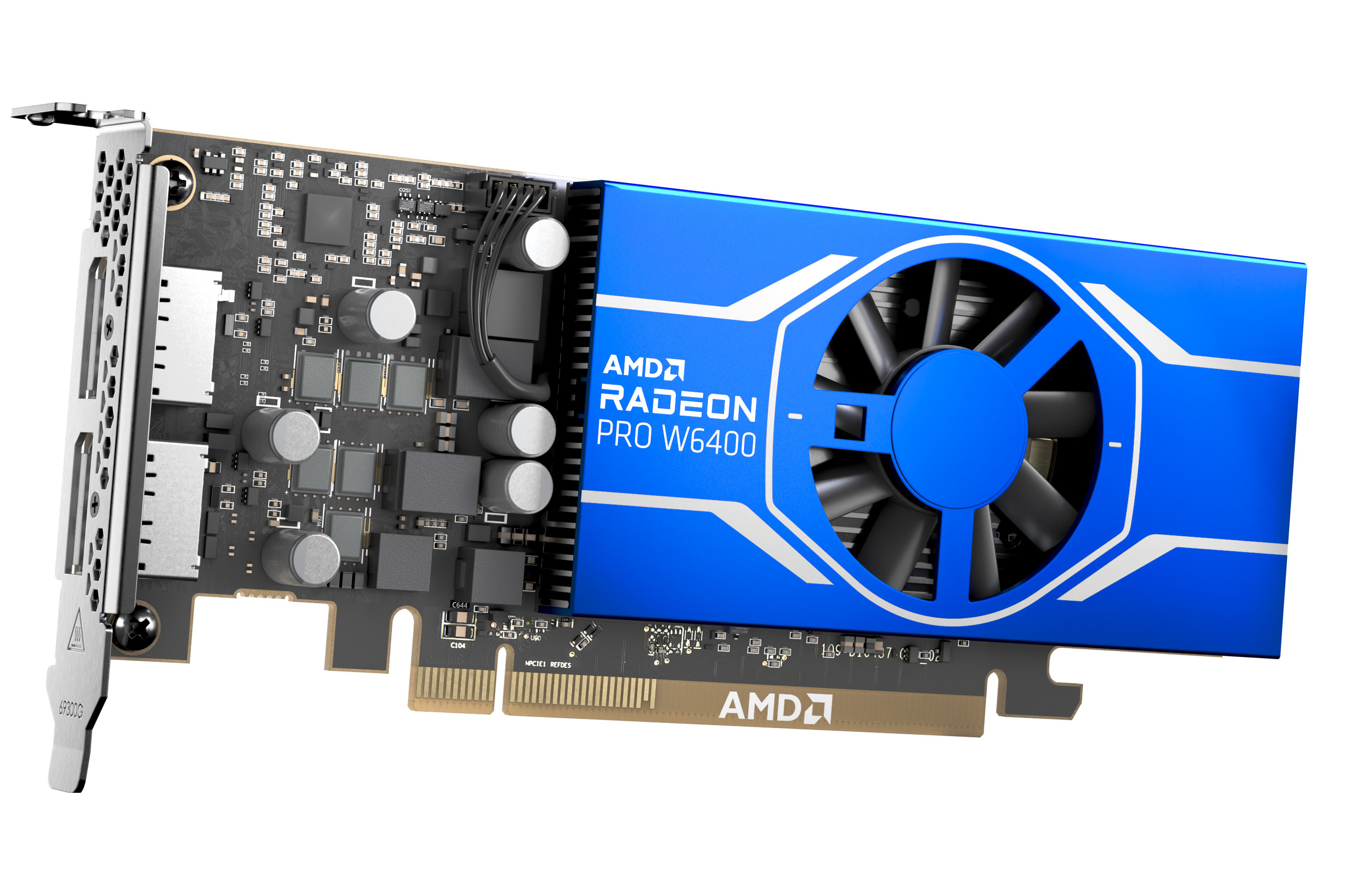
Gamers are likely familiar with so-called coil whine, an unpleasant phenomenon where your graphics card emits tweeting sounds under some loads. It’s especially bothersome with quiet cooling, in which case these sounds—caused by vibrating coils in the VRMs—can get downright grating. OCCT now offers a way to test your graphics card for coil whine, which could be useful when analysing if a PSU replacement might help you, for example.
The OCCT program, used primarily for PC stability verification, has now been released in version 15 (V15). This update includes a revised Adaptive 3D GPU Test, which should have a better ability to uncover errors during GPU stress testing. It also adds storage benchmarking capabilities, and OCCT can now perform stress tests on SSDs and HDDs to verify their reliability under high load.
The most unique new feature in OCCT V15, however, is the newly added Coil Whine Detection function. This test is stated to apply varying loads to the GPU, aiming to reveal whether the hardware has a tendency for coil whine. In the current OCCT V15, you can try three different “tunes” for detecting coil whine. More could be added in the future, and the developers are even considering adding an option for users to define their own.
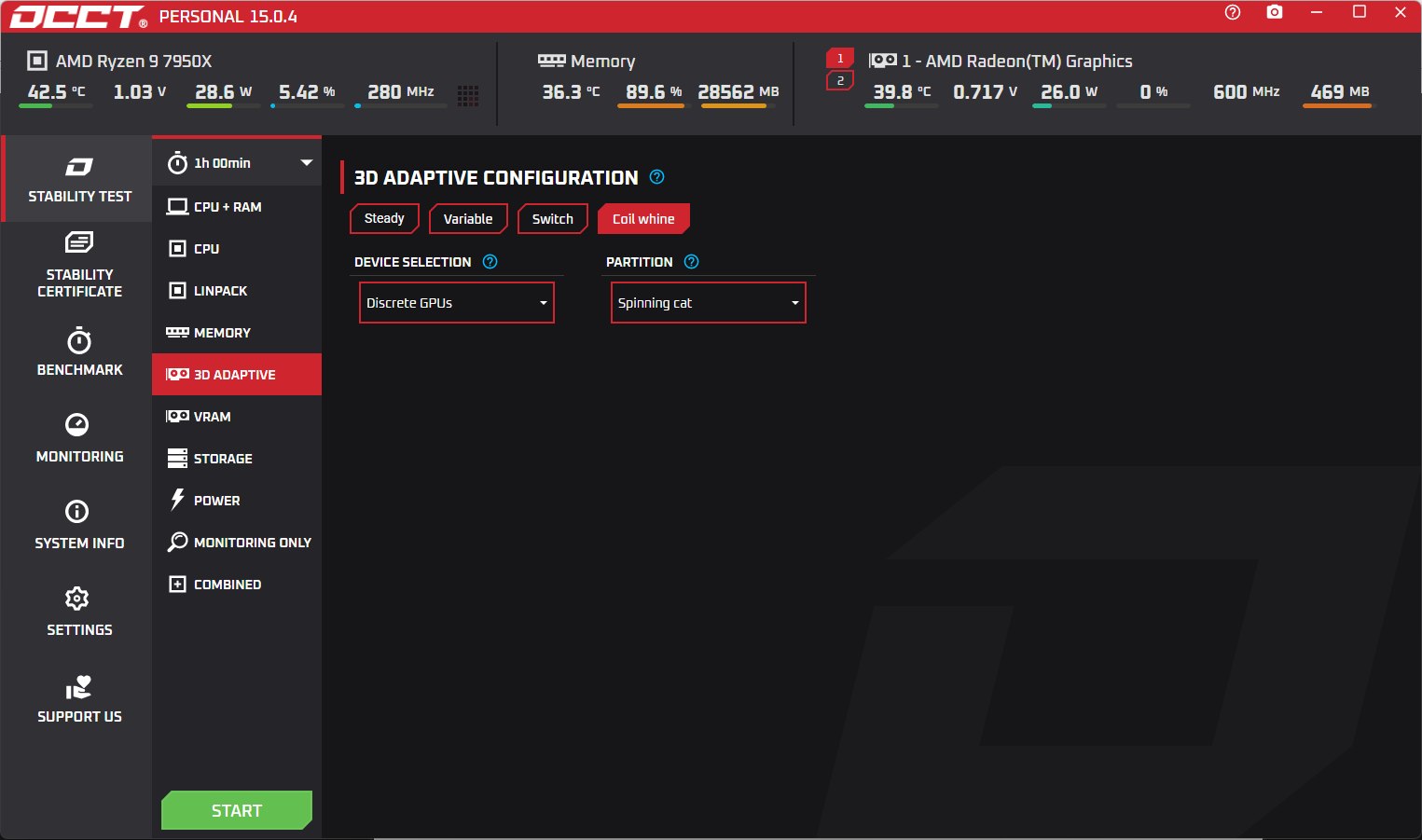
This feature is available in both the professional versions of the tool and the version for home (non-commercial) use, which is free with builds provided for Windows and Linux. You can find the feature among the items in the Stability Test section, though it doesn’t have its own tab yet and is hidden under the “3D Adaptive” test item. There, you can select the “Coil Whine” option and start the test with the Start button.
Should you experiment with the coil whine detection feature, feel free to share your findings in the comments. Personally, I tested a Sapphire Pure Radeon RX 7700 XT card, which based on prior experience doesn’t tend to produce much of coil whine at least in my setup, and OCCT wasn’t able to elicit any audible manifestation from the card using any of the three “tunes.”
It seems, however, that OCCT has been running the coil whine detection tests with full power consumption and GPU load, which might not be ideal for this purpose—coil whine often occurs at lower loads. Therefore, this OCCT feature will probably be most useful for cards and computers with above-average cooling efficiency, which are capable of maintaining full GPU performance without a significant increase in fan speed so that even weak coil whine could be clearly audible.
Sources: VideoCardz, OCCT
English translation and edit by Jozef Dudáš
⠀