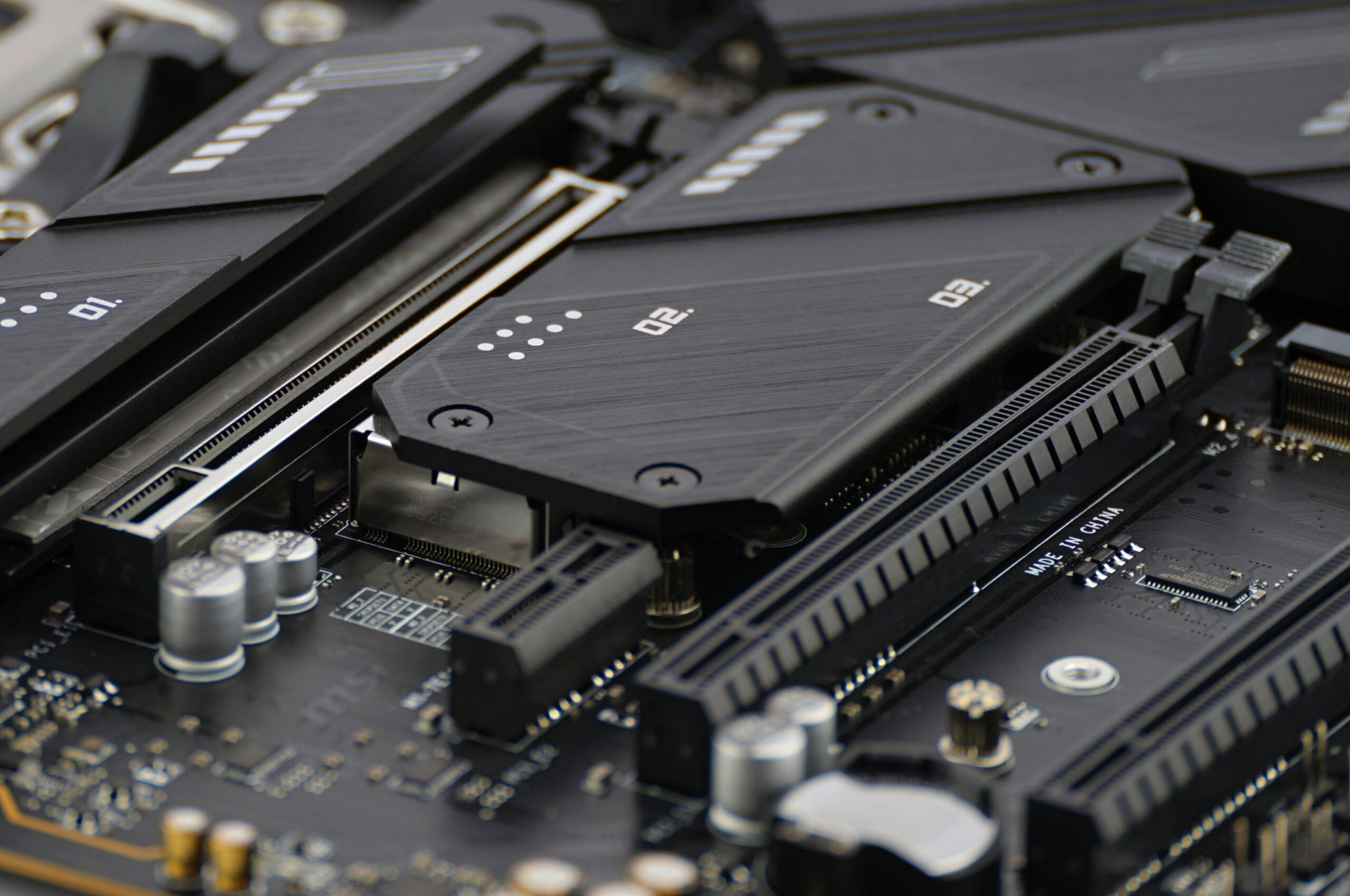
This year is the first time you can actually buy graphics cards using PCI Express 5.0—despite motherboards having support since 2021 for Intel and 2022 for AMD. But the PCI-SIG consortium, creator of the standard, has now officially announced work on PCI Express 8.0, the next stage of this technology, which will be eight times faster than today. Crucially, PCIe 8.0 will still be backward compatible with existing hardware.
PCI Express started more than 20 years ago at in its 1.0/1.1 generation, with speed of 250 MB/s per lane. Each new generation doubled that speed, yet older cards have always remained functional in newer slots, and vice versa—the connection simply operates at the speed supported by the slower side. PCI Express slots thus allow for a very wide range of hardware to be installed. It’s now confirmed this will remain true with PCI Express 8.0. So once again, there will be no break in compatibility—something that has been said to be on the table in the past, for example if electrical signalling was to be replaced with optical communication.
PCI-SIG has now formally announced ongoing work on this standard, which is still far from complete. The previous generation, PCI Express 7.0, has recently been finalized—that announcement came in June. The new PCI Express 8.0 is expected to follow in roughly three years, with specification completion and release planned for 2028.
32 GB/s per lane
PCI Express will increase the bandwidth of a single lane to 32 GB/s in one direction and 32 GB/s in the other, as the interface is duplex (the physical rate will be 256 Gb/s, or GT/s). This means that a PCI Express 8.0 ×16 slot, as used for example by graphics cards, will be able to transfer 512 GB/s in a single direction. PCI-SIG sometimes quotes the interface speed as the total for both directions combined—in that calculation, a PCI Express 8.0 ×16 slot will reach 1 TB/s.
For SSDs using four-lane M.2 slots, the theoretical maximum for read or write speed will already be 128 GB/s. In practice, speeds will be lower due to protocol overhead, but we can expect NVMe modules based on PCIe 8.0 to break the 100 GB/s mark.

A major development goal will be to preserve low latency and high interface reliability. The technology will also aim to reduce power consumption—specifically, the amount of power needed to sustain a given constant speed (for example, using PCIe 8.0 ×8 instead of PCIe 7.0 ×16). That doesn’t mean an interface with the same lane count but double the speed may not consume more power than the slower previous generation.
The press release notes that PCI-SIG will explore the possibility of using new connectors (slots) for PCIe 7.0, meaning the physical design might change. However, as stated before, the aim with PCIe 8.0 is to keep backward compatibility. This could therefore refer to alternative connectors for new use cases, or slot design changes that improve the electrical properties of the connection without preventing installation of older cards.

Practical adoption still far off
While the PCI Express 8.0 specification is set to be completed and released to consortium members in 2028, that doesn’t mean it will see immediate real-world deployment. PCIe has always reached the market with a delay. For instance, PCI Express 5.0 was finalized in 2019, but support in PCs only appeared in 2021 (Intel LGA 1700 platform) and 2022 (AMD AM5). The first PCIe 5.0 SSDs became available only in 2023, and graphics cards from AMD and Nvidia have adopted the technology only this year, rather belatedly.
It’s possible that the arrival of PCI Express 8.0 into consumer PCs and laptop will be delayed even more. In servers, however, the technology might be adopted sooner. For context: makers of SSD controllers expect PCI Express 6.0 (specification finalized in 2021) to reach consumer SSDs only around 2030, while in enterprise SSDs it should work as soon as next year.
If we add six years to that (three years for each new generation), servers could start using PCIe 8.0 around 2032, with personal computers following in about 2036. Of course, adoption might speed up somewhat if CPU and SSD manufacturers push harder for these ultra-fast (and therefore premium, i.e. high-margin) technologies in the PC market.
Source: PCI-SIG
English translation and edit by Jozef Dudáš
⠀