


One of the advantages of AMD CPUs for the AM5 socket compared to the AM4 platform is that even the higher‑end chiplet models include an integrated GPU located in the IO chiplet. Thanks to this, these processors can be used in office PCs (or workstations that don’t require high GPU performance) without the needing a discrete graphics card. But the new generation with Zen 6 cores may lose this advantage, likely due to the AI hype.
Reports have now surfaced online claiming that AMD was apparently not satisfied with the current setup and that the new generation of processors with Zen 6 cores will no longer include an integrated GPU. This generation is supposed to use a new IO die, which should improve memory performance (for example, enabling higher transfer speeds than what Ryzen 7000 and 9000 can achieve). But AMD has allegedly removed the integrated GPU from this very chiplet.
This week, the news appeared on hardware sites after a user going by the nickname Gotou_3rd posted it on the former Twitter. However, the original source seems to be forum members on AnandTech (where the information appeared first). They sometimes have real insider knowledge, but sometimes they are only speculating. So it’s unclear whether the rumor is credible, but at the same time we still have no evidence that the iGPU will remain in the next-gen IO die—and Murphy’s law says that when a rumor is of pessimistic nature, it’s more likely to be confirmed.
The integrated GPU in the IO chiplet doesn’t have sufficient performance for any games except the simplest and very old ones (it contains only a minimal number of compute units), yet it still occupies a significant amount of die area—along with the video decoding and encoding engines. These may also require licensing fees for certain formats (H.264, H.265). The reasons for removing it would therefore be economic—reducing manufacturing costs. For desktop PCs based on these processors, gaming PCs are owerwhelmingly dominant percentage of the market and such PCs always include a discrete GPU, making the integrated GPU something that’s seldom actually used. It still does open an interesting possibility of suing laptop-style hybrid graphics switching on desktops, where you save power (and reduce heat and noise) by using the integrated GPU most of the time, powering the discrete GPU up only for games. But it’s something few gamers take advantage of.
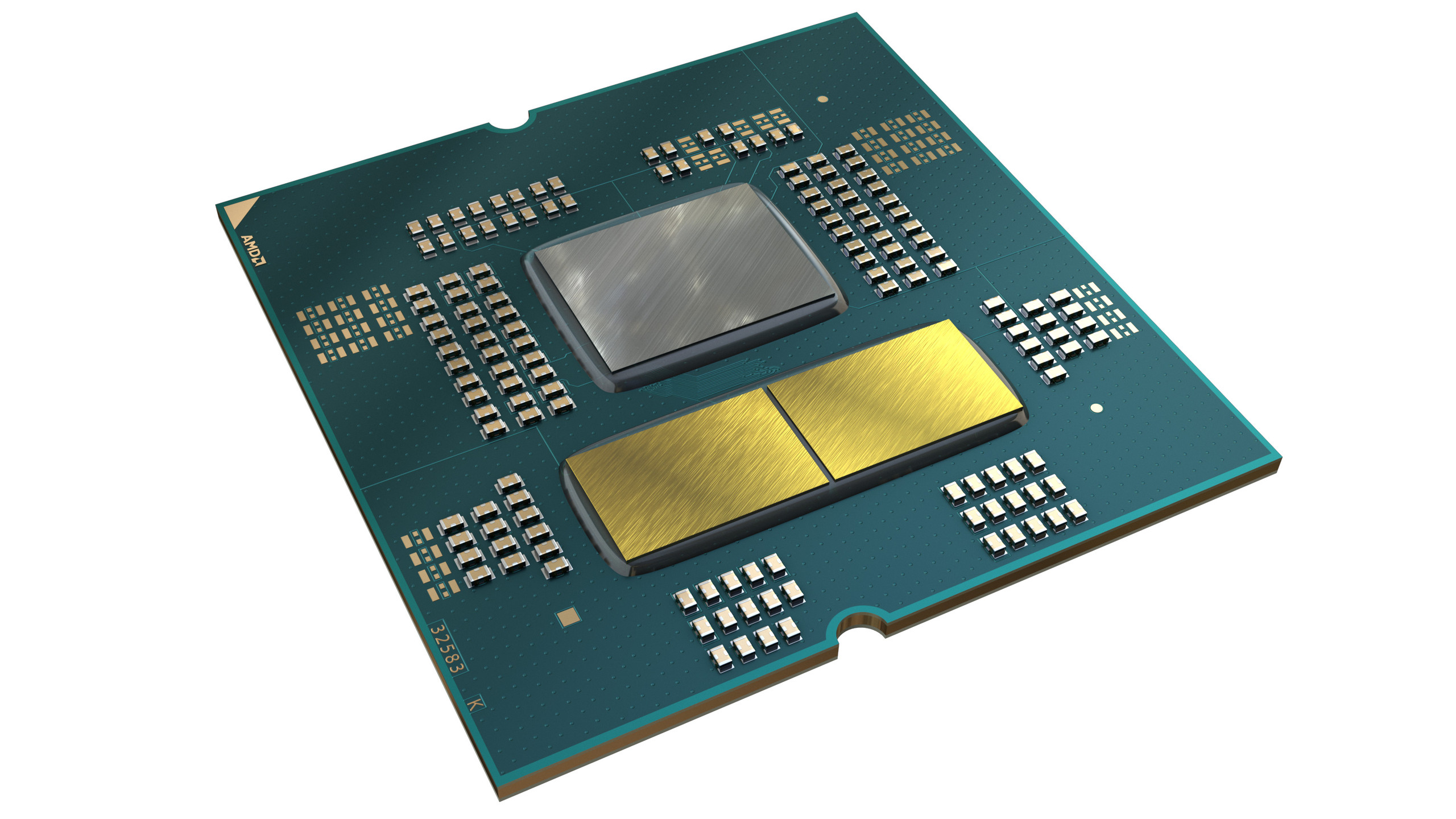
Besides general cost reduction, the integrated GPU may also have fallen victim to the AI craze—specifically Microsoft’s push for so‑called Copilot+ PCs using an NPU in the processor. High‑performance desktop Ryzen CPUs were not compatible with Copilot+ PCs so far because they lack an NPU. But the new generation with Zen 6 cores reportedly adds an NPU to the IO chiplet. However, an NPU also consumes a considerable amount of die area, and AMD may have had to choose what to remove from the IO chiplet to prevent its size from growing too much.
GPUs Only in APU Processors?
Within the Zen 6 lineup, an integrated graphics adapter for connecting a monitor without a discrete card would therefore be something available just to the APU line of processors such as the Zen 5‑based Ryzen AI 300 and 400 “Strix Point” and “Hawk Point” chips—meaning models primarily targeted at laptops and only secondarily offered for desktop PCs. The downside is that APUs are often significantly more expensive, and AMD typically releases desktop models only with a long delay after the launch of the laptop parts—desktop APUs based on Zen 5 may eventually take nearly two years before they appear on socket AM5. And APUs also tend to have worse CPU gaming performance (which becomes apparent when paired with a discrete GPU), as they receive smaller L3 cache. They also usually do not support the faster versions of the PCI Express interface.
The following desktop generation with Zen 7 architecture, which will likely launch in 2028, will probably use the same IO chiplet as the Zen 6 generation, because AMD has so far followed this approach to simplify and reduce development costs. It is therefore possible that this policy—where integrated GPUs are available only in special APUs—will persist until the end of the AM5 socket’s lifespan.
Sources: Gotou_3rd, AnandTech Forum (1, 2)
English translation and edit by Jozef Dudáš
⠀




if zen6 lacks dGPU I won’t buy zen5 but will stay on zen4 instead, 7950X is still powerful
sure, increased number of cores in zen6 would be a great upgrade but if they don’t want to sell it I won’t buy it, that’s simple
I assume you mean an iGPU? A dGPU—if by ‘d’ we mean discrete—will certainly be supported by AMD Zen 6 processors as well. 🙂
yeah, my bad 🙃
I never understood why HEDT/WS platforms had no iGPU of any form, even if the CPU package was too packed the extensive size of EATX mobos could house one easily without forcing you to either buy a cheap outdated one or splurge on something modern
when you need solely CPU and video output you’re pretty much out of luck
Halo would be great, but it needs a way to mount an aftermarket cooler, it may be WS one if the size forces that, but really the ability to mount something decent is required to make something nice from it
The question of why HEDT processors don’t have an iGPU is certainly an interesting topic for discussion. If the priority in workstations is CPU performance, then only a basic display output is really needed. But if hardware acceleration and higher graphics performance are expected, then using a discrete graphics card could be justified—whether it’s a professional card (FirePro, Quadro) or a gaming one (GeForce, Radeon). That’s probably not the actual reason, but it was a thought that came to mind. 🙂
I’d argue decent GPU based workstations could be based on the higher end consumer platform mobos in the past, some form of iGP or at least modern enough display adapter should exist, I’m positively surprised how much 2CU in 7950X can handle, and it’s a dated architecture already
there was a short period of time when Intel was a reasonable option as a cheap modern display adapter, but that time passed
WS and server may share DNA quite a lot, but have different failure modes, debugging options and such, when server can be managed over the network or serial console WS with issues may be booted with a basic display adapter… if you have one, to eliminate issues with the more powerful GPU, power delivery to said GPU, slot contact and so on
and on desktop I’d argue we need even more powerful iGP, some casual gaming (the style of mobile APU) should be possible on the universal machine built with CPU workloads in mind
I honestly prefer no iGPU, TPU, NPU for ATX desktop machines, would rather have all the area of the processor used for just CPU. SFF and laptops I get the appeal.
Yes, it depends on individual preferences and what the computer is used for.
Personally, I tend to lean toward SFF systems, but specifically those with a replaceable processor and the option to install a custom cooler. The ASRock DeskMini systems are quite nice builds. 🙂