


A simple, yet “effective” case. That’s one way you could title an article analyzing the BeQuiet! Pure Base 501 Airflow (BG074). The test model features solid metal panels on both sides – non-transparent – each lined with sound-dampening material. Foam. In short, you’re dealing with a design rooted in the old school, something increasingly rare these days. Despite that, the purchase price of this case remains relatively low, close to the ground.
Conclusion
The case performed very well in our tests. Granted, at a price of around 95 EUR, it’s not exactly a budget model. However, the Pure Base 501 Airflow is still among the more affordable cases that deliver this level of intense cooling. Two efficient fans combined with a highly breathable front panel make it suitable for even higher-end components. It’s not just about what fits – it’s also about how quietly something like a GPU can run. That depends heavily on the efficiency of case airflow, and our results suggest that the Pure Base 501 Airflow performs on par with much more expensive models. Models that already have a good reputation (stay tuned as we continue adding more cases and configurations to confirm this further).
Despite not being particularly large, the Pure Base 501 Airflow is an average-sized mid-tower that can still accommodate truly powerful components and allow them to operate more quietly. This includes large graphics cards and high-performance CPU coolers – even tall dual-tower designs or a 360 mm AIO. All of this is possible while still being considered a mid-size, reasonably priced case.
The Pure Base 501 Airflow also has advantages over similarly priced or cheaper models in areas like sound damping on both side panels (which also helps reduce HDD noise) and its overall sturdy construction. Of course, we’re still talking about a lower-range product, but BeQuiet! avoids using thin, flimsy steel panels that flex easily. The Pure Base 501 Airflow maintains a higher standard of build quality than what is usually found in the low-end segment.
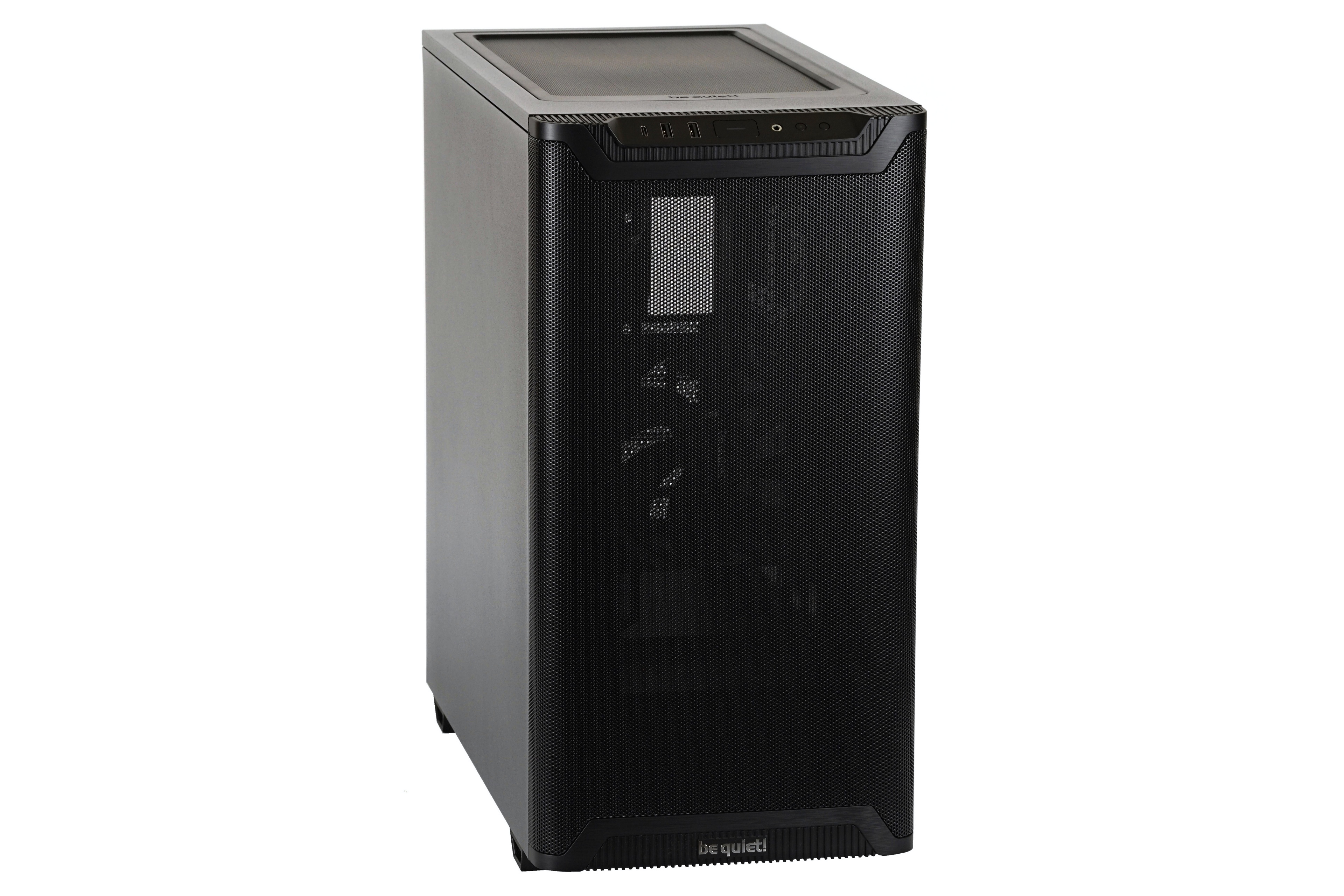
If we had to point out any drawbacks with the Pure Base 501, similar to the DX variant, we’d mention the lack of rubber grommets on cable pass-throughs and the absence of a fan hub. It would certainly be a welcome inclusion, but it might also affect the price – and with just two fans, connecting them directly to the motherboard is relatively straightforward.
Modern motherboards typically include more than two system fan headers, so a hub isn’t strictly necessary. Still, a simple one could have been included. But again, it depends on what that would do to the pricing. And considering what the Pure Base 501 Airflow offers, we think the price is well set. For budget-conscious builds with a goal of staying understated and quiet, it’s a solid choice. A “Smart Buy”? We think so.
English translation and edit by Jozef Dudáš
| BeQuiet! Pure Base 501 Airflow (Black) |
| + Medium-sized, space-saving dimensions... |
| + ... yet supports liquid coolers up to 360 mm... |
| + ... and fits CPU coolers up to 175 mm in height |
| + Support for large graphics cards |
| + Two efficient fans included as standard |
| + Wide fan speed range... |
| + ... can be optimized for ultra-quiet operation or high performance |
| + Easy installation of all components |
| + Attractive price given the features |
| - Cable cutouts are not rubberized |
| - No included fan hub |
| Approximate retail price: 95 EUR |




Hello. I red this review and I want to buy this case, but I’m worried that the Pure Wing 3 fan is approved but not top-notch.
So, which fan is good upgrade?
Reasonable options in my country are Momentum 14, Arctic P14 Pro, P14 Max or NF-A14x25 G2.
the CPU and the GPU of my PC will be 265k with air cooler and 5070 Ti.
What exactly are you expecting from a fan? The Pure Wings 3 is aerodynamically excellent, and personally, I would not replace these fans. Of course, the FD Momentum 14 and Noctua NF-A14x25 G2 are more advanced in terms of technical sophistication—but primarily in other areas, not necessarily in aerodynamic design. You can swap out the original PW3 fans, but you likely won’t see much of a gain in cooling efficiency. That said, you might end up happier with the acoustic profile. I can’t say for sure—that’s something very individual. 🙂
Thank you for your reply.
I would like to make my PC more quiet, but surely as you say, that’s individual thing…
I will try listening to the noise of some fans and I will install fans of which I prefer.
Analyzing sound based on analog recordings is highly debatable. Distortions already occur at the level of speakers. That’s exactly why we don’t include audio recordings in our tests and instead provide spectrograms, which everyone can read the same way. In other words, they show the noise levels at specific frequencies. Naturally, they’re more complex to read and interpret, but once you know how to work with them, they are much more accurate than subjective listening. 🙂
… but, maybe he meant listening live … and not from recordings on the internet 🙂
… and the recording, although distorted, still gives some idea of the pitch of the dominant tone 😛
I have this case. I installed the included fans + 1 third all as top and rear exhaust and reduced the rpm by about 40% via a Noctua NA-FC1 (to not reduce the pressure from the intake fans too much). For the front I installed 3 120mm Shadow Wings 2, also limited a little via Noctua ULN adapter cables. So even at full blast the PC remains quite quiet and is otherwise near silent.
Thanks for sharing your user experience. Yes, having the system fans run at lower airflow rates is often sufficient—it won’t limit the cooling. You’ve got your setup figured out well. It’s quiet, and that was the goal. 🙂