


A simple, yet “effective” case. That’s one way you could title an article analyzing the BeQuiet! Pure Base 501 Airflow (BG074). The test model features solid metal panels on both sides – non-transparent – each lined with sound-dampening material. Foam. In short, you’re dealing with a design rooted in the old school, something increasingly rare these days. Despite that, the purchase price of this case remains relatively low, close to the ground.
… and internal details of the BeQuiet! Pure Base 501 Airflow
You can begin disassembling the case by removing the side panels. These are secured with tabs that slot into the chassis. Some users prefer this method, others favor mounting via troughs at the bottom. In the Pure Base 501 Airflow, the side panels use the tab system to engage with the opposite side (the case frame), followed by a final securing step – fastening with screws from the rear. Notably, these are thumb screws, allowing for easy hand tightening.
Both side panels are lined with material that somewhat absorbs internal noise and also adds rigidity. The panels themselves are around 0.8 mm thick and reinforced with edge creases, while the foam adhered to them is roughly 3 mm thick.
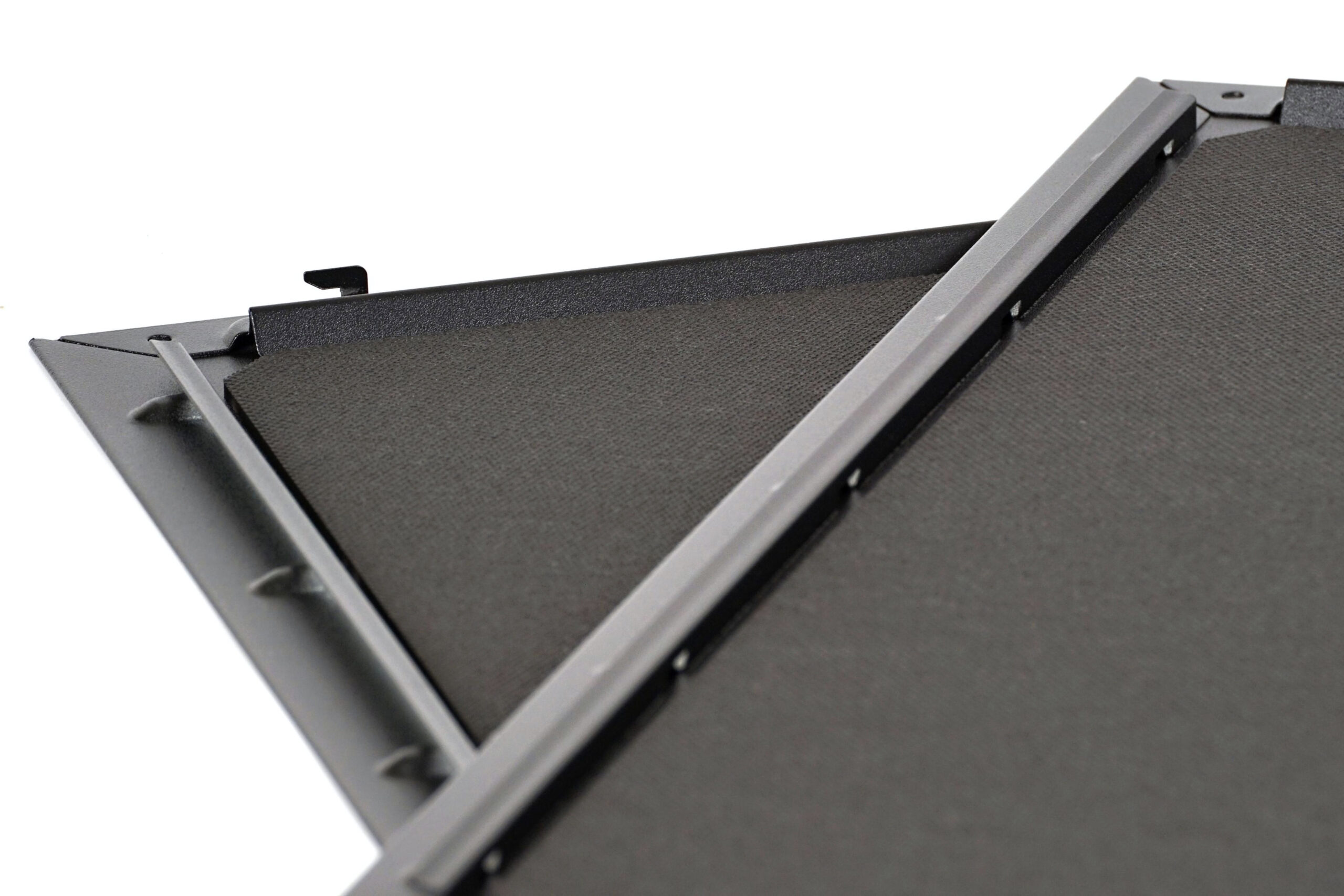
The top of the case also features a removable component – a perforated grille (structurally similar to the front panel’s perforation), which helps prevent dust ingress from above. This is especially useful when the PC is off or doesn’t feature a top-mounted liquid cooling radiator with exhaust-oriented fans. In such cases, the grille helps retain cleanliness.
If you prefer not to use the top grille, it can be easily removed. It attaches magnetically to the case frame and is recessed deeply enough that it won’t fall out during routine transport. This was an issue with early case models that introduced top filters, but not with the Pure Base 501 Airflow. The top grille stays firmly in place and won’t shake loose by accident.

The internal layout of the case is fairly traditional, consistent with current standards. The interior is divided into two sections – one accessible from the front and the other from the rear. The front section houses the motherboard and its front-connected components. Supported motherboards include ATX, and the standoffs are pre-installed also for smaller formats like Micro ATX and Mini-ITX.

At the front intake is a 140 mm Pure Wings 3 fan (a decent performer). It sits roughly 20 mm away from the mesh panel – a sufficient distance to prevent the mesh from increasing acoustic noise by resonating at specific frequencies. This spacing also slightly restricts airflow, due to the semi-closed mesh design, though it’s still more breathable than non-perforated or side-perforated front panels.
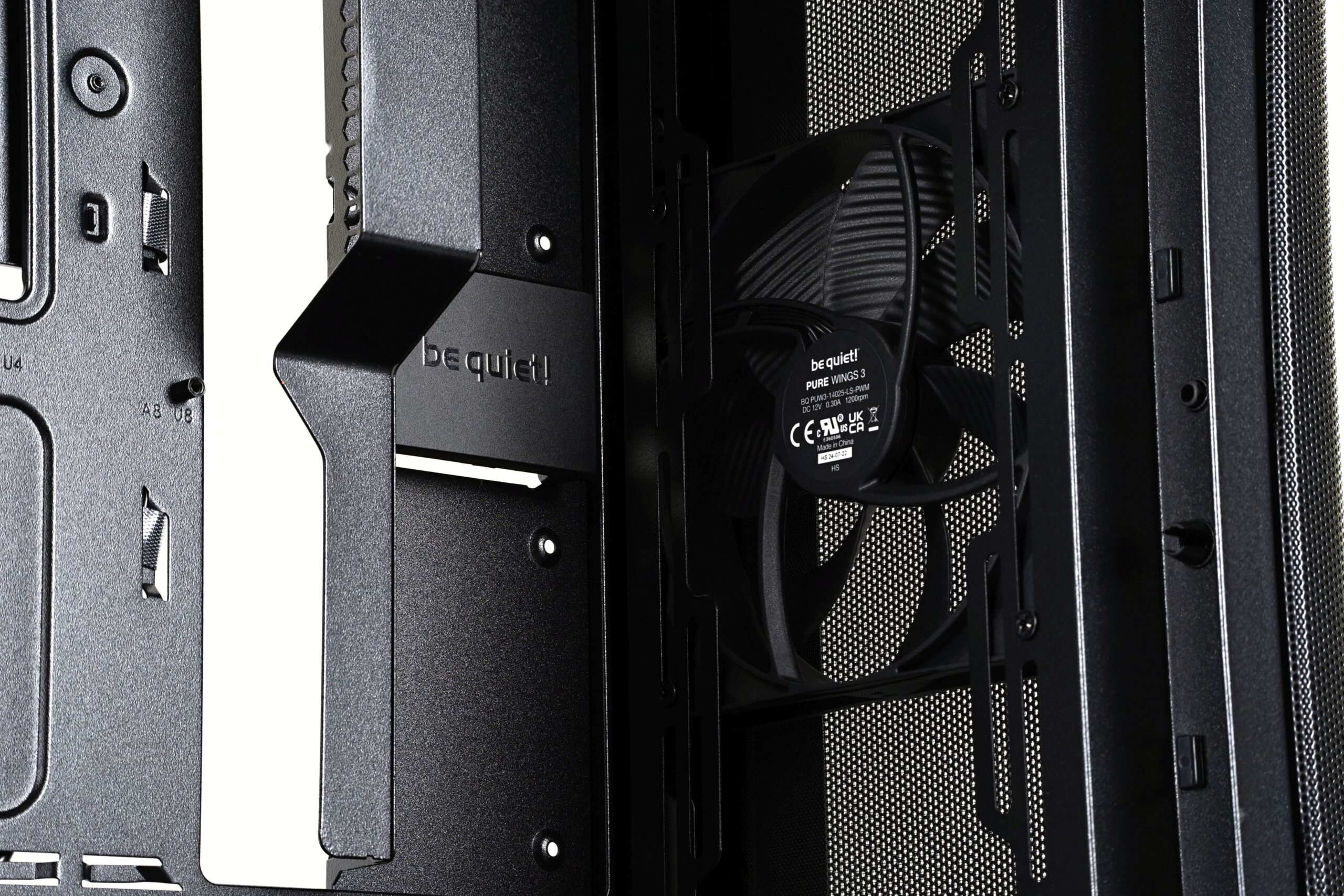
A second 140 mm Pure Wings 3 fan is pre-installed at the rear as an exhaust. It spins at up to 1200 RPM (matching the BL108 retail model). These are the only two fans included. The “Airflow” variant has one less fan than the “DX” (which includes a top-mounted fan), leading to a “1+1” configuration: one intake, one exhaust.
With balanced PWM signals, the airflow will also be balanced – no negative or positive pressure dominance. Of course, this can vary depending on the rest of the system components. CPU coolers, especially liquid ones (e.g., installed in the top), can significantly influence internal airflow as their fans double as system fans.
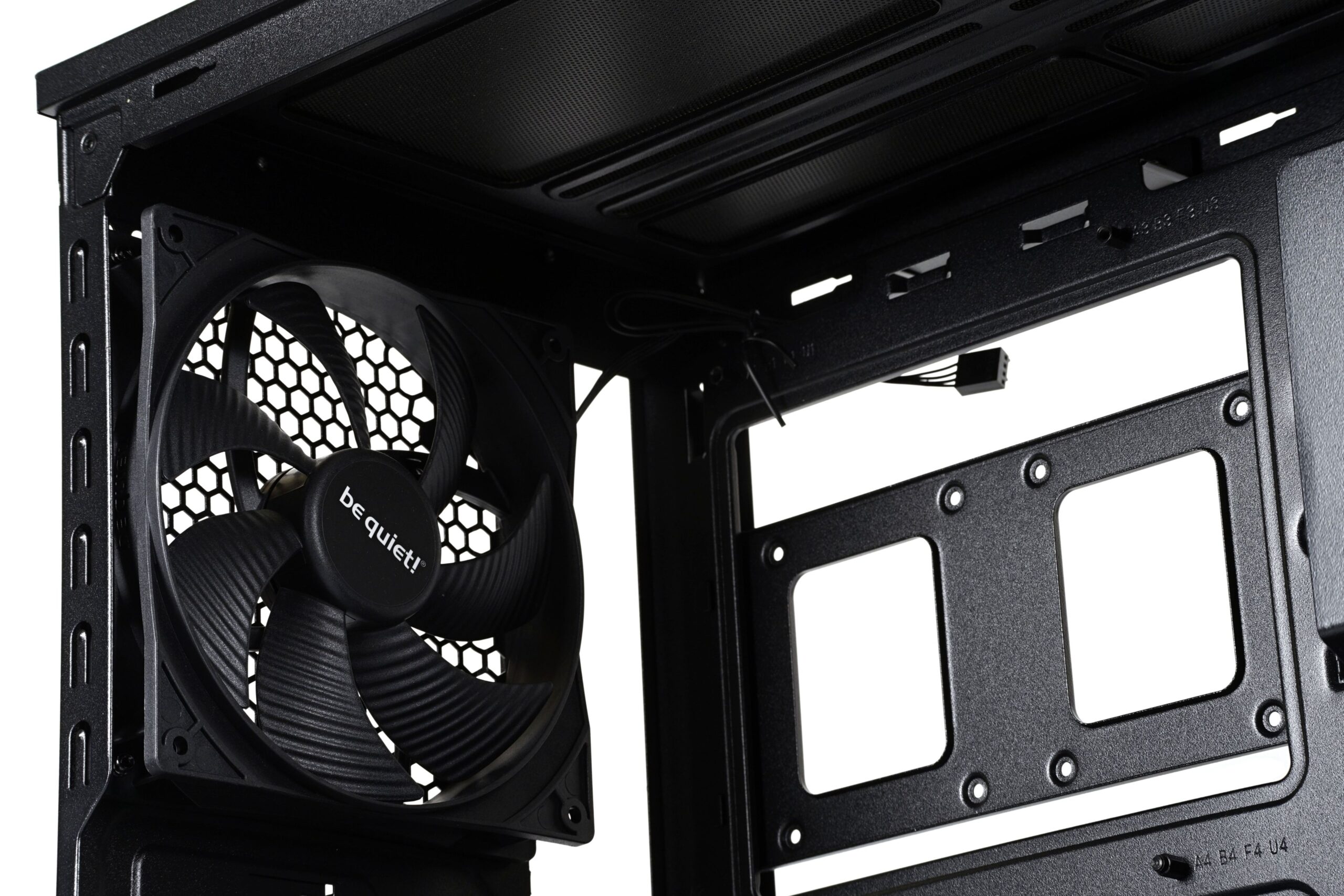

Fan speed is also affected by the resistance of a fan’s obstacle. The front fan faces a finely perforated metal mesh and benefits from a larger gap, while the rear fan is mounted flush against a hexagonal mesh. However, being an exhaust, this setup has a lower impact on noise than if the grille was at the intake side.
There’s no fan hub included in the case, and the rear section’s most useful feature is its Velcro straps, which help with cable management. Additional cables can also be organized using zip ties, which can be anchored to the metal loops integrated into the case.





Hello. I red this review and I want to buy this case, but I’m worried that the Pure Wing 3 fan is approved but not top-notch.
So, which fan is good upgrade?
Reasonable options in my country are Momentum 14, Arctic P14 Pro, P14 Max or NF-A14x25 G2.
the CPU and the GPU of my PC will be 265k with air cooler and 5070 Ti.
What exactly are you expecting from a fan? The Pure Wings 3 is aerodynamically excellent, and personally, I would not replace these fans. Of course, the FD Momentum 14 and Noctua NF-A14x25 G2 are more advanced in terms of technical sophistication—but primarily in other areas, not necessarily in aerodynamic design. You can swap out the original PW3 fans, but you likely won’t see much of a gain in cooling efficiency. That said, you might end up happier with the acoustic profile. I can’t say for sure—that’s something very individual. 🙂
Thank you for your reply.
I would like to make my PC more quiet, but surely as you say, that’s individual thing…
I will try listening to the noise of some fans and I will install fans of which I prefer.
Analyzing sound based on analog recordings is highly debatable. Distortions already occur at the level of speakers. That’s exactly why we don’t include audio recordings in our tests and instead provide spectrograms, which everyone can read the same way. In other words, they show the noise levels at specific frequencies. Naturally, they’re more complex to read and interpret, but once you know how to work with them, they are much more accurate than subjective listening. 🙂
… but, maybe he meant listening live … and not from recordings on the internet 🙂
… and the recording, although distorted, still gives some idea of the pitch of the dominant tone 😛
I have this case. I installed the included fans + 1 third all as top and rear exhaust and reduced the rpm by about 40% via a Noctua NA-FC1 (to not reduce the pressure from the intake fans too much). For the front I installed 3 120mm Shadow Wings 2, also limited a little via Noctua ULN adapter cables. So even at full blast the PC remains quite quiet and is otherwise near silent.
Thanks for sharing your user experience. Yes, having the system fans run at lower airflow rates is often sufficient—it won’t limit the cooling. You’ve got your setup figured out well. It’s quiet, and that was the goal. 🙂