


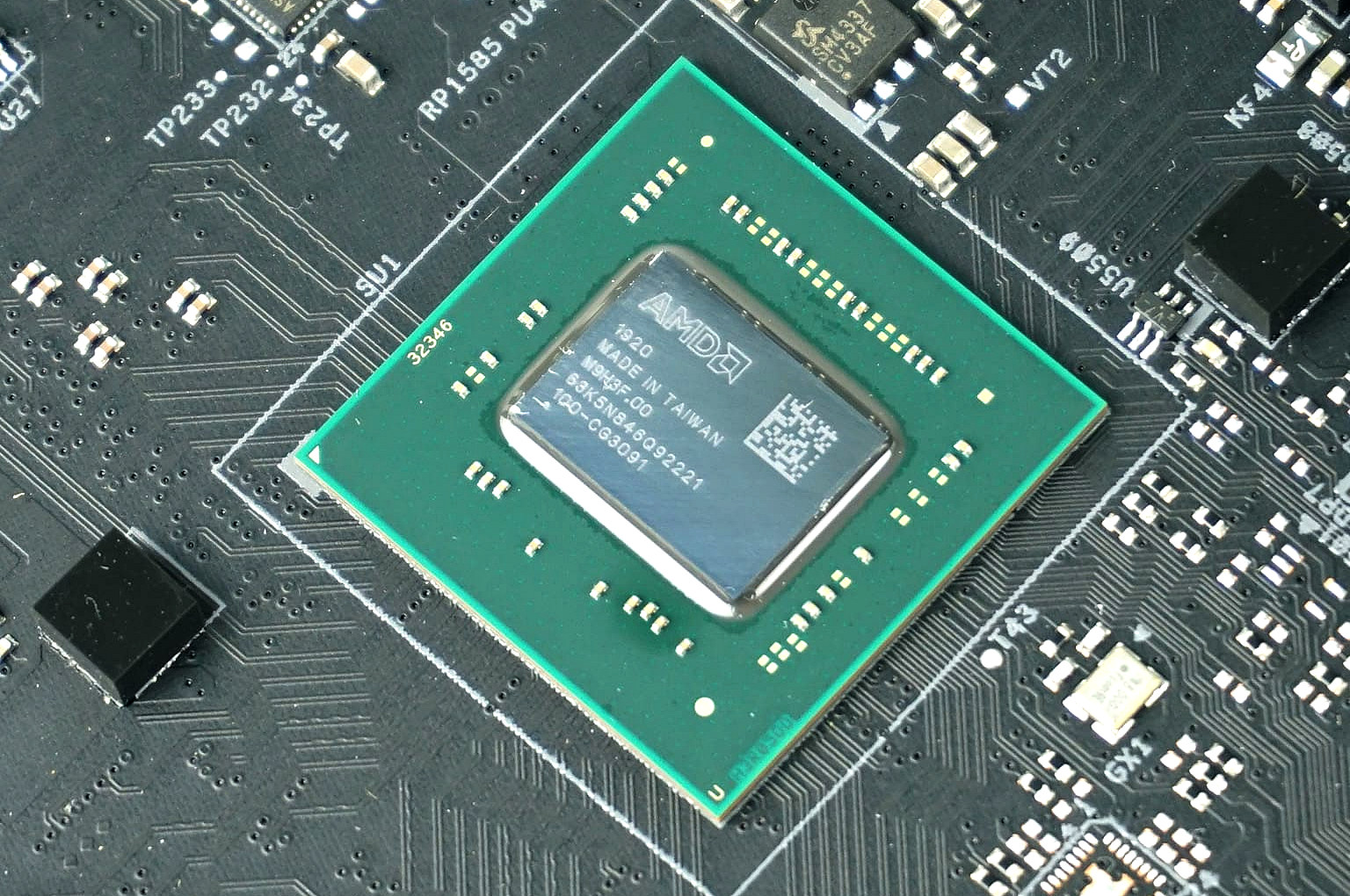
Although chipsets are considered a specialized component characteristic of motherboards, a chipset is actually not all that critical (or even required at all) on AMD’s AM4 and AM5 desktop platforms. Chipsets such as the B650 are just bridges that expand PCIe 4.0 (and SATA) connectivity. And as it turns out, they can do this as add-in cards as well. You can even use one to add M.2 or SATA interfaces to an Intel processor.
AMD chipsets for the AM5 platform based on ASMedia’s Promontory21 chip connect to the processor through a fully standard PCI Express 4.0 ×4 interface, which means they can also be installed on a card for a PCI Express ×4 slot and operated as a standalone expansion device. On such a card you can access all the connectivity that this chipset would normally provide—PCI Express 4.0 and 3.0 lanes, SATA and USB ports. The chipset itself fully handles lane splitting (more precisely, it functions as a switch), so the motherboard does not have to deal with this at all and does not even need to support bifurcation. This could be an interesting solution, for example, for NAS devices.
In June, a card called PCIE TO 4 from Minisforum appeared online. It is set to go on sale this quarter and features four M.2 slots and a USB-C port on the rear bracket with a speed of 20 Gb/s (USB 3.2 Gen 2×2), plus an OCuLink port that could, for example, be used to connect an external graphics card, although on a desktop system it would be much more practical (and faster) to use a PCI Express slot directly.

Now another such card has appeared from the Chinese company LeKuo, designated SouthBridge Max or PB65MX3. It also features four M.2 slots for SSDs, with two providing PCI Express 4.0 ×4 connectivity and two with just PCI Express 4.0 ×2 wiring (when all four slots are populated, however, they all operate with only two lanes). In addition, there are four SATA ports that can be used simultaneously with the M.2 ports, as well as four USB ports on the rear bracket (two USB-A at 10 Gb/s) and two USB-C ports (one at 10 Gb/s and one at 20 Gb/s).
The card is said to work under Windows 10/11, Linux and even macOS, and its price in China is 599 RMB, which should correspond to roughly 90 USD, or 75 EUR. There is no mention of any drivers being required, but it remains unclear whether the card would work with an Arm processor or another non-x86 CPU.
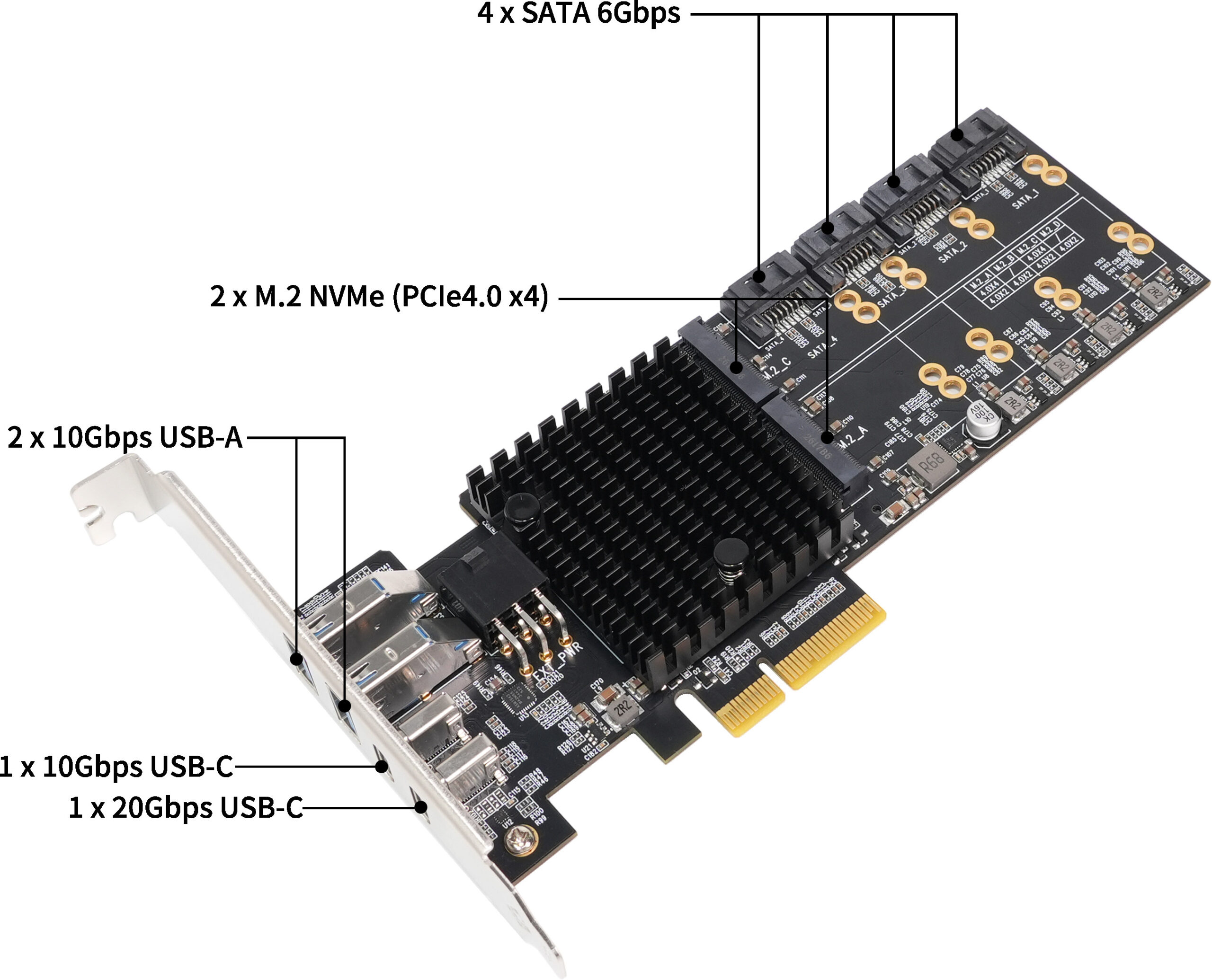
Several chipset cards have already emerged in China
These cards are not a new concept. The possibility of putting an AMD chipset on a standalone card was already explored by ASRock some time ago (essentially as a way to upgrade a B650 motherboard to an X670 chipset), but the company ultimately never sold the card. The potential market for such a device probably isn’t all that large from the perspective of a motherboard manufacturer (which has its own motherboards with expanded connectivity as an alternative competing with card upgrades), but it is apparently large enough for small manufacturers in China.
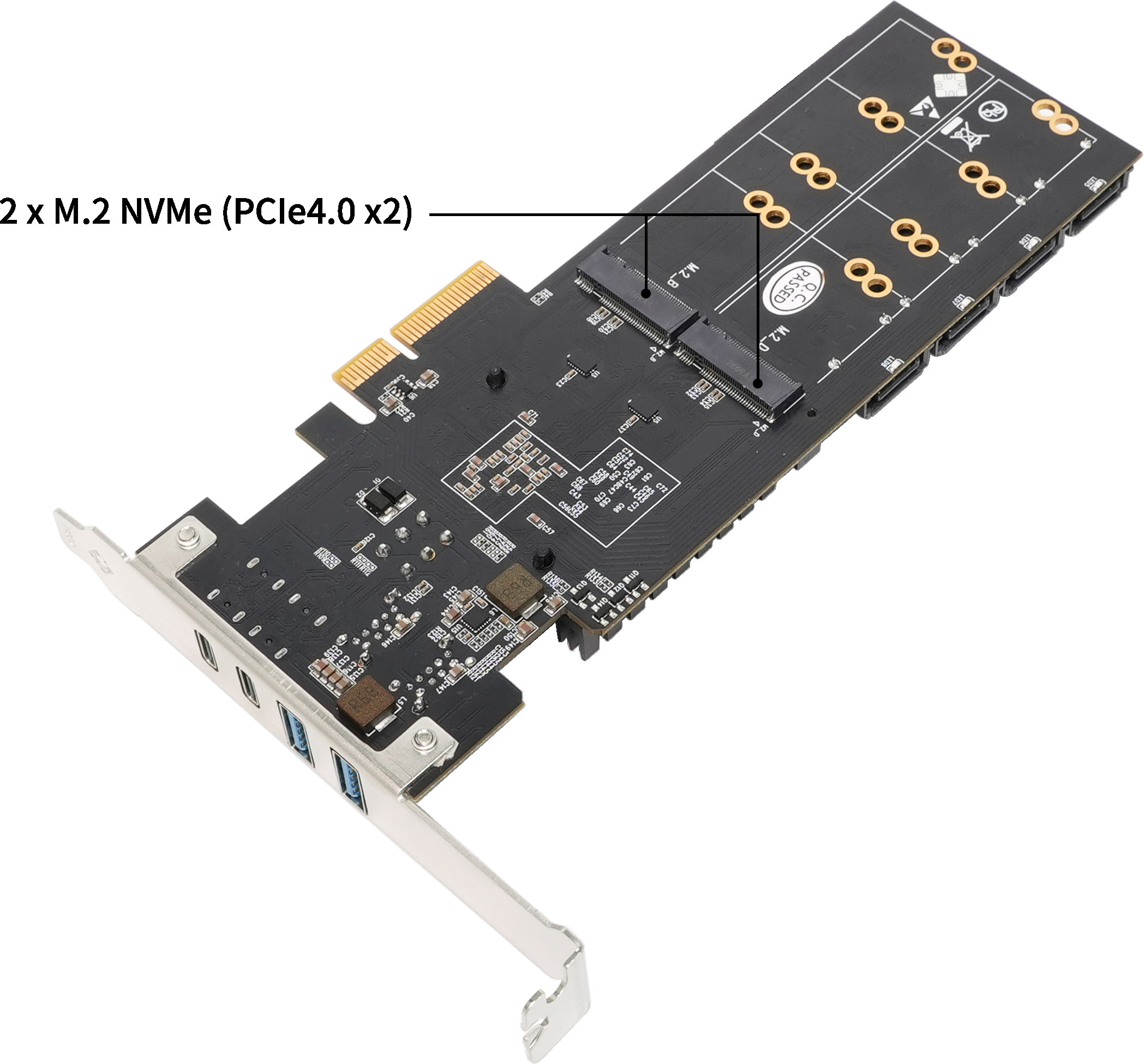
At the end of the year, an open-source design for such a card appeared on OSHWHub, and this year several actual models seem to have emerged that are available on Chinese e-commerce platforms. There apparently are even models with two chips (and thus the equivalent of an X670/X870E chipset). The cards currently being discussed, such as the one from LeKuo, are therefore probably just the tip of the iceberg that has risen above the surface and attracted the attention of international media.
There also appears to be a card with the X570 chipset from the AM4 platform, which is based on a different foundation (it is a derivative of the I/O die silicon from Ryzen 3000X and 5000X processors, designed directly by AMD rather than ASMedia and just configured differently). This card will therefore require different firmware than the B650 ones use but it seems to work as an expansion card as well. The X570 chipset already supported PCI Express 4.0, so apart from its higher power consumption, it is still relevant for use as a PCIe bridge on a card with M.2 slots. This could result in a rather bizarre configuration in which you have a mix of chipsets for two different platforms in the same computer (and according to users’ findings, at least some of these cards can be daisy-chained using M.2-to-PCIe ×4 slot adapters, so in theory you could have an X570 card in a PC with an X870 motherboard—or even use it in a motherboard for an Intel processor—and a B650 card connected to the first card, and so on).
It will be interesting to see whether there is enough demand for these cards for more established manufacturers, such as motherboard makers, to start producing their own versions as well, rather than forcing customers to buy them from Chinese marketplaces. After all you want guaranteed stability and reliable operation with a device like this that is used to control storage drives holding your data.
Sources: VideoCardz (1, 2), Tom’s Hardware, LeKuo (1, 2)
English translation and edit by Jozef Dudáš
⠀



