According to the latest reports, we will be waiting for RDNA 5 cards largely until 2028 (although one of the GPUs may arrive sooner, within 2027). This RDNA 5 launch will cover only discrete GPUs (and hopefully the “Halo” Ryzen AI Max 500 processor), though. Ryzen processors for laptops and their integrated GPUs will stick to being based on RDNA 3.5 for several more years and will receive the new graphics architecture even later.
Leaker Kepler_L2, one of the proven sources when it comes to various information about upcoming AMD GPUs, has now said that RDNA 5 will reach the integrated GPUs in APU processors apparently only in 2029. And it seems it will be in a somewhat updated version of the architecture, which has the internal designation RDNA 5+.
The Plus version could have various improvements over the first version of RDNA 5, which will arrive in the discrete AT0, AT2 and AT3, AT4 GPUs. These changes will probably be relatively minor tweaks, similar to how the RDNA 3.5 architecture was an improvement over RDNA 3, rather than a leap corresponding to a full new generation update. Something like the latter should come only with the RDNA 6 architecture, whose release date we do not yet know.
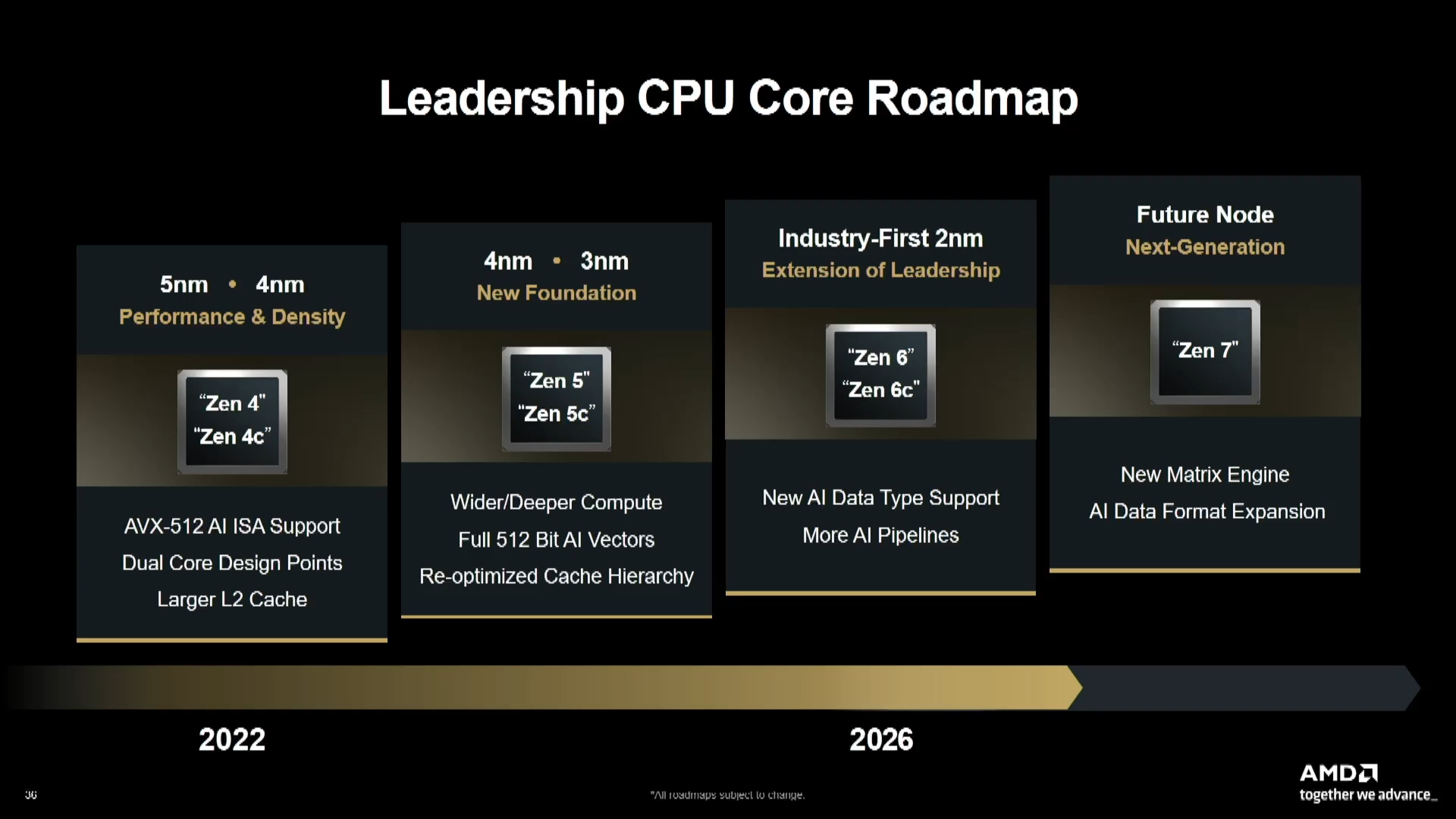
According to Kepler_L2, RDNA 5+ will reach the market with Ryzen processors/APUs codenamed Grimlock. That should already be a generation based on the Zen 7 architecture. AMD’s official roadmap lists Zen 7 as an architecture bound for 2028 market launch, but that may concern only higher performance desktop CPUs for the AM5 socket, or even just server processors, which are now prioritised over other CPU producsts because of the AI boom. It therefore seems that Zen 7 for laptops (Grimlock) will be on the market only the following year.
Some preliminary information about the Grimlock APUs has already leaked earlier, suggesting the products will be chiplet-based, for example. Details like how many RDNA 5+ compute units their integrated GPUs will have are not yet known.
It appears there will be no fundamental architecture upgrade in the integrated GPUs of Ryzen processors/APUs for laptops (or desktops) before these Grimlock processors with RDNA 5+, however. The new generation of Ryzen SoCs with Zen 6 cores, “Medusa Point” or “Medusa,” which is arriving now, should still use the aging RDNA 3.5 architecture carried over from the Ryzen AI 300/400 generation with Zen 5 cores. Or, more precisely, it should hopefully use a further improvement of it, which AMD could reportedly designate RDNA 4m.
RDNA 4m will not be a variant of the newer RDNA 4 architecture, which will apparently not make it into laptops, however. It is to be an evolutionary improvement of the RDNA 3.5 architecture, featuring mainly improved AI acceleration, for example by adding FP8 capability. This will make it possible to use the new AI game rendering technologies from the FSR4 package, but outside of AI, the performance of the compute units will probably not be as good as that of RDNA 4 in the discrete Radeon RX 9000 cards.
Earlier RDNA 5 Only in Halo Processors
Between the Medusa and Grimlock APUs, however, there could be one exception where the RDNA 5 architecture (still in its original version without the Plus) might appear. This architecture could reportedly already be used by the new generation of “Halo” Ryzen AI Max processors with the Zen 6 architecture. Until now these planned processors had been discussed under the codename Medusa Halo, but according to Kepler_L2, AMD has meanwhile changed the internal designation to something else that is not yet publicly known.
According to older reports, unlike all the other APUs of the Medusa generation, this processor could still have a better GPU with the RDNA 5 architecture, possibly with up to 3,072 shaders (48 CUs). We will see whether this is confirmed. This probably also means a later release, though. Regular “Medusa” laptop Ryzens could be launched as early as the beginning of 2027, but the Halo processor is more likely to appear only later in the year, much like the first discrete GPU based on RDNA 5 (the AT2 chip).
Unfortunately, the properties of Halo processors (support for a wider memory bus and high RAM capacities, along with performance for acceleration) have now mostly locked them into AI acceleration usage, and together with expensive memory they have made them a product that is unaffordable for most ordinary users. A Ryzen AI Max with an RDNA 5-based GPU may therefore end up being not overly important for gamers, and, for example, gaming handhelds could only get Medusa chips until the time for Grimlock comes in 2029.
Sources: VideoCardz, Kepler_L2 (1, 2)
English translation and edit by Jozef Dudáš