New GPUs from Nvidia but also from AMD are due out next month. There are fewer rumors about the latter. We know what GPUs AMD is preparing, but not what cards they’ll base on them. Until now, we’ve referred to them as Radeon RX 8000 series, but the reality seems to be more complicated. AMD is in fact preparing Radeon RX 8000, but also Radeon RX 9000 cards at the same time. But it’s actually a similar scheme to what Ryzen CPUs use.
AMD seems to have shared the information in question with card manufacturers recently, as rumours of what the new graphics cards are called have now started to leak onto the internet. The first to talk was apparently a leaker with the handle Apoleon on the Chiphell forums, who reported that the new graphics cards will be branded as the RX 9000 series, and apparently the top model is to have a the number seven as the third digit.
This was subsequently substantiated, it seems, by a semi-official leak – from the Grosbill Pro store, which has created categories for the new model lines in its catalogue (unless the store was just guessing based on Chinese leaks, too). According to this source, the top-of-the-line RDNA 4 graphics card model will be designated as the Radeon RX 9070 XT. This is likely to be a graphics card with a full Navi 48 chip configuration, with 64 CUs (4096 shaders) and 16GB of GDDR6 memory on a 256-bit bus.
The second model is to be called Radeon RX 9070 (without further suffix). It should be a cheaper variant with a partially cut-down Navi 48 chip. Specifications are not known yet, it’s not clear how many compute units will be disavked – something between 48 CUs and 56 active CUs left (3072 to 3584 shaders) is likely. The memory could be 16 GB or 12 GB if the bus is stripped down to just 192 bits (like the Radeon RX 7700 XT).
No names have been leaked yet for inexpensive cards with the smaller Navi 44 chip (it has 32 CUs / 2048 shaders and a 128-bit bus, presumably PCIe 4.0 ×8). This may be related to the fact that they will come to market a bit later. The Radeon RX 9060 XT and RX 9060 designations could be a possibility.

This designation scheme is apparently intended to indicate which Nvidia graphics card a given model competes with, and while the higher-end 9070 (XT) models would be aimed at the GeForce RTX 4070 (Ti) or the upcoming RTX 5070 (Ti), the lower Navi 44 should probably have the GeForce RTX 4060/5060 cards and their Ti variants as their targets.
The result will be something a bit similar to the situation when AMD swiped Intel’s chipset names (B350), because AMD’s generation number is now ahead of Nvidia for historical reasons. But since there are other distinguishing bits in the name, there probably won’t be much conflict here. Furthermore, Nvidia will probably not get through to GeForce RTX 9000 for a very long time, and by that time a similarity of Radeon RX 9070 XT to, say, GeForce RTX 9070 Ti won’t matter so much.
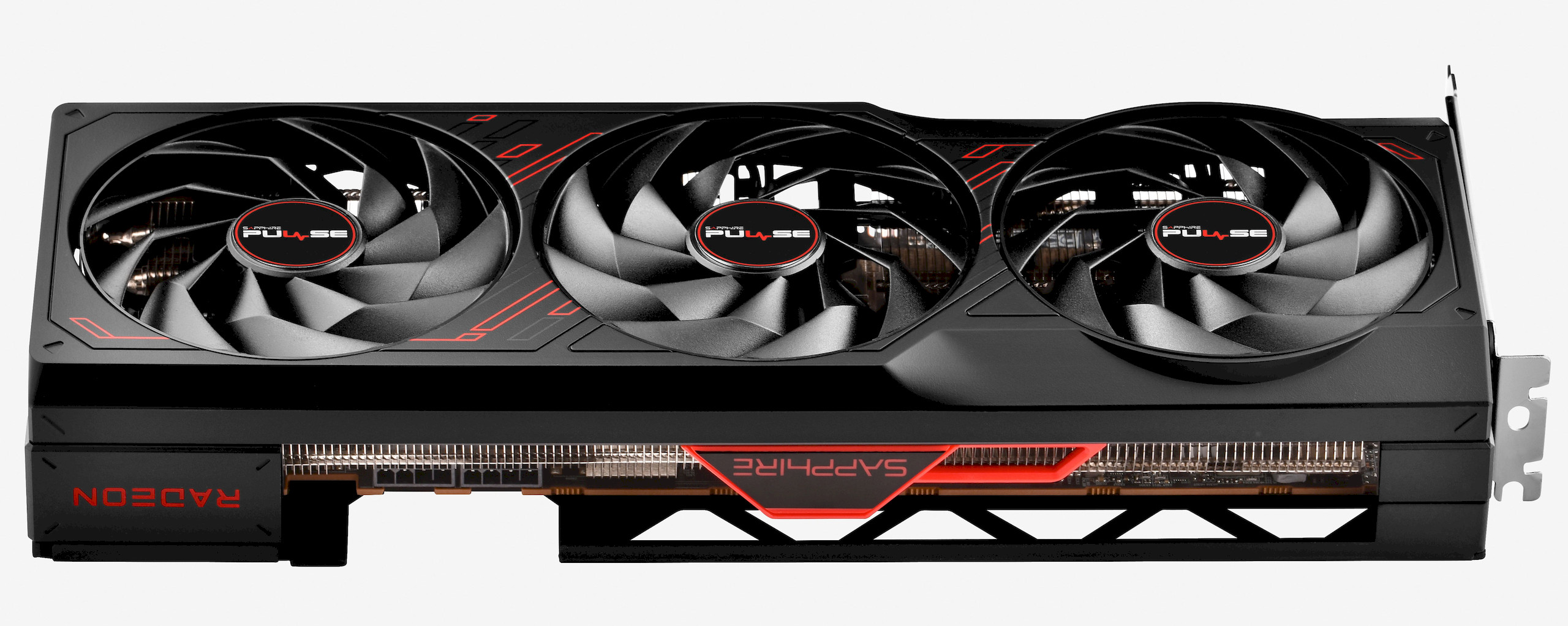
Some time ago, we reported that in the code of the ROCm drivers for AI, the upcoming GPUs were designated as Radeon RX 8600 and RX 8800 in contradiction to this now leaked designations. It seems that was just a place-holder naming. Or AMD was hesitating what name to choose, and the final choice for Radeon “9070” (and probably “9060”) was made only relatively recently.
Generation 8000 will be dedicated to graphics cards with RDNA 3.5 architecture
That this change to the long-standing designation scheme (which can be traced back to the classic Radeon 7500, 8500, 9700 Pro cards and the like) is in the works was already hinted at by the leak of the Ryzen AI Max+ Pro 395 in Geekbench, which we wrote about two weeks ago. This processor does in fact have a graphics card designated Radeon 8060S.

This designation is apparently to position it as the equivalent of the mobile GeForce RTX 4060 (or 5060?). The S suffix at the end is the designation AMD uses for GPUs for slim laptops with high mobility.
Read more: 16-core mobile Ryzen “Strix Halo” has a Radeon 8060S GPU
These Strix Halo processors are probably the reason why AMD skipped the 8000 generation and graphics cards with RDNA 4 architecture chips will be called Radeon RX 9000. The 8000 generation will be reserved for GPUs with the RDNA 3.5 architecture which is used by the integrated GPU in Strix Halo. It would be confusing if cards with the newer architecture were to carry the same designation, but the alternative of using the RX 7060S designation (placing the new SKU into a two-year-old generation, seemingly) probably also wouldn’t look very good. Strix Halo’s iGPU would be easily confused with the dedicated Radeon RX 7600M and 7600S GPUs.
In the end, this scheme is actually something very similar to what AMD did with the Ryzen “APU” processors with Zen 2, Zen 3+ and Zen 4 architectures, which launched as Ryzen 4000, 6000 and 8000, while the next generation architecture desktop processors that were launching during roughly similar time period then jumped to 5000, 7000 and 9000 designation to keep things from getting confusing.
In any case, the designation itself has no more than a symbolic meaning, and while it may affect how graphics cards are perceived, it will not change their gaming performance and features in any way. How the Radeon RX 9000 graphics cards will perform remains to be seen.
English translation and edit by Jozef Dudáš
⠀