


We can state that, regardless of noise levels (indeed very high at maximum), the CPS PCCooler F9 R120 is the highest airflow fan in the 30 mm-and-below profile category. Yes, even the Phanteks T30 comes out “worse” here. However, if your priority is the highest possible airflow at low noise, the picture changes—and it’s not such a happy one, especially with obstacles. That will become clearer in the detailed analysis.
Everything changes with obstacles
So far, we have described how static pressure and airflow measurements are made under conditions where the fan has no obstacles in its path. In practice, however, fans do not usually blow into an empty space, but have a filter, grille or radiator in front of or behind them, the fins of which need to be pushed through as efficiently as possible.
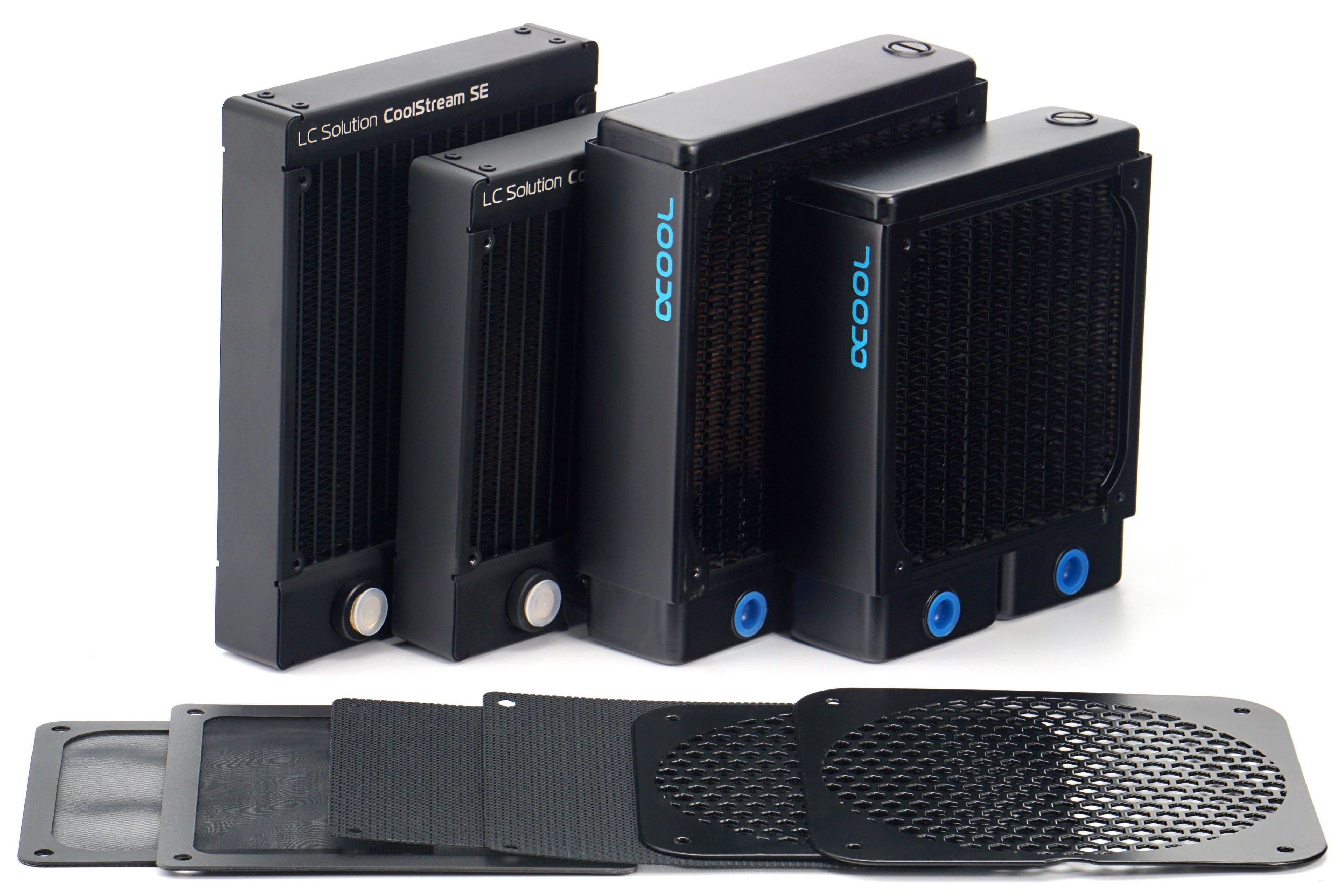
We will also measure both airflow and pressure through practical obstacles for the reasons stated above. These include two types of filters that are usually used in PC cases. One fine – nylon and the other plastic with a thinner mesh. One other obstacle is the hexagonal grille perforated at 50%, on which the vast majority of fans – intake and exhaust – are installed. In some cases, we measure the effect of the obstacles on the results at positions (behind or in front of the impeller) that are used in practice. All obstacles are both pushed through to detect pressure drops, but also pulled through, which in turn speaks to the impact on airflow.

We use two radiators that differ in thickness and fin density. The EK CoolStream SE120/140 is 28 mm thick and the FPI is 22, the Alphacool NexXxoS XT45 v2 is thicker (45 mm) but with less FPI. CoolStream’s fin disposition is also similar in parameters to AIOs. The results on the NexXxoS will again be attractive for those who build their own water cooling loops, where the fans should work well even at low speeds – hence the lower fin density.
These obstacles and especially the radiators, but also the grilles, increase the mechanical resistance in front of the fan, resulting in higher noise levels. However, we will still tune the fan speeds to the specified noise levels of 31 to 45 dBA. Naturally, the speeds will always be lower than when testing without obstacles, but we will maintain the noise levels for clarity. The different noise levels with and without obstacles will only be at maximum power. In this mode it will also be nice to see how the fan design works with the obstacle and in which case the noise level increases more and in which less.



Hi,
I don’t understand the chart Motor Power 12v 100% PWM and Fan power draw max speed.
Should they be the same watts?
One says 5.41 watts the other 15.23 watts do they rally draw that much power?
Thanks
See chapter 11, it’s explained there. 😉
https://www.hwcooling.net/en/cps-pccooler-f9-r120-rising-to-the-top-with-30-mm-of-thickness-review/11/
Yes, thank you! 🙂
In one case (Motor Power), the higher value appears because the motor, due to braking, has to overcome significantly greater resistance than it does during regular operation at 12 V or 100% PWM control (which are effectively the same). The motor power measurements are meant to illustrate the difference between the best and worst scenarios in terms of friction the fan must overcome. The operating power consumption of an older fan will be higher because friction increases over time with use—and it’s good to know how far the motor’s capabilities extend. 🙂
while we’re at it, 😉
It would probably be appropriate for manufacturers to limit max.motor power to 12W, cause many 4-pin fan headers on motherboards have max. current of only 1A, right?
…or what is your opinion on it? 😛