
The files of the AI game image enhancement technology DLSS 5 have leaked last week, and modders added the filter to the first games—unofficially. However, the official launch was not far behind. Nvidia has announced that it is now officially launching in the first game, NBA2K27, which is also the title from which the files previously leaked. Starting tomorrow, you will be able to try out what it looks like and what its costs are.
The launch of DLSS 5 is tied to the premiere of NBA2K27 (a basketball sports game, as you can probably guess from the name), which is being released this Friday, September 4—or today, Thursday, September 3, depending on which time zone you are in. In the Central European time zone, it will happen on 6:00 a.m. on Friday. DLSS 5 should be available in the game immediately upon release, so according to Nvidia, this date is also the availability date of the technology itself.
You will also need to update your GPU driver to a new version that will be released in conjunction with the game on September 4. According to the company, more titles will follow NBA2K27, although they have not been named yet; some of them are reportedly expected to appear within weeks.
DLSS 5 is an optional technology in the sense that it is not supposed to be enabled in games by default, but only offered as an option. This is probably also related to its performance and GPU requirements, which we will get to shortly. At the same time, it is a “proprietary” technology—Nvidia is making it available only on its own GPUs, so players will not be able to enable it with other GPUs or on other platforms.
3D-Guided Neural Rendering?
DLSS 5 is not a direct continuation of the previous DLSS technologies, which perform upscaling (meaning that frames are actually rendered at a lower resolution than what is presented on your display) and frame interpolation (where fewer frames are actually rendered than are displayed, rest is interpolated from them). DLSS 5 is a separate technology with a different purpose.
Nvidia gives DLSS 5 the grandiose name 3D-Guided Neural Rendering, and in the drivers (the Nvidia App) as well as in NBA2K27’s configuration menu, you will find it labeled as “DLSS Neural Rendering.” This is name is probably overstating what DLLS 5 actually does quite a bit; a better designation might be something like “AI image enhancement.” We can say this because Nvidia has already confirmed how DLSS 5 works, and the concept is actually quite simple.

The filter—which is, of course, based on a neural network like most Nvidia’s developments—works on top of what is already a fully rendered scene. The frame serving as an input to DLSS 5 is always fully rendered and complete. DLSS 5 then works with the bitmap representation of this frame and applies machine-learned effects to various parts of it. Where the effect is to be applied is determined by the game’s programmers when setting up the scene, while they can choose from three different models with different effects (A, B, and C) and also configure the intensity of the effect. Parts of the scene can be completely excluded from processing using masks.

In addition to the actual data, DLSS 5 works with motion vector information (similarly to frame generation or upscaling with temporal reconstruction), but otherwise uses relatively little information from the game and its engine (some additional data is used when training the model, but not during inference in the actual shipping game). It does not even directly query scene’s lighting sources and information from the game’s engine. This is quite remarkable because the effect, the “AI enhancement” applied by DLSS 5, primarily consists of approximating shadows and the way light falls on and scatters through materials.

The goal is to make, for example, faces look more realistic, but this is not achieved through actual simulation of lighting and the behavior of materials or skin. Instead, the neural network applies an appearance that “fakes” realistic facial lighting based shadows and textures the game renders using its standard rendering. Typically, this means painting in more dramatic, deeper shadows (and potentially wrinkles) on the face, giving the skin a shinier/wetter appearance, and potentially sharpening and increasing image contrast.

At least at first glance, such effects often look attractive to an unprepared observer and it can be presumed DLSS 5 will successfully be scoring points thanks to that. Whether this is actual photorealism, however, or just a “filter that mimics the appearance of photorealism,” is another question. Similarly, we have to wonder whether, instead of photorealism, we will instead get a deluge of uniform “AI slop” look in games that is actually rather unnatural. Nvidia, for example, showed this demo where the AI effect is pretty clearly going way too far in an attempt to make the image more attractive, while actually making it rather unnatural and uncanny.


The name Neural Rendering was previously used mainly to refer to expected game graphics approach that would use neural network to directly generate the image, just as AI models today generate images or video clips (that you can see everywhere in advertisements and so on). The idea was that we would abandon image creation from 3D models and textures and the game would be generated directly as a photorealistic image. DLSS 5 is nothing like that. It is a filter that is entirely dependent on traditional 3D scene rendering, taking the image produced by it and applying some makeup to it (if we exaggerate a bit).
That’s actually what the “3D-guided” qualifier essentially refers to—it is basically a grandiose description of a post-processing filter that takes a bitmap image (composed of pixels, as DLSS 5 does not work with the actual objects, geometry, or lighting information of the scene in any way) and applies various filters to it, much like when a photograph is being retouched. One could probably say that DLSS 5 is all about being “3D-guided,” while of “neural rendering”, there is just a smaller indirect portion present in the technology.
Performance: Bad News (and Highly Misleading Benchmarks)
DLSS 5 is extremely computationally demanding. Nvidia boasts that it has managed to make the filter six times faster during the development of DLSS 5 (prototypes revealed at the beginning of the year allegedly used an entire GeForce RTX 5090 to run, while the game itself ran on another card), which may sound great on its own. However, in absolute terms, the filter is still very slow even so. Nvidia itself states that enabling DLSS reduces performance by 50 to 60%. This means that it consumes more than half of the GPU’s performance by itself, and after enabling it, the frame rate drops to less than half.
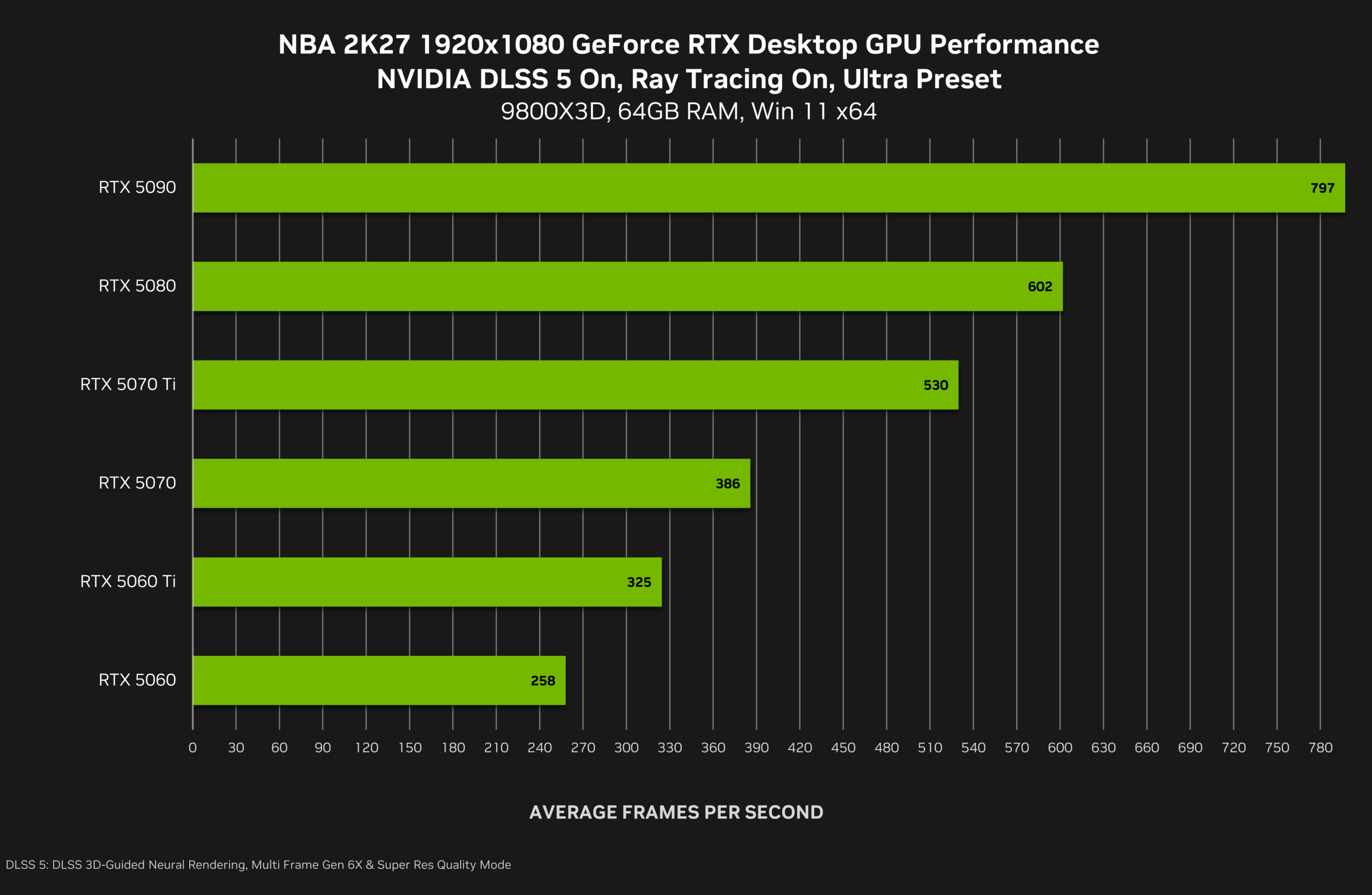
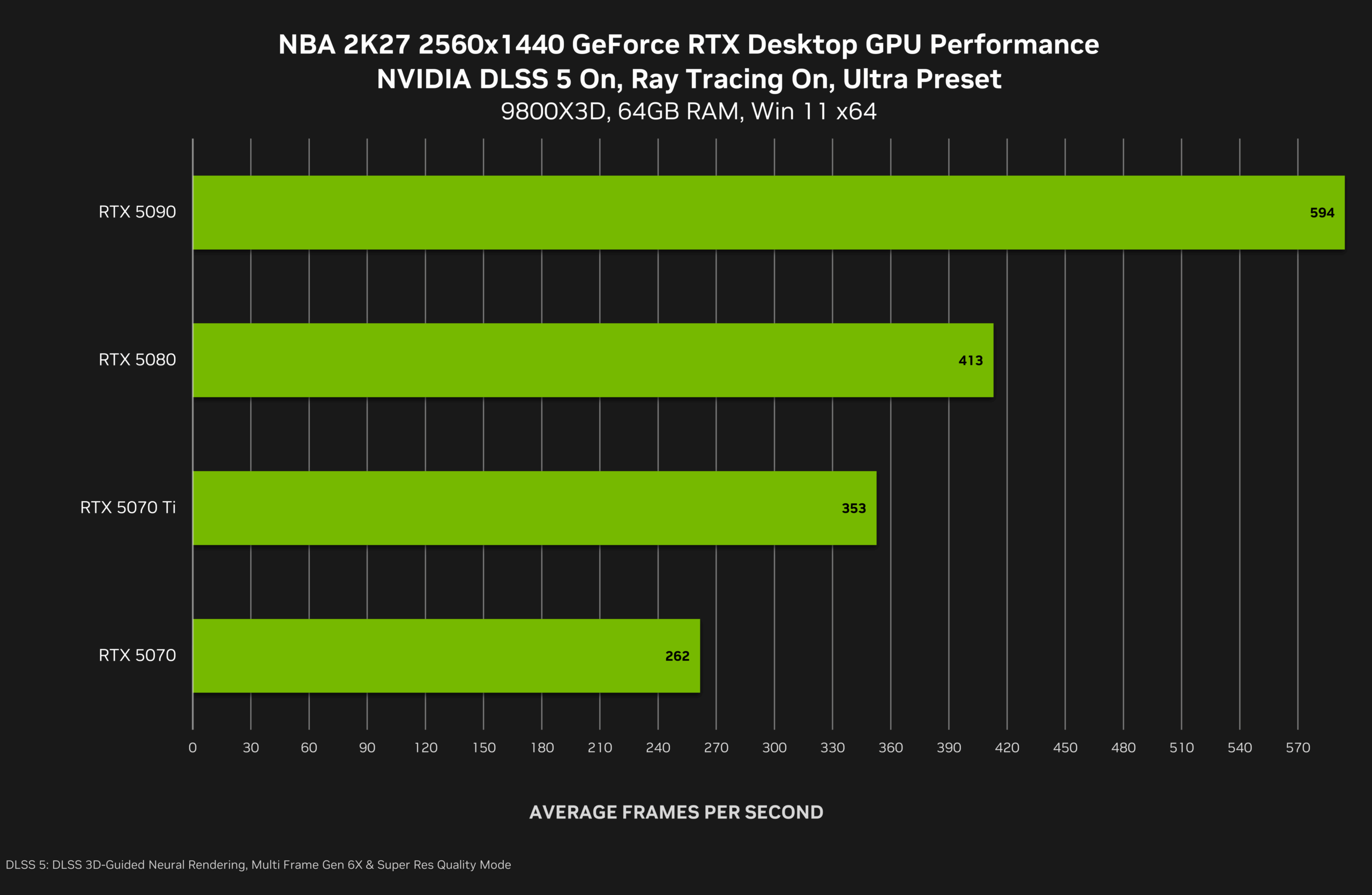
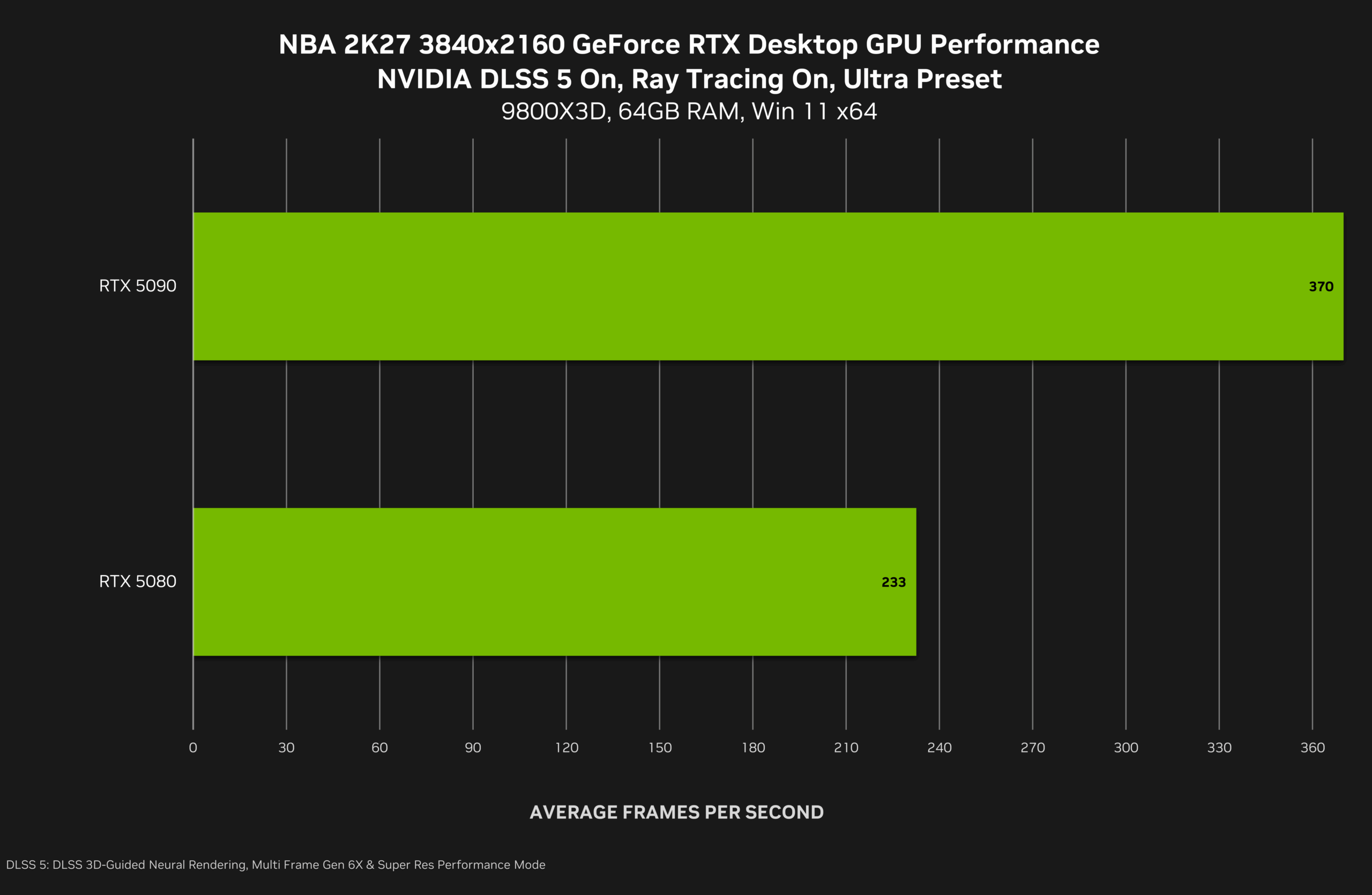
Nvidia showed benchmarks of NBA2K27 at 4K, 1440p, and 1080p, showing it running on cards ranging from the GeForce RTX 5060 to the RTX 5090, but all of these benchmarks use DLSS Quality upscaling (where the scaling factor should be 1.5×, so 1080p is actually 1280 × 720 pixels and 1440p is only 1706 × 960 pixels), or even, in the case of 4K resolution, DLSS Performance mode with a 2× scaling factor (so the actual rendering resolution is 1920 × 1080 pixels).
And on top of that, all of this benchmarks uses 6× frame generation, where every real frame is followed by five interpolated intermediate frames that the game (and therefore DLSS 5) did not actually render. The game’s real frame rates are therefore actually almost six times lower.
So if the GeForce RTX 5060 is said to manage 258 FPS at 1080p, that is actually 43 FPS at 720p. The GeForce RTX 5090 is supposed to manage 370 FPS at 4K with frame generation, and Nvidia shows a comparison in its article on the technology where the game achieves only 227 FPS “without DLSS,” i.e. a lower FPS. But that would be at native 4K / 2160p resolution and with all the frames being actually rendered frames, making this an extremely misleading comparison and a rather shameless attempt to obscure the actual performance hit. If we compared apples to apples (just real frames), DLSS 5 would reduce the actual frame rate to 62 FPS, and that is still only at 1080p rendering resolution with one quarter of the pixels that native 4K resolution renders.

Only for the GeForce RTX 5000 Generation
If you own one of the older graphics cards, you also will not be pleased that DLSS 5 is available only for Blackwell-generation GPUs, with no support for older Nvidia graphics cards. Its AI model uses the FP8 data type, which is also supported by GeForce RTX 4000 cards in theory, but Nvidia has so far given no indication that it plans to add support for these cards (although it is not ruled out).
It is possible, however, that support for GeForce RTX 4000 graphics cards could be forced using programs such as Optiscaler. It is less clear whether it will ever be possible to unofficially “hack” support onto GeForce RTX 3000 and 2000 graphics cards in this way, which would require emulating FP8 compute ops using FP16 compute ops. This could run into the problem of making the already high performance requirements even worse, because FP16 inherently provides lower performance.
Source: Nvidia
English translation and edit by Jozef Dudáš
⠀