




At Computex 2025, DeepCool unveiled two products that arguably drew more attention than anything else in its booth: the Spartacus 360 liquid cooler and the CL6600 PC cases. One represents the very peak of cooling performance in DeepCool’s current portfolio, while the other embraces a design trend that has recently gained traction—cases with wood-inspired elements.
DeepCool’s most powerful liquid cooler to date is now becoming a reality under the name Spartacus 360. The design is based on a 360 mm radiator paired with three 120 mm fans. At first glance, the fans stand out with aerodynamically optimized geometry: long, curved blades combined with a relatively small hub. Because the hub occupies only a small portion of the impeller’s cross-sectional area, high airflow per revolution can be expected, along with elevated static pressure—an important factor for radiator performance.

Another key feature is DeepCool’s 6th-generation pump, which promises a higher coolant flow rate. The Spartacus 360 is also distinguished by a “multifunction” display integrated into the pump block. This screen can be used not only for system monitoring and diagnostics, but also to display custom images or animations.
From a performance standpoint, the cooler includes optimizations targeting Intel processors. The cold plate mounting is offset so that its most effective cooling area aligns more closely with CPU hotspots—particularly on Arrow Lake processors (Core Ultra 200S), where the P-cores are located toward the north side of the die. The mounting position of the block is shifted accordingly, a design choice illustrated in DeepCool’s promotional materials, in the visualization below.

The suggested retail price for the Spartacus 360 is 185 EUR. The cooler should already be available for purchase from authorized DeepCool retailers.
Also new is the CL6600 case, which DeepCool previously showcased at Computex in Taiwan. It is available in both black and fully white variants, with both versions featuring a decorative “wood” panel integrated into the front.
Structurally, the CL6600 is a three-chamber case with a separated compartment for liquid cooling. A radiator up to 360 mm can be mounted at the top, while a 280 mm position is optionally available behind the front panel. For users opting for air cooling instead, tower coolers up to 175 mm in height are supported. Graphics card clearance officially reaches up to 413 mm in length, although this is reduced to 388 mm if a front fan is installed. The case also supports motherboards with rear-mounted connectors, with cutouts in the steel panel positioned to ensure cable routing does not interfere with the board or its connectors.
Three fans come preinstalled—two intake and one exhaust—and DeepCool emphasizes airflow optimization in its design materials. The airflow layout is somewhat unconventional, especially when combined with top-mounted liquid cooling, but the company claims it delivers effective thermal performance.

It is worth mentioning that according to DeepCool’s own materials, the liquid cooler mentioned (and shown in the picture) is pre-installed, meaning it is part of the package of the supplied case. The specific type of liquid cooler is not clear from the materials or the manual. According to the information on the website, this AIO uses a 360mm radiator with an advanced pump with adjustable speeds from 2500 to 3400 rpm. Three 120mm fans with FDB bearings, which are not further specified, are mounted on the radiator. According to the manual, the liquid cooler should have broad compatibility and can be installed on the following processor sockets: Intel LGA 1200, 1151, 1150, 1155, 1851, 1700 and AMD’s AM4 and AM5.
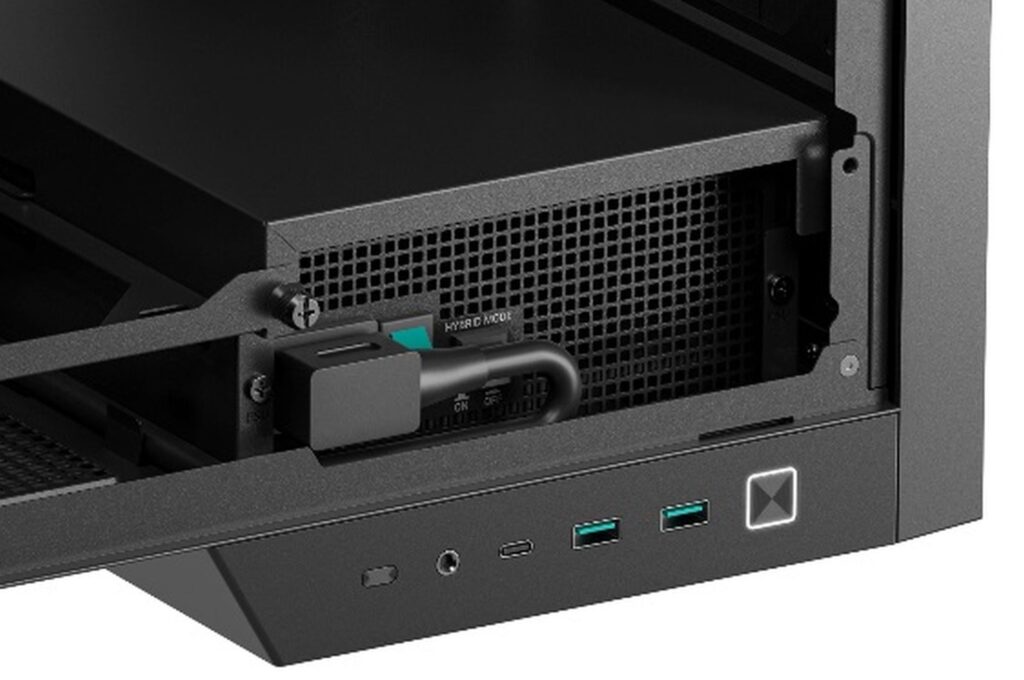
The power button and front I/O (three USB ports and a 3.5 mm audio jack) are located on the lower left side of the front panel. Internally, above this area, the case provides space for an ATX power supply with a supported length of up to 160 mm.
The DeepCool CL6600 is already available at some retailers, with an MSRP of 200 or 210 EUR, depending on the configuration.
Note: We apologize for the low quality of the images used in this article.
English translation and edit by Jozef Dudáš


