
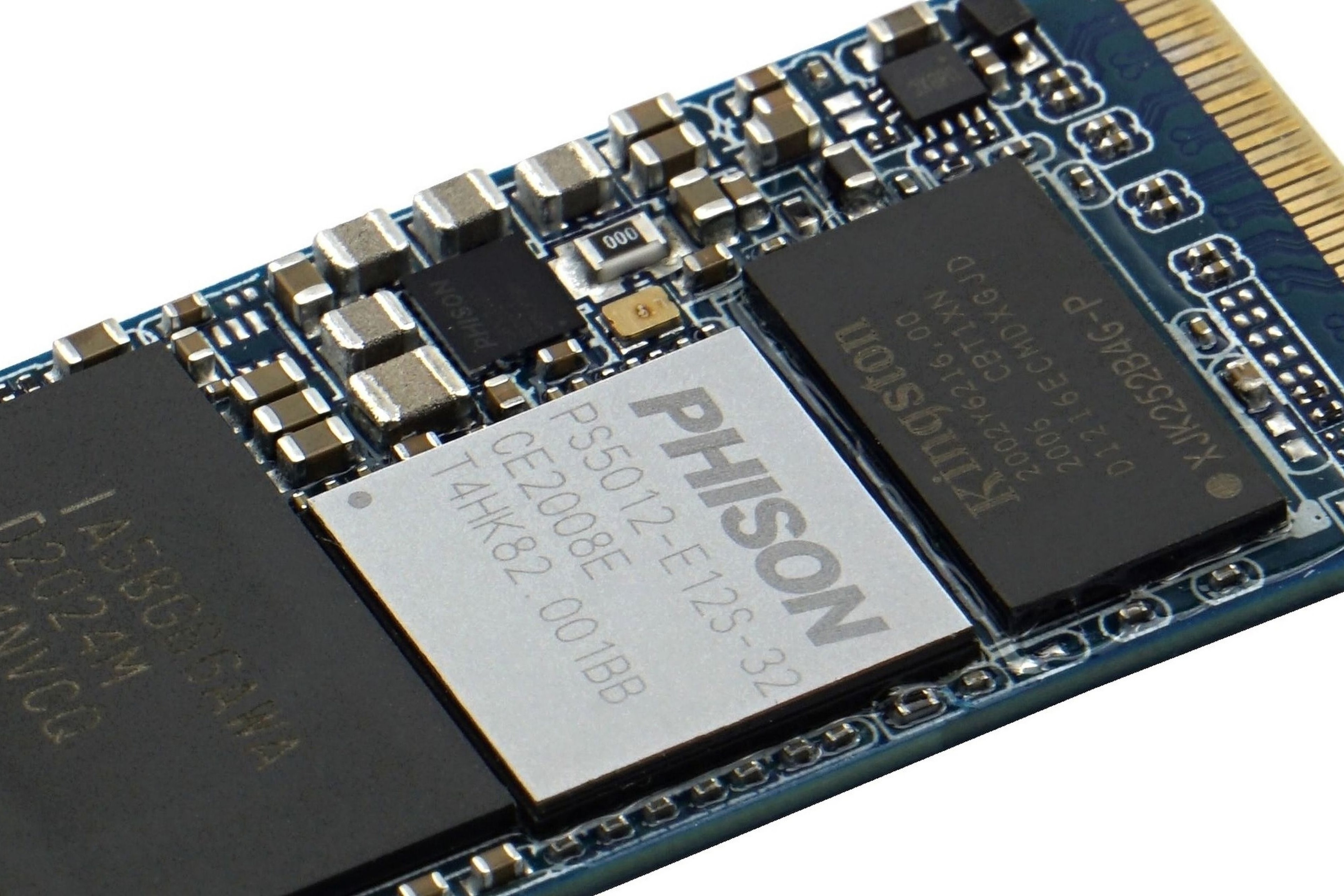
NAND flash has become significantly more expensive, while DRAM prices have surged even more dramatically. DRAM is used as cache in higher-end drives and modules and cheaper SSDs will therefore become more important than ever—especially those that do not require DRAM. “DRAMless” SSDs have improved considerably in recent years, but a new PCIe 5.0 controller from Phison could push them even further—practically to high-end levels.
When PCIe 5.0 SSDs first appeared on the market (almost exactly three years ago), the only option available was the high-end Phison E26 controller, which needed high power consumption and eight NAND channels to deliver performance that still fell well short of the true potential of the PCI Express 5.0 ×4 interface limits. With the fastest NAND chips available at the time, maximum read speeds initially reached only around 12.5 GB/s, while many drives used slower NAND that limited performance to roughly 10 GB/s. It was only much later, with the arrival of faster NAND chips, that read speeds climbed into the 14.0–15.0 GB/s range.
It is precisely these higher NAND speeds that now make it possible to build similarly fast SSDs using a simpler, less power-hungry design. Phison has now introduced a new controller called the E37T, which is expected to achieve comparable sequential performance using just four channels—a typical characteristic of cheaper, mainstream controllers, as fewer channels mean a smaller and less expensive chip. The Phison E37T will feature a PCI Express 5.0 ×4 interface and should be able to pretty much saturate it despite using only four channels. The controller will support NAND with interface speeds of up to 4800 MT/s, which—when paired with sufficiently fast NAND—allows read speeds on par with earlier eight-channel Gen5 drives even with just four channels.
Drives based on this controller are expected to reach read speeds of up to 14.7 GB/s and sequential write speeds of up to 13.0 GB/s. The caveat, however, is the use of sufficiently new NAND chips, meaning it may take a year or two before conditions allow such SSDs to be produced at truly low prices.
Random performance is expected to be around 2,000,000 IOPS. This is not the absolute best available today, but it would still be a very respectable result—for example, high-end models such as the WD Black SN8100 (which is now being rebranded as the Sandisk Optimus GX Pro 8100) deliver around 2,300,000 IOPS in random access. Samsung’s flagship SSD 9100 Pro reaches 2,200,000 IOPS in reads and 2,600,000 IOPS in writes. Phison’s high-end E28 controller with DRAM cache can reportedly reach up to 3,000,000 IOPS—so top-tier solutions will still maintain a performance gap over the mainstream E37T drives in random access and heavy parallel workloads.
The E37T controller also reduces SSD cost by omitting dedicated DRAM cache, relying instead on HMB technology, which uses a small portion of system RAM to serve as cache. This approach has proven quite successful with newer generations of DRAMless SSDs, so these drives are no longer something to be wary of as they once were. SSDs typically include only a single DRAM chip (although higher capacities may feature quite large buffers, up to 2–4 GB), and historically this did not add much to the price. Under current conditions, however, where DRAM prices have increased up to sixfold, it becomes a real issue. Current market dynamics will likely push buyers toward exactly this type of SSDs, potentially establishing them as the new standard—much like TLC and even QLC SSDs once replaced earlier SLC and MLC devices. It is therefore a positive development that their quality and performance continue to improve.

The combination of a four-channel design and a DRAMless architecture also likely contributes to low power consumption. According to Phison, the controller will draw up to 2.3 W under load, making these SSDs even more efficient than the Silicon Motion SM2508 controller, which is rated at around 3.5 W and typically results in whole SSD power draw of roughly 7 W. It should be noted, however, that the SM2508 is a high-end eight-channel solution with DRAM. Like that controller, the Phison E37T chip will be manufactured on TSMC’s 6 nm process to enable the energy efficiency.
Prototype for now, SSDs coming soon?
Phison demonstrated a prototype SSD with the E37T controller at CES 2026, where read speeds in the showcased benchmarks reached an impressive 14,926.78 MB/s in CrystalDiskMark—almost 15 GB/s. Write performance, according to Tom’s Hardware, which recorded these specific results, reached 13,180.21 MB/s (techPowerUp observed 14,926.24 MB/s reads and 13,115.39 MB/s writes during their visit). Total SSD power consumption was 4.47 W, which is a solid figure for an NVMe module.
It hardly needs to be said that the low power consumption of these modules could make them an excellent solution for notebooks, enabling efficient “Gen5” storage with 15 GB/s speeds to gain traction in mobile devices. Or even for gaming handhelds, for example those built around Intel Core Ultra 300 processors, which support PCIe 5.0 SSDs. According to Phison, the E37T controller will also be suitable for smaller M.2 2242 and M.2 2230 modules intended for such devices.
That said, this performance comes from a reference design with pre-production firmware. Real-world SSDs may of course differ, depending in part on how fast the NAND used by manufacturers actually is. Phison controllers appear in drives from many different vendors, and their characteristics will vary accordingly—especially when older, slower NAND is used.
According to Phison, SSDs with this controller could reach the market soon, although it is unclear what is the meaning of “soon” in this case. Silicon Motion controllers, for example, are sometimes announced years before products actually become available. That said, Phison has historically been relatively quick to market—it delivered the first PCIe 4.0 SSDs and the first PCIe 5.0 SSDs well ahead of competitors (albeit at the cost of high power consumption with early controllers such as the E12 and E26). It is therefore quite possible that the Phison E37T will appear in finished SSDs relatively quickly, with the first models perhaps available as early as summer or autumn.
Sources: Phison, techPowerUp, Tom’s Hardware
English translation and edit by Jozef Dudáš
⠀