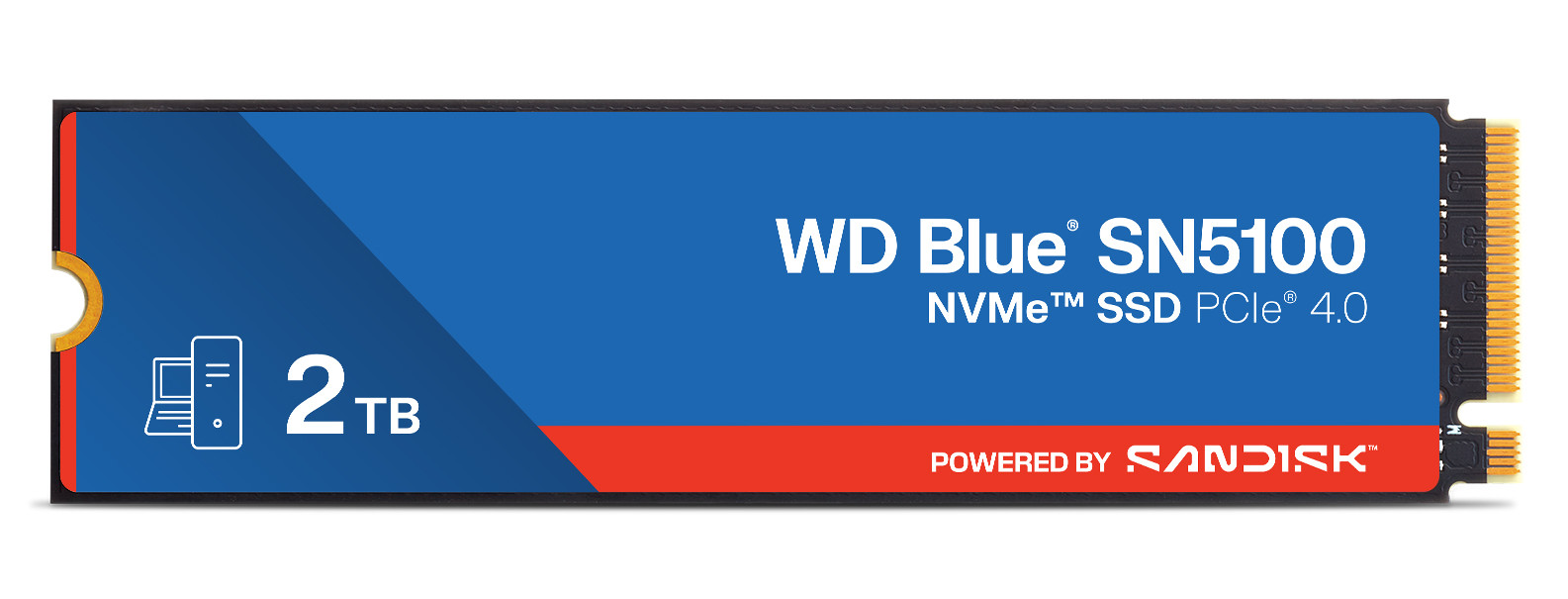
Western Digital, or more specifically its SanDisk division, is among the more popular SSD brands. Now they’re introducing a new addition to the budget WD Blue lineup: the WD Blue SN5100. These modules replace last year’s SN5000 line-up and promise significantly better performance. Not always though, because while the new series uses a newer and better generation of NAND, all models now come with QLC-based chips.
The previous WD Blue SN5000 series was based on a four-channel in-house controller and 3D NAND from SanDisk and Kioxia (both companies share NAND manufacturing fabs and the technology development), specifically the fifth-generation BiCS5. These modules achieved read speeds of up to 5150 MB/s and write speeds of up to 4900 MB/s for the 500 GB to 2 TB models. Only the 4 TB model used QLC NAND, and ironically, it offered slightly higher sequential speeds (5500 MB/s read, 5000 MB/s write), thanks to the fact that the QLC NAND used was newer BiCS6 chips.
The new WD Blue SN5100 modules again feature a four-channel controller developed by WD and SanDisk, using a DRAM-less design with HMB technology, and connect via PCI Express 4.0 ×4 (PCI Express 5.0 hasn’t reached this segment yet). However, the new drives now extract almost the full potential of this interface. Sequential read speeds on the SN5100 reach up to 7100 MB/s, and sequential write speeds go up to 6700 MB/s, which is essentially the level of high-end PCIe 4.0 modules before PCIe 5.0 SSDs started appearing.
The WD Blue series is now based on QLC NAND across the stack
The downside of the new SN5100 modules is that QLC NAND is now used in all capacities: 500 GB, 1 TB, 2 TB, and 4 TB. The increase in sequential speeds is thanks to using new NAND chips, which are eighth-generation BiCS8 with 218 layers and a capacity of 2 Tb per chip (the same chips that made it possible to create 256 TB SSDs for servers). However, since this is QLC NAND, write speed will rely on the temporary pseudo-SLC cache. Once this cache is filled, sustained write performance is expected to drop significantly.
Random access performance on the 1 TB and 2 TB models should reach up to 1,000,000 IOPS for reads and up to 1,300,000 IOPS for writes, although the write figure again refers to operations within the pseudo-SLC cache. As shown in the specs table, the 500 GB model has worse performance. If it’s also made with 2 Tb NAND (and not older 1 Tb chips), it should only contain two NAND dies offering limited paralelism. There’s also a slight performance drop on the 4 TB model.
| Capacity / model | 500 GB | 1 TB | 2 TB | 4 TB |
| NAND | QLC BiCS8 | QLC BiCS8 | QLC BiCS8 | QLC BiCS8 |
| Cache (DRAM) | N/A, HMB | N/A, HMB | N/A, HMB | N/A, HMB |
| Sequential read speed | 6600 MB/s | 7100 MB/s | 7100 MB/s | 6900 MB/s |
| Sequential write speed | 5600 MB/s | 6700 MB/s | 6700 MB/s | 6700 MB/s |
| Random reads (4K) | 660 000 IOPS | 1 000 000 IOPS | 1 000 000 IOPS | 900 000 IOPS |
| Random writes (4K) | 1 100 000 IOPS | 1 300 000 IOPS | 1 300 000 IOPS | 1 100 000 IOPS |
| Maximum power consumption | 3,8 W | 3,9 W | 4,1 W | 4,3 W |
| TBW warranty | 300 TB | 600 TB | 900 TB | 1200 TB |
| MSRP | 55 USD | 80 USD | 150 USD | 300 USD |
The use of QLC NAND is evident in endurance figures, although the total bytes written quotas covered by warranty are not showing the expected linear steps. The 4 TB modules are rated for just 300 erase cycles per cell (1,200 TB written total), and the 2 TB models for 450 cycles (900 TB total), while the smaller 500 GB and 1 TB models are rated for 600 cycles (300 TB and 600 TB total), despite also using QLC NAND. Warranty duration is the usual five years.
The design is the standard M.2 2280 format, and SN5100 modules will ship without a heatsink. While endurance and likely performance under heavy workloads could be a step back, the WD Blue SN5100 modules make up for it with relatively low power consumption. Depending on capacity, read power draw ranges from 3.8 to 4.3 W (compared to up to 6.3 W on the SN5000). If you’re curious about how this new QLC SSD implementation performs, you can check reviews on ComputerBase or TechPowerUp.
Official pricing
The 500 GB, 1 TB, and 2 TB models should already be available for purchase, with WD/SanDisk listing suggested prices of 49 EUR / 55 USD (500 GB), 79 EUR / 80 USD (1 TB), and 137 EUR / 150 USD (2 TB). The 4 TB model will launch later in October, with a suggested price of 275 EUR / 300 USD.
These recommended prices may not match real-world pricing, as SSDs are often sold for less. Local street prices of older WD Blue SN5000 series are currently about 10–20% lower, so there may be room for gradual price reduction on the SN5100 line as well. The question is how long it will take for it to happen.
Source: SanDisk
English translation and edit by Jozef Dudáš
⠀