In May, AMD announced that FSR 4.1 AI upcaling is coming to Radeon RX 7000 and later also RX 6000 graphics cards. It was supposed to be due next month for X 7000, but AMD went and launched it this week possibly due to the launch of Valve’s Steam Machine, which uses GPUs from the Radeon RX 7000 series. And furthermore: Official FSR 4.1 should work better than the leaked FSR4 libraries that could previously be used unofficially.
FSR 4.1 (and FSR4 in general) running on Radeon RX 9000 graphics cards uses FP8 compute ops, which are not supported on graphics cards based on the RDNA 2 and RDNA 3 architectures. AMD therefore had to develop an alternative model using INT8 computations (eight-bit integer values). An earlier development version leaked onto the internet when the FSR4 code was released a year ago and could be used unofficially, for example through the Optiscaler utility.
According to AMD, however, the technology still needed to be improved and fine-tuned before it could be released officially, which is now happening with FSR 4.1 for Radeon RX 7000 cards. Radeon RX 6000 cards will require further adjustments before performance and image quality reach the desired level.
The new FSR 4.1 library (internally it may be designated FSR 4.1.1) using INT8 ops and therefore compatible with older graphics cards first appeared on Monday in a new version of the Proton software layer used by Valve in SteamOS, but shortly afterward AMD also issued an official release as part of the new Adrenalin 26.6.2 drivers launched on the same day. These drivers are already available for download and installation.
The FSR 4.1 library compatible with Radeon RX 7000 graphics cards is included in these drivers, and the software will be able to inject the upgrade into all games that already support FSR 3.1 or newer. This version enables automatic library replacement by the GPU driver. For games that still do not support FSR 3.1, you will still have to inject support manually, for example using Optiscaler (the file from the drivers required for this is named amdxcffx64.dll and has a size of 63.7 MB; Optiscaler 0.9.3 is also required, and you may need to manually enable the Fsr4Update=true option).
Warning: It has been reported that these drivers do not work correctly with the older Windows 10 operating system. Do not install them on this OS, or at least not until a fix appears (one has already been promised) to address the issue—you will end up with a yellow exclamation mark in Device Manager indicating that the drivers and GPU are not compatible. The issue does not occur in Windows 11. (Update: Adrenalin 26.6.3 drivers have been released by AMD which fix the errors.)
The Library Also Works on RDNA 3.5-Based APUs
The new drivers apparently make FSR 4.1 available only on discrete Radeon RX 7000 graphics cards based on the RDNA 3 architecture, thought it seems the library could also be compatible with RDNA 3.5 integrated GPUs found in various Ryzen APUs if mods were used to force its use. You can therefore use it on handheld devices as well, although it will require the aforementioned manual intervention.
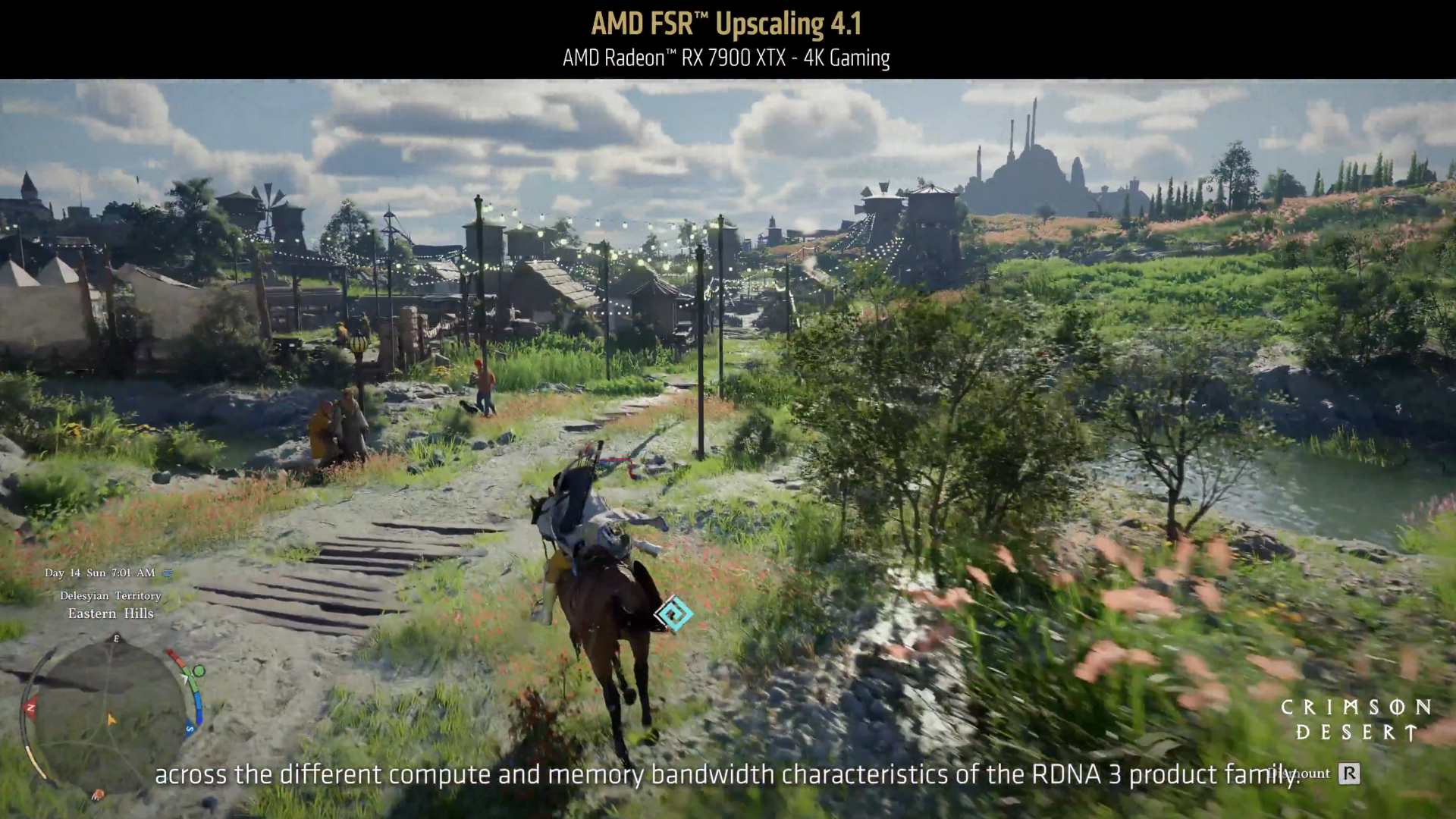
A Lighterweight Version Is Being Prepared for APUs
Whether APUs would receive FSR 4.1 recently became the subject of debate, but AMD has now confirmed that they will indeed receive official support, although it will probably arrive later. AMD stated that it is preparing a lighter AI model for them, which should achieve better performance on these less powerful integrated GPUs.
Image Quality and Performance Should Be Better Than the Previously Leaked Version
Thanks to the optimizations that have been made, AMD says that the INT8 version of FSR 4.1 for Radeon RX 7000 cards should come fairly close to the image quality of the regular FP8-based FSR 4.1 running on Radeon RX 9000 graphics cards.
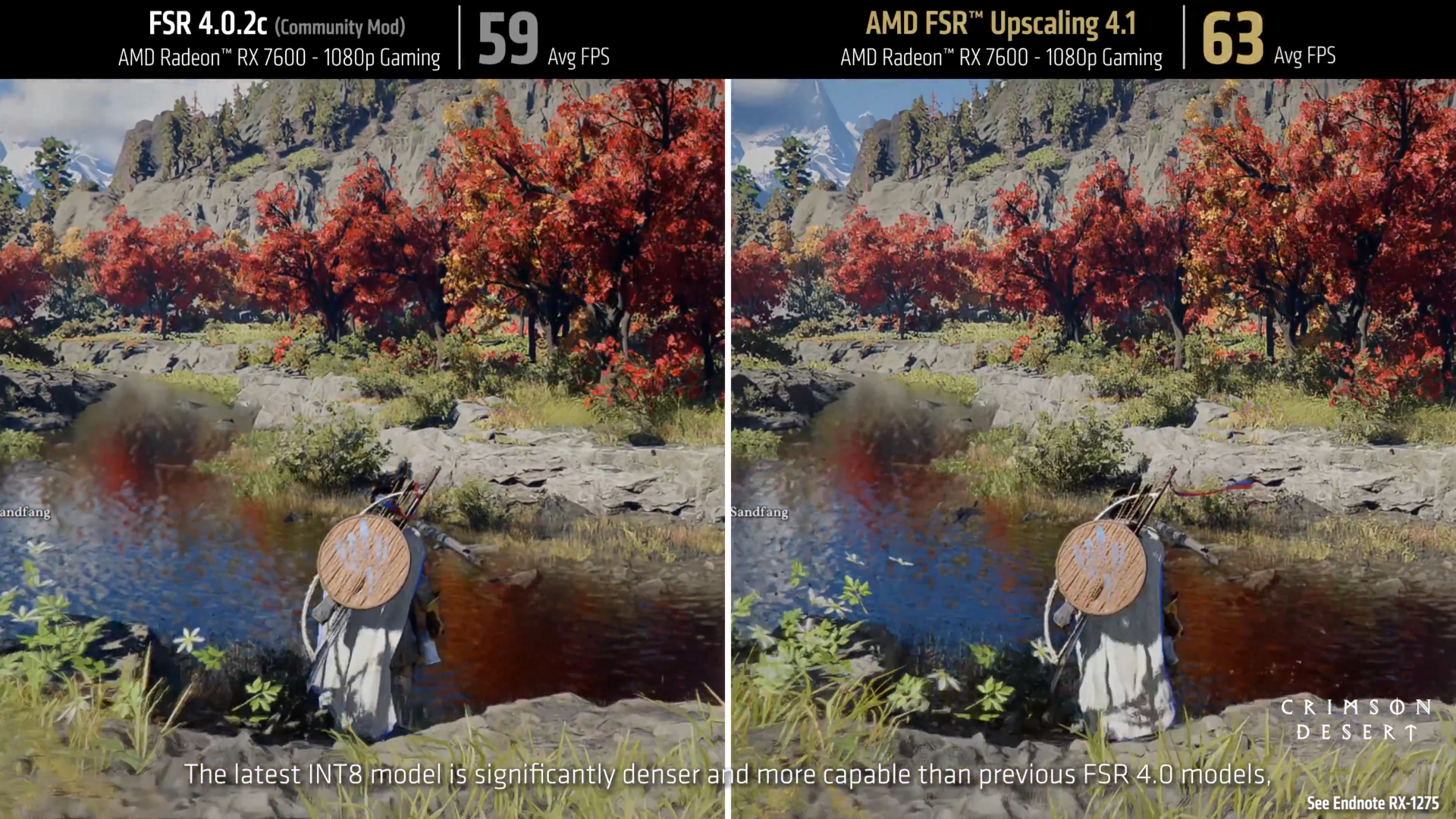
Interestingly, in a short video accompanying this announcement, the company compares the newly officialy released FSR 4.1 not only against FSR 3.1 but also against the leaked FSR 4 version (4.0.2c), which you could use for some time unofficially through mods. Compared to that version, the officially available FSR 4.1 should offer better visual quality and possibly even slightly better performance—the video shows a somewhat higher frame rate.
However, FSR 4.1 on Radeon RX 7000 graphics cards will generally be more computationally demanding than the previously available FSR 3.1 upscaling that does not use AI. The time spent upscaling each frame should increase. With the same scaling factor, a lower frame rate should therefore be expected, but in exchange you ger better image quality. This should often make it possible to use a higher scaling factor with FSR 4.1 (a faster upscaling preset, such as Balanced instead of Quality). In such a scenario, FSR 4.1 could ultimately deliver higher performance in terms of achieving a higher final frame rate as well, although this may depend on how well the AI upscaler works for a given game.
Sources: AMD, VideoCardz (1, 2, 3)
English translation and edit by Jozef Dudáš
⠀