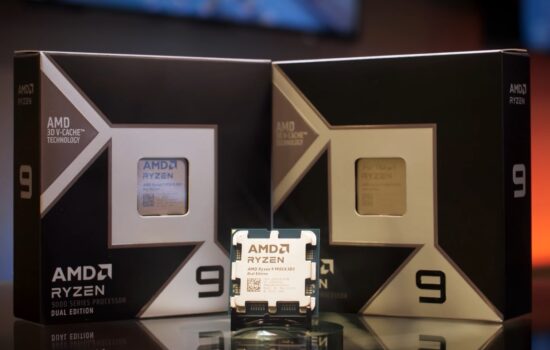
In August, we had a report that AMD is preparing new Ryzen 9000 processors aimed at gamers: a 16-core chip that would no longer have its large 3D V-Cache only on half the cores (or better said under, as the cache die sits beneath the core die), but on both, and a new gaming 8-core with V-Cache. The specifications have now surfaced, and it looks like both CPUs could be a bigger surprise than expected.
More information about them was revealed this week by Chinese leaker Chi11eddog. According to him, the new models that are on their way are designated Ryzen 7 9850X3D and Ryzen 9 9950X3D2. This directly indicates that these models will be the higher-performance successors to today’s 9800X3D and 9950X3D models.
Ryzen 7 9850X3D: AMD to extend its lead over Intel
The Ryzen 7 9850X3D will be an eight-core processor with a 120W TDP. What will be special about it are significantly better clock speeds. Last year’s Ryzen 7 9800X3D model has a maximum boost of 5.2 GHz, which is considerably lower than the maximum single-thread boosts of Ryzen 9000 series without 3D V-Cache, which reach up to 5.7 GHz. While the cache more than makes up for this in games, it does not in application software. There, the single-thread performance was lacking as a result, making the Ryzen 7 9800X3D somewhat of a “trade-off” processor.
The new 9850X3D model will not be like that. According to Chi11eddog, this model has a base clock of 4.7 GHz and a maximum boost of 5.6 GHz, thus practically without the previous compromise in non-gaming applications. Gaming performance, however, will also increase as a result. The processor still has the same 96 MB L3 cache as the 9800X3D model, but with a 7.7% higher clock speed, it should gain some additional percentage points in gaming performance. This will further extend the lead that AMD currently holds over Intel in CPU gaming performance.
Intel is preparing a refresh of its Arrow Lake processors for the beginning of next year, but it will likely not even catch up to the 9800X3D, whereas the new 9850X3D will set the bar a little bit higher.
Ryzen 9 9950X3D2: The new top-tier CPU?
The second upcoming model will be an improvement on the existing sixteen-core Ryzen 9 9950X3D, which has 128 MB L3 cache in an asymmetric configuration. Eight of the cores in this older model have 96 MB L3 cache thanks to the added 3D V-Cache (and the clock speed of these cores is limited to approx. 5.2 GHz, as in the 9800X3D model). The remaining eight cores have just the standard 32MB L3 cache, but a maximum boost of 5.7 GHz. This, as mentioned, serves for better application performance—a software layer ensures that games preferentially use the first group of cores and single-threaded applications use the second.
The new Ryzen 9 9950X3D2 (if that is indeed the final name for this model) is said to have 192MB L3 cache, meaning 3D V-Cache for both groups of cores (under both CPU chiplets of the processor). This processor will therefore not require special assignment of tasks to one or the other type of core. Gaming performance, just like with the 9850X3D, should see a further increase too.
And just like the previous model, it will have that high boost for single-threaded tasks—the base clock is said to be 4.3 GHz and the maximum boost again 5.6 GHz. The downside will be that power consumption will apparently increase compared to the current top models for the AM5 socket—TDP will be 200 W instead of 170 W. This most likely means that the so-called PPT, which is the actual power consumption limit, will also increase—from 230 W to 270 W, if the usual 1.35× ratio still applies.

However, it should be noted that the existence of these processors is currently known from only one source. So for now, this report should be taken with a grain of salt.
X3D issues with high clock speeds fixed?
Increasing clock speeds from 5.2 to 5.6 GHz might seem like a simple thing, but it is actually a breakthrough, if this report is legitimate. From the beginning, 3D V-Cache suffered from a deficit in achievable clock speeds, which was rooted in the technology itself—the 3D chiplet interconnects were not capable of handling the high voltages that the CPU cores needed for high boost clock speeds. This limited the potential of these processors. If this deficit has really been reduced to just 100 MHz, that is significant news.
This is also the reason why a 16core model with 3D V-Cache for all cores, which AMD had previously refused to release, can now be launched. One CPU chiplet in 12-core and 16-core models was always left without 3D V-Cache precisely so that the CPU could achieve high boost on it for the needs of single-threaded software. The 9950X3D2 model with a 5.6 GHz boost no longer needs this; a 100MHz reduction is probably not substantial anymore. Actually, if the application performance of Zen 5 cores benefits just a tiny bit from the 3D V-Cache, the 100MHz disadvantage could easily to be eliminated.
How this was achieved is not yet clear. If AMD manages to keep 3D V-Cache from incuring the cost of worse clock speeds in the next generation (Zen 6) as well, we might possibly no longer see any more asymmetric processor versions where one half of the cores has 3D V-Cache and the other does not.
We do not yet have information on when AMD plans to release these processors; Chi11Eddog does not share this. The company could launch them in January at the CES 2026 trade show, thus directly competing against the refreshed Core Ultra 300 models that Intel is preparing.
English translation and edit by Jozef Dudáš
⠀