The GeForce RTX 5080 series gaming graphics cards go on sale today, and simultaneously, we can now publish performance test results. The biggest improvement over the last generation is an interesting performance boost in the most demanding titles at 4K and support for new standards and technologies. The edge is especially gained in demanding ray tracing scenarios, and vice versa.
Closing summary
Although we’re not testing many games yet, it’s clear that next to the RTX 4080, the RTX 5080 is better suited to scenarios with higher graphics demands. With lower resolutions and less demanding visuals, the gap between the two models narrows. The RTX 5080 handles demanding ray tracing significantly better. But games are also moving more in this direction, and in titles that don’t use ray tracing yet, graphics cards usually don’t have a performance problem.
If we had stuck to the suggested prices at launch for the evaluation, we would have had reason to rejoice. The last-gen RTX 4080 was launched with an MSRP of 1199 USD. The RTX 5080 has an MSRP of 999 USD, down 200 USD. But after that came the RTX 4080 Super for the same 999 USD. So the newcomer matches its price and offers more performance for it. But the increase in raw performance is not very high, Nvidia is betting more on an increase in performance thanks to Multi Frame Generation. To some extent, this is a repeat of the last generation scenario.
From a quick look at the stores, it doesn’t look like any big RTX 4080 discounts are happening. Given that the RTX 5080, which is about a fifth more powerful in 4K in the most optimistic scenarios, should start selling tomorrow, I’m already worried about what the prices of non-reference cards will look like. One can suspect that manufacturers will set prices for new models so that RTX 4080 Super stocks will sell out without big discounts.
DLSS 4: Two extra frames with similar responsiveness
I’ll point out again that the idea that the card only renders every fourth frame in 4× multi frame generation mode tempts people to think that the response time will be longer than in single frame generation. This is not the case, the response time in 3x and 4x mode is not significantly worse compared to what we know with frame generation with a single intermediate frame from the last generation. In both single frame generation and triple frame generation, only one rendered frame is still being deferred. The only difference is that the card stacks more frames generated at a higher speed in front of the rendered frame.
However, the basic principle that the card postpones rendering the last rendered frame remains. So the same applies to Multi Frame Generation as it does to frame generation in RTX 40 – it’s not suitable for situations where you’re starting from too low a frame rate and interpolating to, say, a smooth 80. In that case, while the image is not jerky, it has a noticeable lag behind mouse movement. It’s similar to playing at 25 frames per second. When rendering at a low 25 frames per second, the long response time is natural and will not be improved by adding three generated frames before the rendered frame.
Therefore, it is a good idea to adjust the detail settings to achieve higher base frame rates and then interpolate from there to higher frame rates for fast monitors. If the graphics card doesn’t have enough horsepower to run games with the given settings, this means either lowering the detail or using classic DLSS in one of the Quality, Balanced or Performance modes along with the frame rate generation. Once you get to a base 40–50 frames per second, it still won’t be for pro gaming or frenetic shooters, but everything else can be played comfortably.
Higher performance for higher consumption
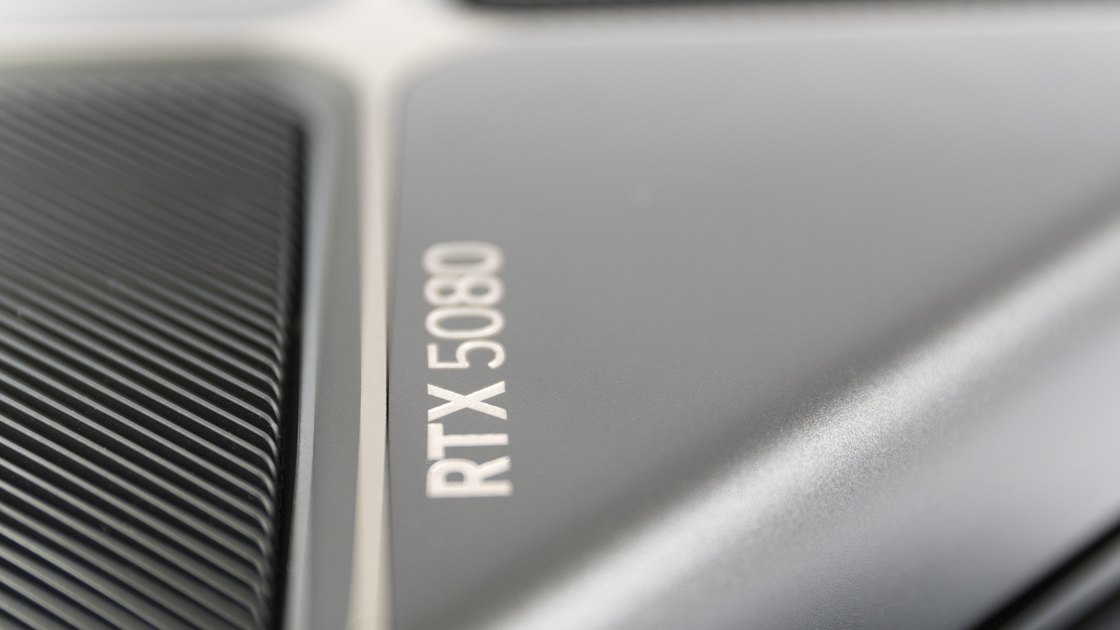
What was true of the RTX 5090 in relation to power consumption can also be said of the RTX 5080. The manufacturing process node has not improved significantly, and so the RTX 5080 also delivers higher performance, but at a higher power consumption. In the case of the Founders Edition, it’s clear that a similarly designed cooler handles the lower-power card better. Still, the fan control could have been a bit quieter at the cost of higher chip temperatures.
When it comes to performance, in some scenarios the difference is big, but especially at lower resolutions the edge is not so significant. But the trend in game development is clear, demanding ray tracing is becoming the standard for big titles and developers are equally taking advantage of the opportunities that upscaling gives them to push the demands on the graphics card much further.
The performance difference isn’t enough to give RTX 4080 owners a reason to upgrade. It’s more a question of whether to choose the RTX 4080 Super or the RTX 5080 when buying a new card. At similar prices to the RTX 4080 Super, or at a small premium, the new card is clearly more prospective, in which case buying the RTX 5080 can be clearly recommended.
It will ultimately depend primarily on the market prices of non-reference models and the actual availability of the cards. Unless the RTX 5080 will sell for significantly more, there is no reason to prefer RTX 4080 Super.

Pros and cons
+ High performance for 4K gaming
+ Compact design while maintaining good performance
+ Decent performance gains in the most demanding scenarios
+ Compared to RTX 40, the bonus of DLSS 4 with Multi Frame Generation
+ Support for new standards
+ New features for professional use (AI, video processing)
– With less demanding ray tracing and at lower resolutions, the performance increase is smaller
– Fans could run at lower speeds
– Increase in power consumption, performance/watt ratio similar to last generation