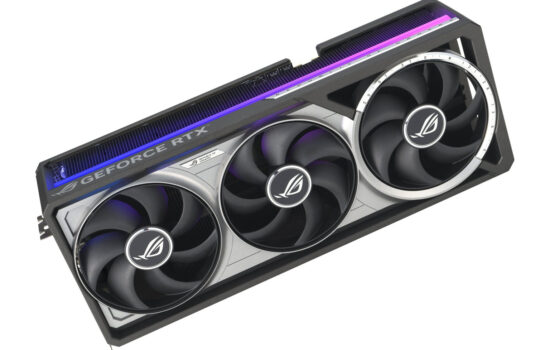
We already reported on reports of Radeon GPU price bumps coming this month. Unfortunately, the move won’t be limited to AMD cards. Shortly after, similar news started coming about competitor GPUs as well. The price rise will thus happen across the market, making them pretty much unavoidable for graphics card buyrs. The main factor behind these price hikes should be the AI boom, which is massively driving up memory prices.
This information, like the reports of planned Radeon price hikes, appeared on the Board Channels forum, where leaks from Asian hardware makers can often be found. According to Board Channels, card makers are also preparing price increases for Nvidia graphics cards on the Chinese market, which are planned to go into effect during the current month (November). One of these makers is Colorful, which sells cards mainly on the domestic Chinese market and which has reportedly already implemented the price move. Another brand, Galax, which is also active on the global market, will reportedly raise prices next week.
This report does not say that the prices of GPUs and/or GDDR6 or GDDR7 memory the card makers pay were raised by Nvidia itself, nor that the price hike is global. It is likely, that card makers are raising prices because their costs are rising however, which affects the entire market globally, and it is likely that Nvidia itself is also raising memory prices in this case. That likely means the increase will eventually affect all card makers, who will more or less pass it on to end customers in the price of graphics cards. And since price hikes have already begun in Asia, they may show in European and American markets very quickly.
Dozens to Hundreds Extra for Expensive, but Also Cheaper Cards
The largest price increase is for the GeForce RTX 5090D V2 graphics card, which should stop being produced altogether, as Nvidia has reportedly stopped supplying the GB202 chip for consumer graphics cards. Colorful, or possibly Nvidia, may be raising the price of the last batches essentially just to extract the maximum from buyers who will line up to get their hands on the last batches of the SKU, which are guaranteed to sell out. Colorful will reportedly raise the price by 2,200–3,300 Chinese yuan, which corresponds to around 285 to 450 EUR.
The GeForce RTX 5080 is also to become more expensive, by 2,500–2,800 yuan (325–365 EUR). Here too, the reason may be that Nvidia is reportedly ending chip supplies. Nvidia is reportedly winding down production of the existing 16GB version of the card, but has not yet begun the production of the GeForce RTX 5080 24GB models, which are to arrive next year as a replacement. The RTX 5080 16GB cards may thus be selling out, which may lead to considerable inflation in the prices of the last units (and potentially also inflate the pricing of the first batches of 24GB models when those reach the market).

On the global market, GeForce RTX 5080 cards have already become more expensive for this reason, recording prices that exceed double the original recommended price ($1,000) in some places. In our market, the situation has not gone that far yet; the largest czech e-shop, Alza, currently has the cheapest card for roughly 1,880 EUR, whereas the original recommended price was 1,199 EUR. This means that the price increase relative to the original recommended price works out to cca +50%.
A milder but still unpleasant price increase is expected for the GeForce RTX 5070 Ti and GeForce RTX 5070. The former is to rise by 1,000 yuan (about 125 EUR), the latter by 600–900 yuan (80–125 EUR).
The price increases also affect cheaper models: the GeForce RTX 5060 Ti will rise by 250–400 yuan (33–53 EUR) for the 16GB version and 100–250 yuan (12–33 EUR) for the 8GB model. The GeForce RTX 5060 will go up by 150–200 yuan (around 20–27 EUR).
These are prices for China including the local sales/value-added tax, which should be lower (13%) than the usual European rate. If the same increases were carried over to EU market, they would therefore probably be several percent higher precisely because of the higher VAT rate.
Unfortunately, this is probably not the last price increase for graphics cards for gaming PCs. The memory prices (and probably the prices of the GPU chips themselves) will keep going up for as long as the hype and hunger for potential future profits in the artificial intelligence sector continue going strong, fuelling the investments in data centers. Saturation of demand for DRAM chips is not expected in the near term, so it is possible that gradual price increases may continue throughout 2027 and perhaps beyond. And price hikes like this coming successively every month may not be an exceptional phenomenon either.
Source: VideoCardz
English translation and edit by Jozef Dudáš