


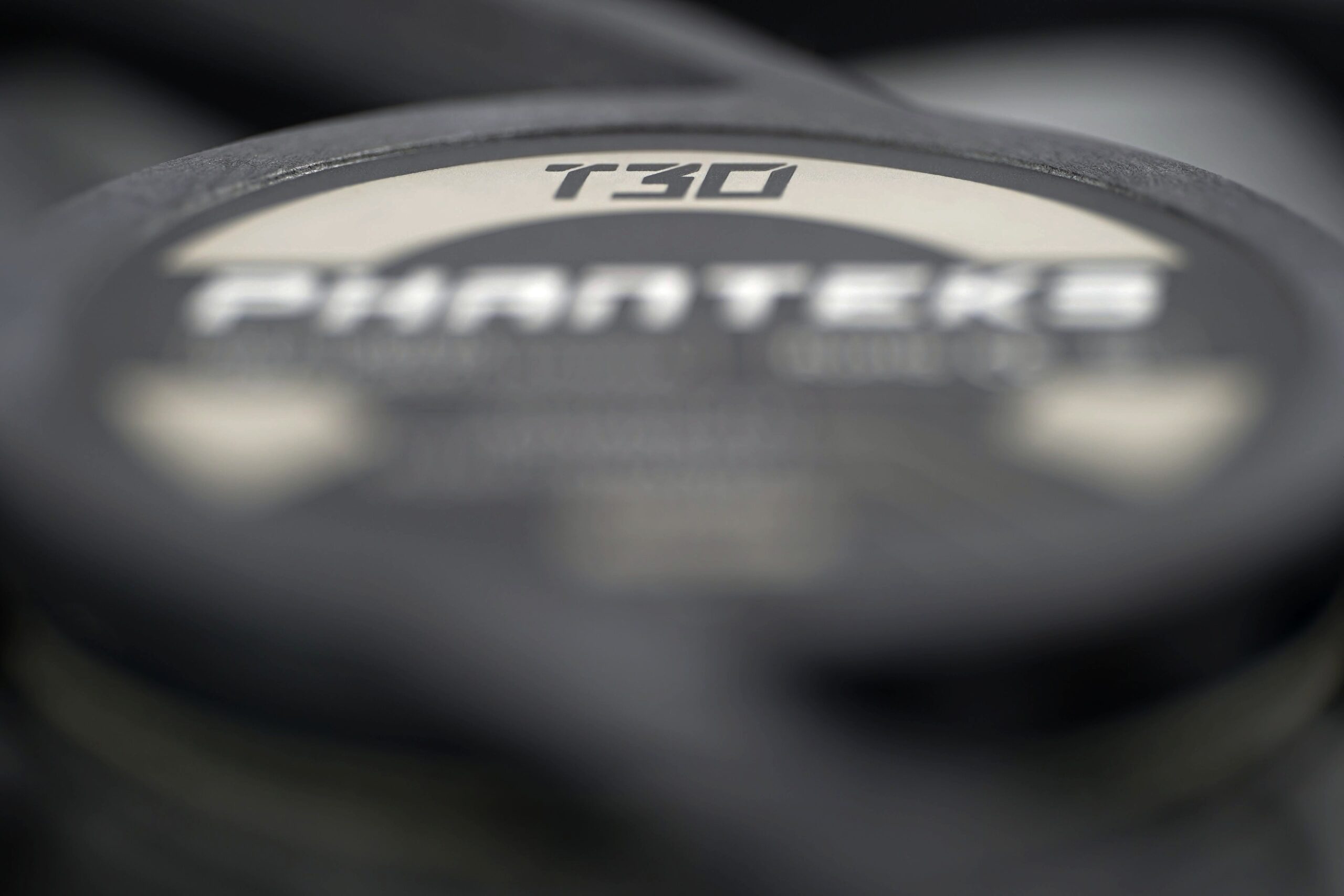
The long-anticipated 30 mm-thick fan in the 140 mm format has become reality. Albeit with a delay, Phanteks has finally expanded its official sales page to include the long-awaited new model—T30-140. The geometric foundation is derived from one size smaller “ready-to-wear size” of the T30-120 fan. The expectation of attractive results is therefore well grounded. The “legendary” T30 fan series has at last grown to include a bigger brother.

Phanteks is bringing to market a 140 mm version of a fan that, in its 120 mm format, pushed performance limits and thanks in part to its thickness even outperformed the then-reigning king, namely the first generation of Noctua’s Sterrox fan (NF-A12x25). Only the arrival of the second-generation NF-A12x25 (G2) returned the crown to the talons of Athena’s owl from Austria, despite its standard 25 mm thickness. On the other hand, it must be noted that even several other manufacturers that opted for a thicker profile in this battle failed to reach Phanteks’ level of success. It is therefore evident that Phanteks devoted long-term, meticulous effort to the design. All the more remarkable, then, is the return of the king in the form of Noctua’s second-generation A-series fan, which managed to surpass this notable Phanteks achievement while retaining a standard thickness (25 mm).
The road to the T30-140 was longer than originally planned, however, and its launch is shrouded in a veil of uncertainty. When Phanteks introduced the PH-F120T30 in 2021, few doubted that it was one of the most technologically ambitious fans on the market. The combination of a 30 mm-thick frame, LCP material, and aggressive blade geometry pushed boundaries in both airflow and static pressure—even at noise-normalized levels and across various applications. In testing, the T30-120 established itself as a reference model for radiator as well as system use, especially where the greater thickness did not compromise compatibility. The question “when will the 140 mm version arrive?” has since appeared in virtually every discussion about top-tier fans. The answer finally comes in the form of the Phanteks T30-140, which began appearing for sale at the end of December, so far only on the U.S. market and without any significant global communication from the manufacturer. The price of a single fan is set at USD 39.99, while a three-pack is priced at USD 114.99.
Interestingly, the T30-140 was not an unknown project. After its presentation at Computex in May 2025, various information emerged in community discussions that the launch was expected to take place in late June or early July. This was supported by several reports featuring Tenzin Rongen (Phanteks product manager). In the videos, the product appeared to be more or less finished, with development work spanning more than five years seemingly nearing its end.
Among several noteworthy details from the mentioned videos, one stands out: the existence of two balancing rings, visible in footage featuring Mr. Tenzin (Gamers Nexus).

Balancing rings are used for final impeller calibration, similar to wheel balancing in motor vehicles during geometry checks. While wheels—or even other high-end fans that perform such geometry checks—may feature a similar system (for example, ID-Cooling Boreas), Phanteks likely performs this process more meticulously.
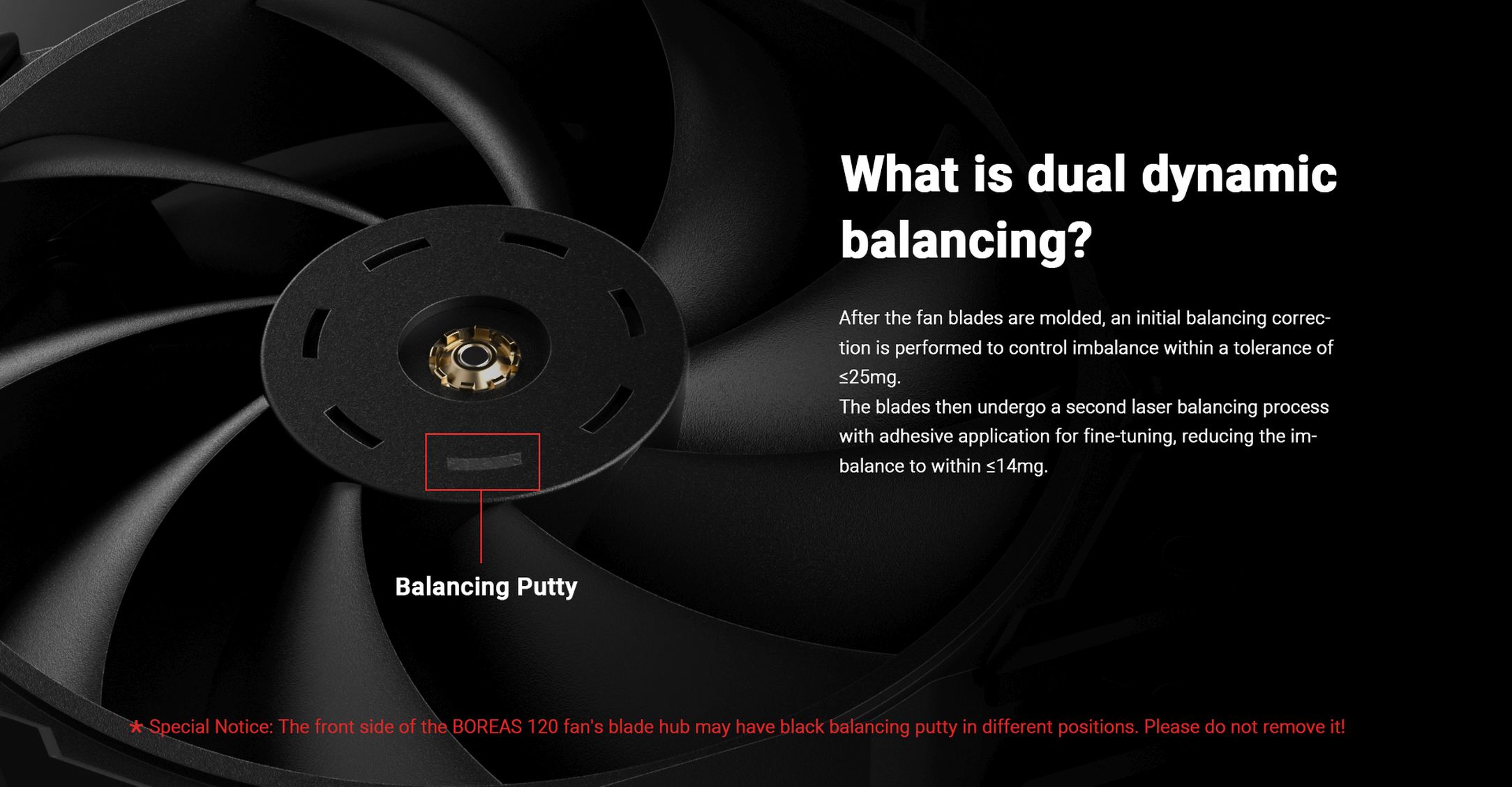
Mr. Tenzin Rongen himself speaks of an advanced form of geometry control. For more precise balancing, two rings are used instead of one. Specific sections of the ring are filled with a special putty (that hardens over time) in the process of checking the rotor balance.
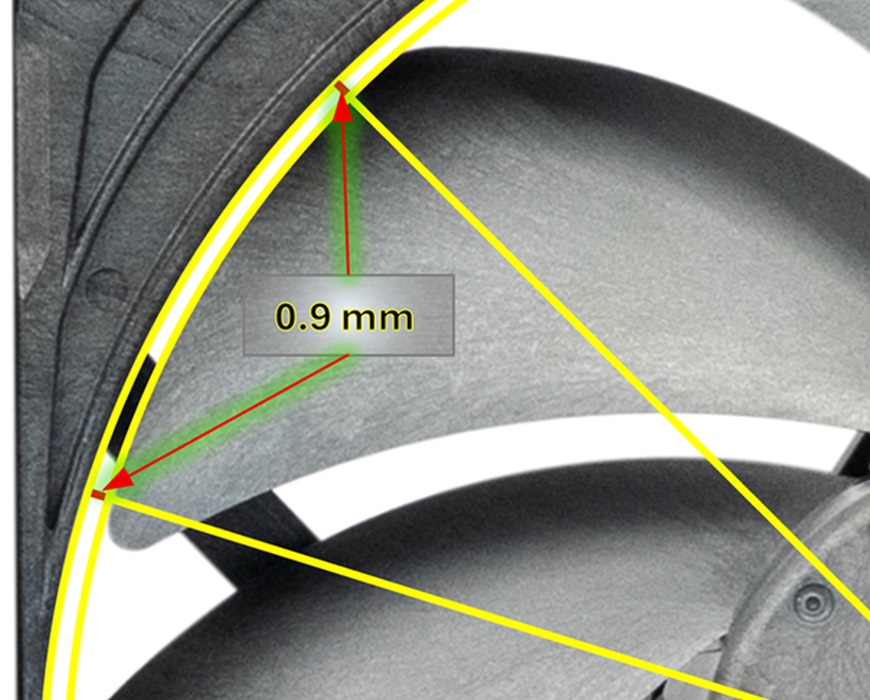
This dual-ring balancing solution may also relate to another feature Mr. Tenzin highlighted in the interview: the stated clearance between the blade edge and the inner fan frame is only 0.9 mm and remains consistent along the entire blade edge, not just between the blade-tip and the frame (where it matters most). Simply put, the blade edge and the frame are parallel and equidistant at every point.
Edit – 24/02/2026: According to the latest information, the tip of the blade is only 0.8mm away from the frame, while the parallel gap of the blade edge from the frame is still stated to be 0.9mm. (Although I don’t know how two parallel lines can have different distances, we’ll leave that to Ľubo’s measurement in March)
However, when the fan failed to appear over the summer, various speculations began to surface—ranging from development issues to outright cancellation of the 140 mm T30 variant. Phanteks never officially communicated the reasons, but community discussions most often cited fine-tuning aerodynamics for the 140 mm geometry, manufacturing challenges with larger LCP components, and the difficulty of maintaining the same quality standard achieved by the T30-120.
As noted above, the T30-140 has in fact appeared only toward the end of the year (December 2025) and, for now, exclusively in the U.S. There is still no mention of it on Phanteks’ global website, and European availability has not been officially confirmed. Another intriguing aspect of the T30-140 launch is the virtually nonexistent marketing campaign. No major press releases, no banners, no visible promotion. The fan simply appeared in the store. This contrasts sharply with the product’s expected significance and performance, reinforcing the impression that the T30-140 went through a more complicated development process than originally anticipated. On the other hand, it is also true that the successful T30-120 launch was not accompanied by a marketing blitz either, with its excellent results doing most of the talking.
The Phanteks T30-140 arrives later than expected, quietly, but with a very strong technical foundation. If it replicates what the T30-120 achieved in the 120 mm segment, it could become a new reference point in the 140 mm class as well. Conceptually, the T30-140 is exactly what was anticipated—a direct scale-up of the T30-120 philosophy. At its core is once again a 30 mm-thick frame (the standard is 25 mm), LCP (Liquid Crystal Polymer) for both frame and blades, a highly efficient 3-phase motor from Sunon, and Dual VAPO bearings with magnetic stabilization for improved balance at low RPMs as well as reduced friction, contributing to longer service life. Like the T30-120, the T30-140 features a hardware mode switch on the frame for quiet, power-efficient low-RPM operation (Hybrid), a balanced mode (Performance), and finally a no-compromise maximum-performance mode (Advanced). This allows users to physically limit the fan’s maximum speed without having to manage curves in BIOS/UEFI or dedicated software.
| Parameter | Phanteks T30-140 | Phanteks T30-120 | |
| Dimensions | 140 × 140 × 30 mm | 120 × 120 × 30 mm | |
| Material | LCP (frame + blades) | LCP (frame + blades) | |
| Bearings | Dual VAPO | Dual VAPO | |
| Torque | 3-phase | 3-phase | |
| Max. speed (Hybrid) | 1200 ±75 RPM | 1200 ±75 RPM | |
| Max. speed (Performance) | 2000 ±100 RPM | 2000 ±100 RPM | |
| Max. speed (Advanced) | 2500 ±150 RPM | 3000 ±150 RPM | |
| Max. airflow | 237.18 m3/hr. | 171.4 m3/hr. | |
| Max. static pressure | 5.41 mm H2O | 7.37 mm H2O | |
| Max. noise level | 44.3 dBA | 39.7 dBA | |
| Max. current | 0.56 A | 0.41 A | |
| Control | 4-pin PWM | 4-pin PWM |
When compared with the T30-120, it is clear that these are siblings rather than merely products sharing a name, although there are some logical differences. Besides weight—which is unknown for the 140 mm format but can be expected to be higher—the specifications reveal differences in maximum power draw (and thus current). And while the larger sibling also supports fan daisy-chaining, at the highest performance mode (Advanced) we cannot recommend any daisy-chaining on a standard motherboard header rated at 1 A.
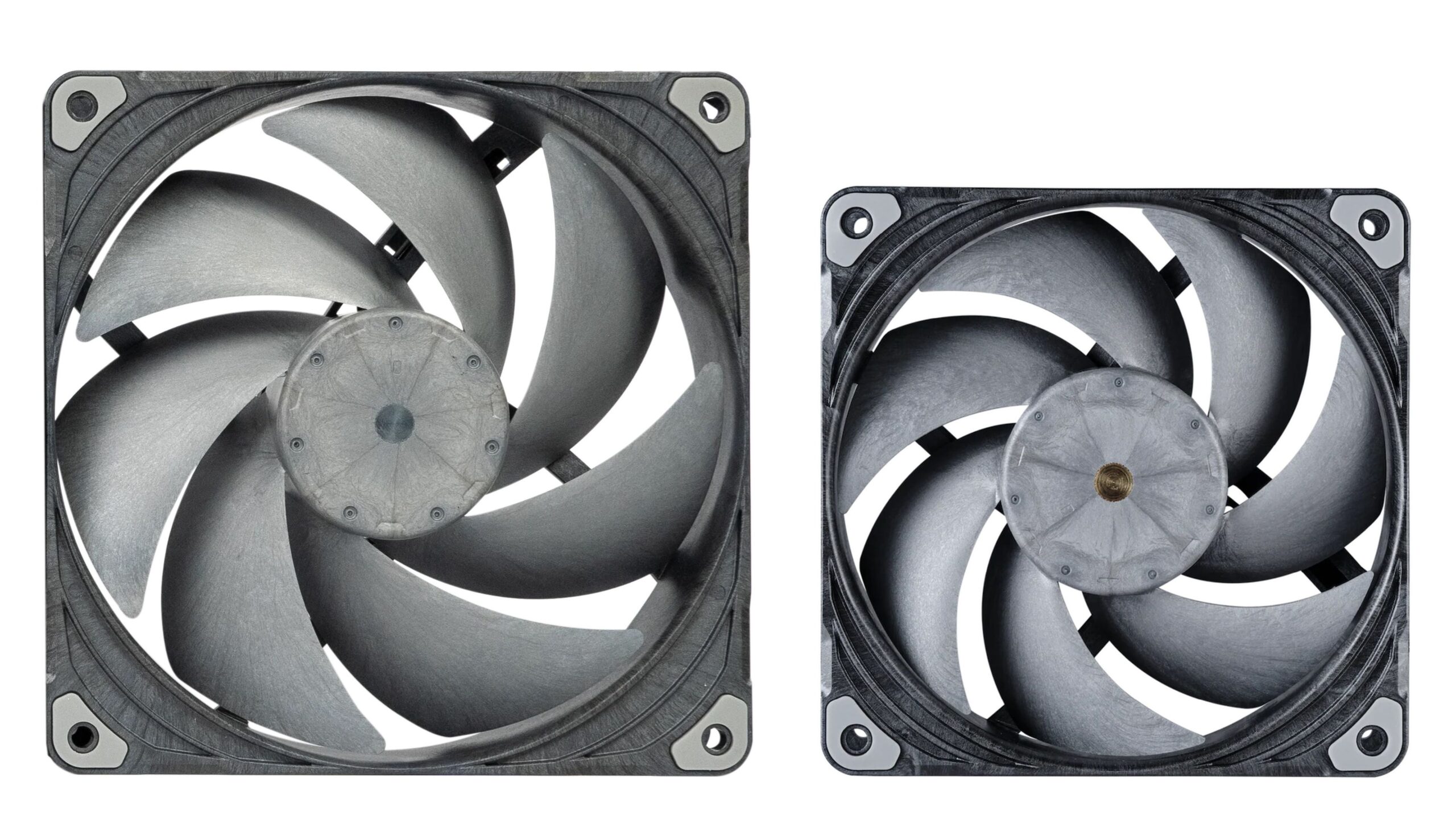
Beyond numerical differences, a closer look also reveals some changes in the blade geometry itself. The blade tips on the 140 mm variant are not as sharp; conversely, the blade pitch near the impeller hub is steeper, and the curvature of the leading edge appears slightly gentler—judge for yourself. The hub area/size, however, seems to have been retained.
In closing, it is fair to say that the wait was long, but the potential appears substantial. The Phanteks T30-140 arrives quietly, yet with a very strong technical foundation. If it repeats what the T30-120 accomplished in the 120 mm segment, there is reason for excitement. However, in this format it faces not only the traditionally strong challenger in the form of the NF-A14x25 G2, but also another formidable opponent in the Fractal Design Momentum 14 ARGB. We therefore look forward to a (hopefully) soon and thrilling review in the battle for the throne of the larger 140 mm format.
English translation and edit by Jozef Dudáš




Thank you for the great news report packed with information! 🙂
Hmm, this 140 mm fan could really shake things up. 🙂
What will be particularly interesting is the comparison with the Noctua NF-A14x25 G2 PWM.
Looking at the spec table and the mirrored comparison with the 120 mm model, the T30-140 shows higher airflow but lower static pressure. That’s quite natural, since the larger model not only has bigger blades (which determine airflow), but also larger gaps between them. Those gaps, in turn, influence static pressure.
With comparable geometry, larger gaps usually mean lower static pressure mainly because there’s more space for pressure to escape. Under restriction, more airflow lines leak in the undesired direction (away from the obstacle), reducing the airflow that actually passes through the obstacle—the part that scales with cooling performance.
That doesn’t mean the airflow is lower than that of a smaller fan with higher static pressure. Static pressure only expresses how well a fan can push air in a restrictive environment. A higher number means it can push more air—but the baseline matters.
140 mm fans have a higher baseline airflow, and even with lower static pressure, the airflow drop across a radiator is smaller. As a result, a 140 mm fan with lower static pressure but higher airflow delivers higher cooling performance overall.
I’m spelling this out because this relationship doesn’t make sense to many people. The smaller the fan, the higher the static pressure tends to be—due to a smaller “idle” cross-section, mainly between blades and also between blades and the frame. Larger-format fans, however, usually have higher airflow, and that airflow is the key factor for cooling performance. 🙂
I’m even more curious to see how they will perform in tests, which I can’t wait for as always!
I believe tests of the T30-140 fans will appear sooner rather than later. We don’t have any news about samples yet, but that may change once European retail availability ramps up. 🙂
I dislike the hybrid mode in these, makes it much harder to force them to run at expected speeds, you need to set up a faster mode to make them run slower! But somehow that still performs oddly, probably depending on the exact controller it’s connected to? I remember having T30-120 running fine in the past, but a few months ago I couldn’t force it to slow down no matter the mode, in faster modes it just ignored low PWM settings and stayed at higher speed…
I have no personal experience with the T30 😛
… but with the ThermalTake ToughFan 12 Pro it was almost impossible to control the RPM, with DC regulation. The TF 12 Pro motor simply required PWM modulation. Did you happen to update the UEFI? …while doing so, the control can switch to “Auto” or “DC”, which can go unnoticed.
Yes, some fans genuinely struggle with DC regulation. It mostly comes down to which type of control the motor was primarily designed for. Especially with cheaper PWM models, optimization for DC control is often limited, which can result in exactly what you’re seeing with the Toughfan 12 Pro.
That said, there are also fans where linear voltage control allows for lower achievable speeds. It really depends on the specific fan. As is often the case, the final outcome depends on multiple technical factors. 🙂
it may be some weird interaction between the PWM controller, modes switch and the mobos ability to tune fans whatever that means, after all if I set it to certain percentage it should send exactly that signal, but maybe it has some broken speed map and attempts to send speed percentage instead of PWM? hard to tell, I gave up as I didn’t have enough time to play with it recently and it’s not as important, the fan has it’s pretty place in the drawer and remains unused for now
When using the same fan, setting the same PWM duty cycle does not necessarily guarantee the same result. It sounds strange, but PWM signal quality itself can vary, and what really matters is how well the fan’s internal IC can interpret that signal.
We discussed this with Noctua as well, around the release of their NA-FH1 fan hub. If the PWM signal quality is insufficient and too many errors occur during interpretation by the fan’s controller, the result can differ compared to a clean, correctly read signal. This likely applies across different fans and different control implementations.
That’s probably why “20% PWM” doesn’t always behave like 20%. 🙂
that absolutely makes sense
and it’s entirely possible last time I tried T30 it was on a different mobo, I can’t be sure as I don’t have a complete history of my purchases to verify that
Yes, many things are possible. In any case, it’s true that different signal sources can result in different fan speeds, even when the PWM control is set to the same percentage value. 🙂
— „… u need to set up a faster mode to make them run slower!“
Phanteks might be a bit unusual in this regard. You’re right—our T30-120 tests mention that the lowest “Hybrid” mode resulted in the highest minimum speeds. That’s not typical. Usually, minimum speeds remain the same across switch positions on higher-speed fans (like the PCCooler F9 R120, for example).
It actually seems to work as if a resistive adapter were placed between the fan and the motherboard, lowering the supply voltage so that lower maximum speeds are achieved. Sometimes this can also affect minimum speeds, although typically lower voltage also means lower minimum RPM.
Essentially, the original 12 V is reduced to something like 9 V or even lower, and PWM then operates on that reduced voltage. The PWM (impulse) control itself remains intact, but the voltage ceiling changes. This behavior likely depends on how the individual fan motor handles startup voltage versus sustained operation. It’s probably very fan-specific. 🙂
since the hybrid mode is semi-pasive it’s expected to cut off at some point, but iirc it does so at 50%, a speed much higher than lowest possible in two other modes, and that’s pretty weird
I know I had a mobo in the past that was unable to set PWM below 50%, but that was literally the cheapest H61 on the market, cheaper than the fan itself, so I doubt anyone would pair them
personally I’d set it not higher than 20% and that would make sense, still allowing reasonable control
Once we get access to T30-140 samples, we’ll examine this properly as part of the analysis.
So the semi-passive behavior applies only to the Hybrid mode, correct? In addition to having the narrowest speed range, that’s also the only mode where the motor actually stops, while in the other modes the fan keeps spinning at some minimum RPM. Is that right? 🙂
I honestly don’t remember the second part, some fans do stop when supplied PWM below their supported range without explicitly declaring it (but I think that may be the motor failing to provide enough torque but still trying vs cutting off the motor completely), T30 at hybrid mode stops at 50% and declares that
— „… I think that may be the motor failing to provide enough torque but still trying vs cutting off the motor completely…“
That’s possible, I don’t know—I wouldn’t dare speculate on this. It’s a topic that someone from the development team responsible for the fan design would probably be able to answer much better. 🙂
Meanwhile, the Arctic P14 Pro Reverse have been released, and they also have a 30 mm thickness. I think they will be great, especially considering their price.
Yes, Arctic P14 Pro Reverse fans could also be a serious contender for the Phanteks T30-140—at least in terms of aerodynamic design. We’ll see whether they make it into testing as well. For now, from the new reverse-flow Arctic fans, we’re planning to test only the P12 Pro Reverse models. 🙂
I will say, it kinds of bugs me that Phanteks didn’t do something like the Momentum for the D30 series – aka, guts like the T30 series and a slightly smaller impeller, but ARGB in the rim. Maybe for the D30 Gen2?
Do you consider the increased thickness (30 mm instead of the standard 25 mm) to be the main drawback of the D30? Yes, compatibility is worse with fans like these, and Phanteks may not see the combination of LCP blades with ARGB (perhaps that’s what you’re referring to?) as particularly important. I don’t know—we’re only speculating here. The design of Phanteks’ illuminated fans is likely based on some internal rationale, at least from their point of view.
If you can formulate a more specific question, we can pass it on to Phanteks. And if we get a response with meaningful technical insight, we’d be happy to publish it. 🙂
The LCP with ARGB thing, yeah. The D30 is, from the reports I’ve seen a decent but not that standout premium radiator/general purpose fan (hint if you want to do some testing). They did make the Halos ARGB rim that would allow adding that to the T30 series but the availability is dodgy, more’s the pity. I like the thickness, I don’t see the problem with it in most use cases – we’ve designed cases to have rads in most good spots for decades now, you can get in an extra thick fan in most places; to be honest, I am surprised there’s not more extra thick chassis/air cooler oriented fans. I’m betting, if they wanted to be adventurous for a P(premium, lol)30 fan following the example of the Momentum’s ARGB solution and illuminated framework but it generally being a T30 in all other respects, they’d have a contender to the throne of ARGB premium general purpose fans.
Hell, I wish there was more 40mm fans,tbh.
Yes, fans thicker than the standard 25 mm also make sense in cases. However, profile thickness primarily affects static pressure, and there’s a widespread belief among users that higher static pressure isn’t needed unless the fan is used on a heatsink or radiator. Of course, we know that higher static pressure also makes sense for case grills or dust filters—but regular users would need to perceive it the same way before manufacturers start producing and promoting 30 mm–thick fans specifically for cases. 🙂
Did you get a fan for reviewing from Phanteks yet? Since yesterday the T30-140 is available in Germany (Caseking) and the UK (Overclockers UK).
We don’t physically have the fan samples yet as of this date. However, we do have the shipment tracking number for the package that contains them. So yes—the fans are on their way to the test lab, and unless something unforeseen happens, tests of the Phanteks T30-140 will happen sooner or later. 🙂
Update: We now have the Phanteks T30-140 fan samples in the test lab. The plan is to get to the tests sometime in March 2026. 🙂
That’s great to hear! 🙂 Eagerly waiting for the review.
🙏
Shall we try and test the T30-140 at the beginning of March? The comparison with the Noctua NF-A14x25 G2 is bound to be worth it. 🙂