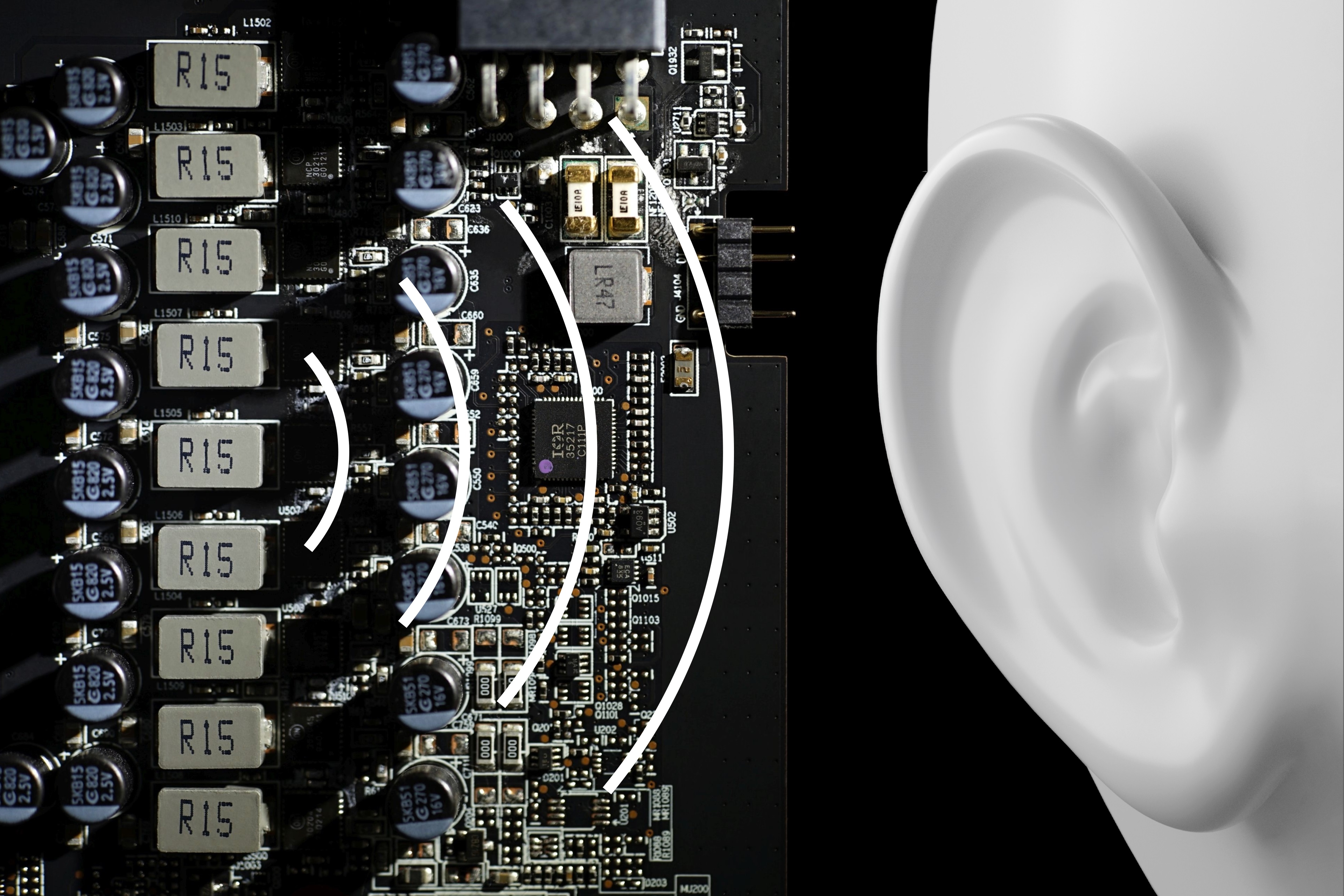
“After replacing the PSU, the video card coils stopped whining”. An extremely common statement and yet it always remains on a subjective level, which is a pity. But that is also why we will now look at things in an exact, numerical way. We do this by testing several graphics cards, where for each, noise levels of VRM coils are monitored with each ATX (3.0) power supply used. So how is it with the “whining”? When is it stronger and when is it weaker?
Noise level measured with a noise meter
Relative noise level
Explanatory note: Based on the results with each graphics card, we created three groups of rankings (from the quietest to the noisiest solution) that, when averaged, give a “relative noise level” number. From this, it is possible to make an approximate prediction of how much the noise level will increase with any other card. A lower number means a better (quieter) result. Naturally, this is only a rather imprecise estimate, which will not always be accurate. With the MSI MPG A850G with the best possible placement the lowest noise level is never achieved, but at the same time the opposite does not occur either.
Last week, we reported from the Computex trade show, visiting the booths of various companies. But we’ve got another photo report from Taiwan. We also managed to get into a Gigabyte factory, where the company produces motherboards and graphics cards, and we’re bringing you a gallery of photos from there. Contrary to popular belief, not all hardware manufacturing takes place in China – many components are made in Taiwan. Read more “Gigabyte factory photo tour: Mobo and graphics cards production”»
Performance testing is still under an information embargo, but today we can unpack the box, look at its contents and introduce the card in detail. and take a closer look at the card in detail. The Founders Edition design is unlike anything we’ve seen before in graphics cards. The design and craftsmanship are precise, and when you look at the dimensions of its dual-slot cooler, it’s hard to believe it can cool the nearly 600W GeForce RTX 5090. Read more “Nvidia GeForce RTX 5090 FE unboxing: Ultimate Design”»
Among RTX 4060 Ti graphics cards, Asus has multi-functional designs with an M.2 slot for NVMe SSDs. These, unlike other models, don’t waste the potential of the PCI Express ×16 interface so significantly. To evaluate this design, partial results from motherboard tests are now extremely useful. Those results that relate to the M.2 slot speeds and the efficiency of SSD coolers. After all, the Asus Dual RTX 4060 Ti SSD also competes in both disciplines. Read more “Rare host: How does an SSD work in the Asus Dual RTX 4060 Ti?”»
Great job, I don’t think anyone has ever tested this before! Indeed, the differences look quite small if compared to coil whine variance between GPU models. Based on your data, every other change will have a bigger impact than replacing the PSU. Undervolt, underclock, switching to a non-mesh PC case.
This is very interesting. Anecdotally, my 4090 Suprim X has occasional coil whine when working on Folding@home. Its not consistent, perhaps 1/24 hours it’ll whine, and of course its worse the more power its drawing. This was on my Corsair HX750 Platinum (2022? version) with the VHPWR adapter with 3 PCIE cables.
I switched to an FSP Hydro Ti 1000W and I used the native VHPWR cable and I haven’t noticed any whine since.
The sound that you have registered and no longer register may be the result of higher harmonic frequencies, which may eventually arise depending on the of noise in the power grid. The latter is always unique and each source may react differently to it. It is impossible to generalise here. What worked “somehow” with the same components in your country may work differently elsewhere (because the power supply is connected to a different network, with a different noise). And then there is what always applies. The sound that subjectively disturbed you may have disappeared, but the character of the coil whine may have changed so that someone else evaluates it as more disturbing (because again there may be a different frequency to which another user’s hearing is more sensitive, and which you may not mind). Personally, especially after this test, I have a great respect for this topic and I consider it advisable not to draw any conclusions, because they may be subjective. In any case, it is very dangerous to give any advice to anyone. They are always irresponsible because there are too many variables.
I think the idea is very cool, but the writing is very poor, overly wordy, meandering and back and forth… For example, adding snakey paragraphs of caveats (along the lines of subjective opinions or perceptions) to a conclusion is never interesting (and I would say, shouldn’t be the concern for an article, only to desperately fish likes on reddit etc).
Or when you want to explain the role of the PSU in the whole phenomenon (seemingly, interestingly as possibly the main culprit), you never actually say anything regarding the PSU… But mostly some general stuff about coils, with very indirect, vague sentences amounting to a murmuring. However an interesting detail is mentioned about VRM smoothing… Which actually brought me here, as I wonder if more or better VRMs or better PMW controller might work against it. Maybe a good topic on its own.
Subjective opinions or perceptions? Are you sure you are under the right article? I don’t understand any of your objections, but we will be happy to give you the space to show how this topic should be treated objectively. 😉
To provide the best experiences, we and our partners use technologies like cookies to store and/or access device information. Consenting to these technologies will allow us and our partners to process personal data such as browsing behavior or unique IDs on this site and show (non-) personalized ads. Not consenting or withdrawing consent, may adversely affect certain features and functions.
Click below to consent to the above or make granular choices. Your choices will be applied to this site only. You can change your settings at any time, including withdrawing your consent, by using the toggles on the Cookie Policy, or by clicking on the manage consent button at the bottom of the screen.
Funkčné
Always active
Technické uloženie alebo prístup sú nevyhnutne potrebné na legitímny účel umožnenia použitia konkrétnej služby, ktorú si účastník alebo používateľ výslovne vyžiadal, alebo na jediný účel vykonania prenosu komunikácie cez elektronickú komunikačnú sieť.
Predvoľby
Technické uloženie alebo prístup je potrebný na legitímny účel ukladania preferencií, ktoré si účastník alebo používateľ nepožaduje.
Štatistiky
Technické úložisko alebo prístup, ktorý sa používa výlučne na štatistické účely.Technické úložisko alebo prístup, ktorý sa používa výlučne na anonymné štatistické účely. Bez predvolania, dobrovoľného plnenia zo strany vášho poskytovateľa internetových služieb alebo dodatočných záznamov od tretej strany, informácie uložené alebo získané len na tento účel sa zvyčajne nedajú použiť na vašu identifikáciu.
Marketing
Technické úložisko alebo prístup sú potrebné na vytvorenie používateľských profilov na odosielanie reklamy alebo sledovanie používateľa na webovej stránke alebo na viacerých webových stránkach na podobné marketingové účely.
Great job, I don’t think anyone has ever tested this before! Indeed, the differences look quite small if compared to coil whine variance between GPU models. Based on your data, every other change will have a bigger impact than replacing the PSU. Undervolt, underclock, switching to a non-mesh PC case.
This is very interesting. Anecdotally, my 4090 Suprim X has occasional coil whine when working on Folding@home. Its not consistent, perhaps 1/24 hours it’ll whine, and of course its worse the more power its drawing. This was on my Corsair HX750 Platinum (2022? version) with the VHPWR adapter with 3 PCIE cables.
I switched to an FSP Hydro Ti 1000W and I used the native VHPWR cable and I haven’t noticed any whine since.
The sound that you have registered and no longer register may be the result of higher harmonic frequencies, which may eventually arise depending on the of noise in the power grid. The latter is always unique and each source may react differently to it. It is impossible to generalise here. What worked “somehow” with the same components in your country may work differently elsewhere (because the power supply is connected to a different network, with a different noise). And then there is what always applies. The sound that subjectively disturbed you may have disappeared, but the character of the coil whine may have changed so that someone else evaluates it as more disturbing (because again there may be a different frequency to which another user’s hearing is more sensitive, and which you may not mind). Personally, especially after this test, I have a great respect for this topic and I consider it advisable not to draw any conclusions, because they may be subjective. In any case, it is very dangerous to give any advice to anyone. They are always irresponsible because there are too many variables.
I think the idea is very cool, but the writing is very poor, overly wordy, meandering and back and forth… For example, adding snakey paragraphs of caveats (along the lines of subjective opinions or perceptions) to a conclusion is never interesting (and I would say, shouldn’t be the concern for an article, only to desperately fish likes on reddit etc).
Or when you want to explain the role of the PSU in the whole phenomenon (seemingly, interestingly as possibly the main culprit), you never actually say anything regarding the PSU… But mostly some general stuff about coils, with very indirect, vague sentences amounting to a murmuring. However an interesting detail is mentioned about VRM smoothing… Which actually brought me here, as I wonder if more or better VRMs or better PMW controller might work against it. Maybe a good topic on its own.
Subjective opinions or perceptions? Are you sure you are under the right article? I don’t understand any of your objections, but we will be happy to give you the space to show how this topic should be treated objectively. 😉
There is a mistake – Seasonic and MSI have the same spectrum image for the 4070 Ventus.
Thank you for the heads-up. It’s corrected! 🙂