


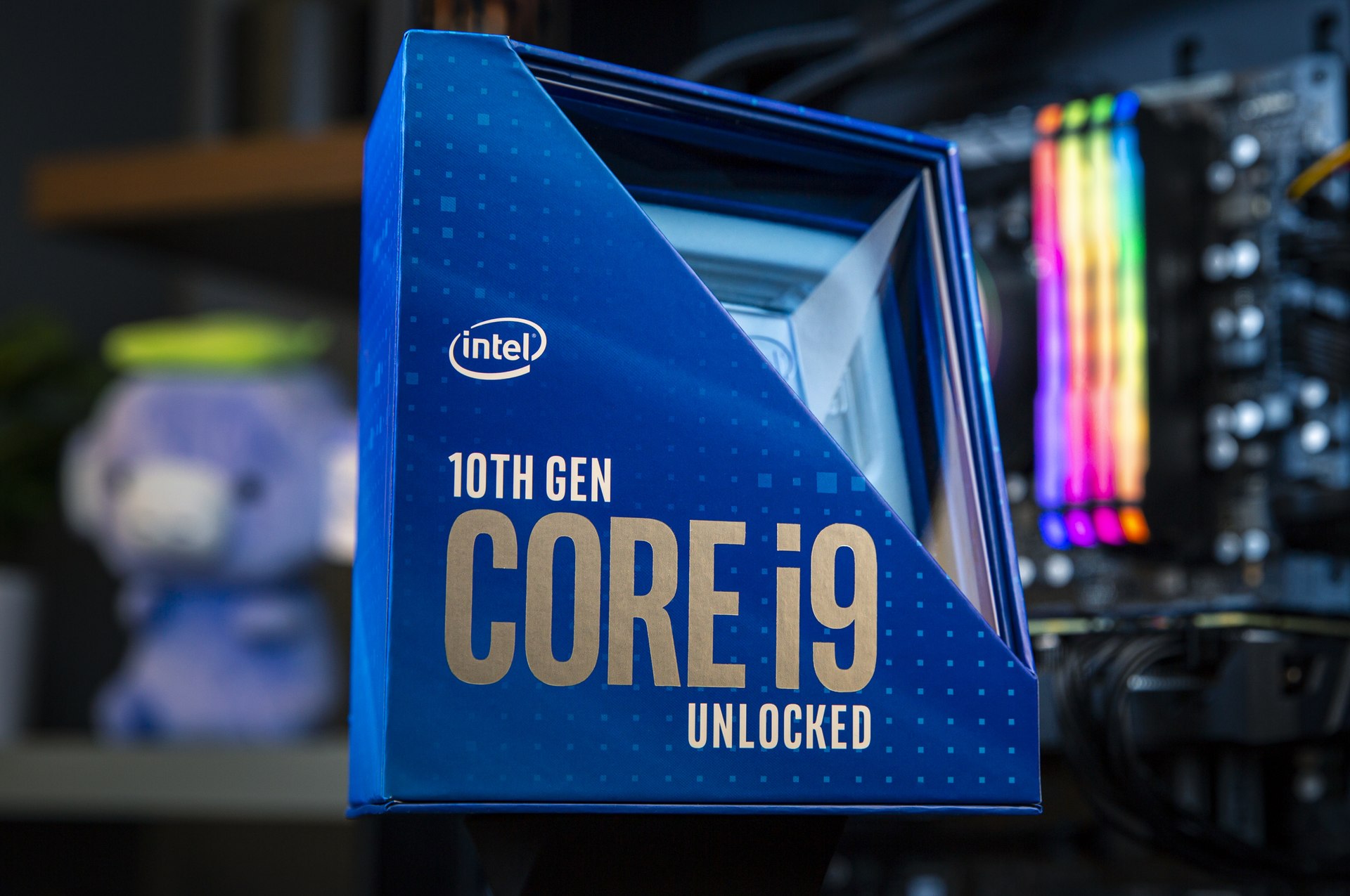
A short while ago we reported on new budget Intel processor that appeared in the company’s lineup as Core 5 120. Behind this new name, however, hides a 7nm Alder Lake chip from 2021, which Intel is calling back into service simply because it doesn’t have much choice. But that was nothing compared to the oddity coming now. Intel has now put the new Core series 100 branding on an almost ancient Comet Lake generation (10th Gen Core) chip.
Last year Intel started branding its CPUs as Core Ultra (a similar shift to what AMD later did with Ryzen AI), which broadly signals modern features like a chiplet design, an NPU for AI workloads, and the use of cutting-edge process nodes. The downside to those is higher costs though. That’s why Intel still needs to pad out its lineup with “non-Ultra” models based on older technologies, like the Core 5 120, without which it would struggle to cover the lower market segments while preserving margins.
Intel Core 5 110 is in fact Comet Lake for LGA 1200
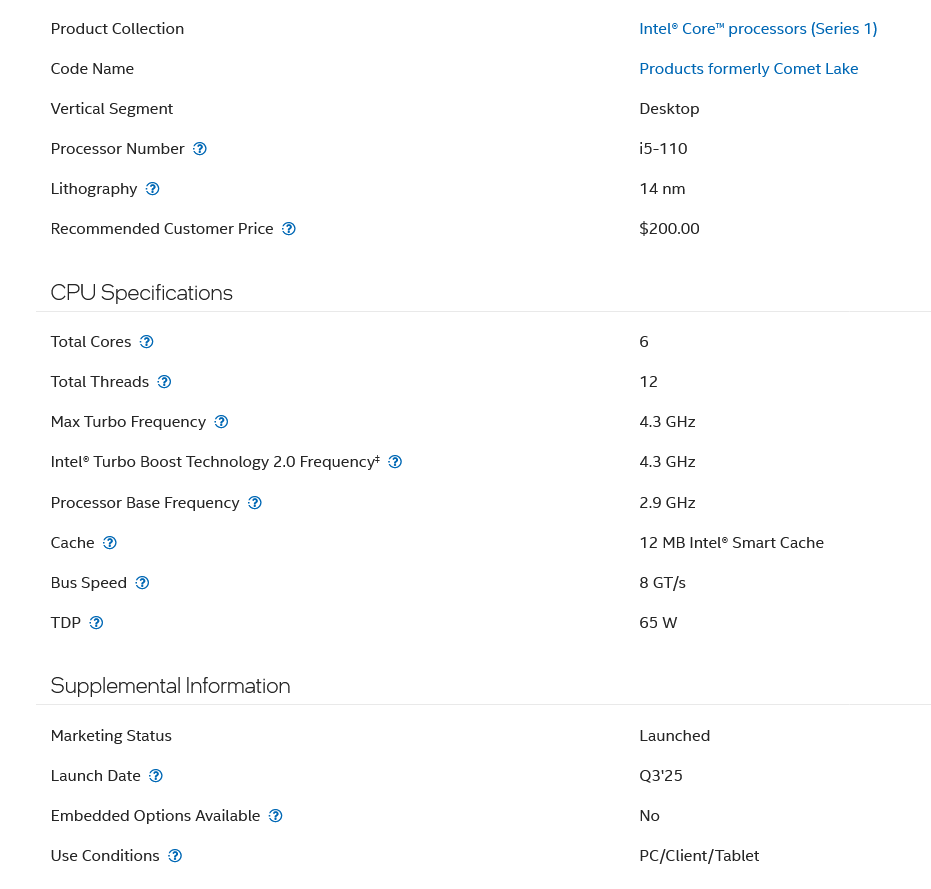
Now another such processor has shown up in Intel’s lineup: the Core 5 110. Since both belong to the Core (non-Ultra) 100 series, you might be fooled to expect it to share the same architecture as the Core 5 120. That one is a rebadged Core i5-12400 from the Alder Lake generation, still based on quite modern Golden Cove cores. But the 110 is built on much older foundations—it’s essentially a rebranded Core i5-10400. That chip launched in spring 2020 as part of the Comet Lake lineup, and Intel’s own spec sheets confirm this—the Core 5 110 is listed as Comet Lake family member. Amusingly, Intel’s database is inconsistently listing the model as “Core i5-110,” a strange hybrid of the old and new naming (most likely a typo, since the “i” shouldn’t be there).
Intel says the processor has already launched (quietly, sometime in Q3 this year). It’s a six-core, 12-thread chip with 12 MB of L3 cache, a 2.9 GHz base clock, and up to 4.3 GHz boost, rated at 65 W TDP. As with all non-K 65W Intel CPUs, overclocking is not supported.
These clock speeds are identical to the Core i5-10400, so other parameters that Intel doesn’t list for the rebadged new part are also likely unchanged—such as PL2, also known as the maximum power. For the i5-10400, the value was 134 W. Under all-core load, its maximum boost was 4.0 GHz, which probably applies to the Core 5 110 as well.
The processor also keeps all its original features and connectivity. For example, the integrated Intel UHD Graphics 620 runs at 350 MHz to 1.1 GHz, but it can’t handle HDMI 2.0—so a 4K monitor over HDMI is limited to 30 Hz (DisplayPort 1.2 output does support 4K at 60 Hz). The GPU also lacks AV1 decode support. The PCI Express controller only supports PCIe 3.0 (16 lanes for discrete GPU), and the memory controller tops out at DDR4-2666 (no DDR5, which is a drawback given current pricing trends).
Another important point: Comet Lake for desktops used a different socket than newer Core 12th, 13th, and 14th Gen CPUs (and the Core 5 120). The same goes for the Core 5 110—it requires a 400- or 500-series chipset motherboard with the LGA 1200 socket, which shipped in 2020 and 2021. Intel is clearly intending for this platform to stay in production, along with CPUs to match.
The Core 5 110 hasn’t appeared in local retail yet. Where the Core i5-10400 still continues being sold, it usually costs around 135 EUR, which isn’t a great deal—modern Alder Lake/Raptor Lake chips like the Core i5-12400 or i5-13400 are often only slightly more expensive. We’ll see if Intel decides to cut prices to make the rebadged part more worthwhile. Unfortunately, rebranding often serves as an excuse to charge more, instead. It’s also possible this CPU will mainly be sold in prebuilt PCs. Either way, other newer processors should usually be a better choice.
Decade-old technology and cores
That the chip is a rebrand of a product from 2020 doesn’t sound so bad on its own—AMD still sells AM4 processors based on the Zen 3 architecture from that same year, too. The problem is that in 2020 Intel was at the peak of its long stagnation period, caused by disastrous multi-year delays to its 10nm technology. Because of that, the company kept stretching the production on its 14nm node, gradually pushing clocks from 4.2 GHz up to 5.3 GHz in the flagship Comet Lake (Core i9-10900K). The infamous “pluses” being added to the designation of the 14nm node (Comet Lake was on 14nm+++, and it was actually followed by yet another generation called Rocket Lake) became a running joke.
Intel also raised core counts, from four up to ten. But every desktop generation from 6th Gen (Skylake) through 10th Gen (Comet Lake) was in the end still made on the same 14nm family of technologies, first introduced in late 2014, and worse, all of them used essentially the same CPU core architecture. That microarchitecture is mostly unchanged CPU core from Skylake processors, which launched in August 2015. Since then, Intel has introduced three major architectural upgrades—none of which the Core 5 110 benefits from.
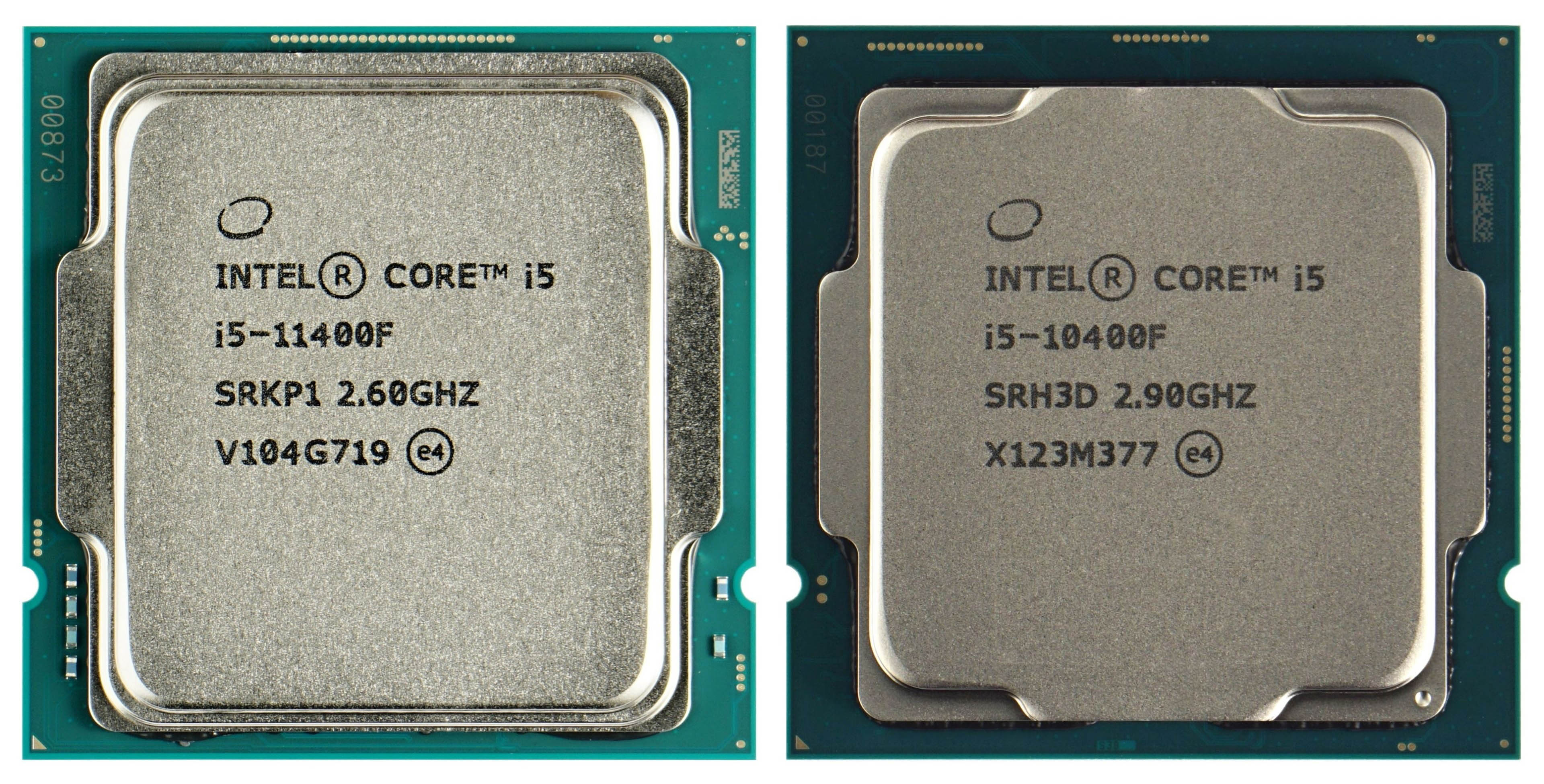
So if you buy the Core 5 110, you’re getting a CPU with more than a decade-old architecture and silicon process. That doesn’t make it unusable—older hardware can still run fine today, and performance is adequate for most everyday tasks (though, to be fair, Core i5-10400 alias Core 5 110 is no longer a great choice for gaming). As a late offshoot of the Skylake design, Comet Lake also has official Windows 11 support.
What’s remarkable is just how long this architecture has lingered in Intel’s lineup. The company is clearly reaching for ways to improve margins and profitability. Manufacturing old 14nm chips is likely still cheaper than Intel’s own 7nm process—not to mention the cost of producing modern designs at TSMC, which Intel must do for its Core Ultra 200 desktop parts. Five years ago, lots of jokes circulated that proposed Intel will still shipping new Skylake refreshes on 14nm node in 2025—and despite the eventual, successful transition to 10nm and 7nm, here we are again. The jokes were spot on, kind of.
It would be far more transparent if Intel kept selling these CPUs under their original names. Rebranding isn’t a complete no-no, but there should be some consistency to it. Instead, Intel lumped everything into the “Core 100” lineup, selling both a solid CPU that Alder Lake is and a near-antique Skylake derivative under almost the same name. That’s not exactly a great idea.
Sources: VideoCardz, Intel
English translation and edit by Jozef Dudáš
⠀


