


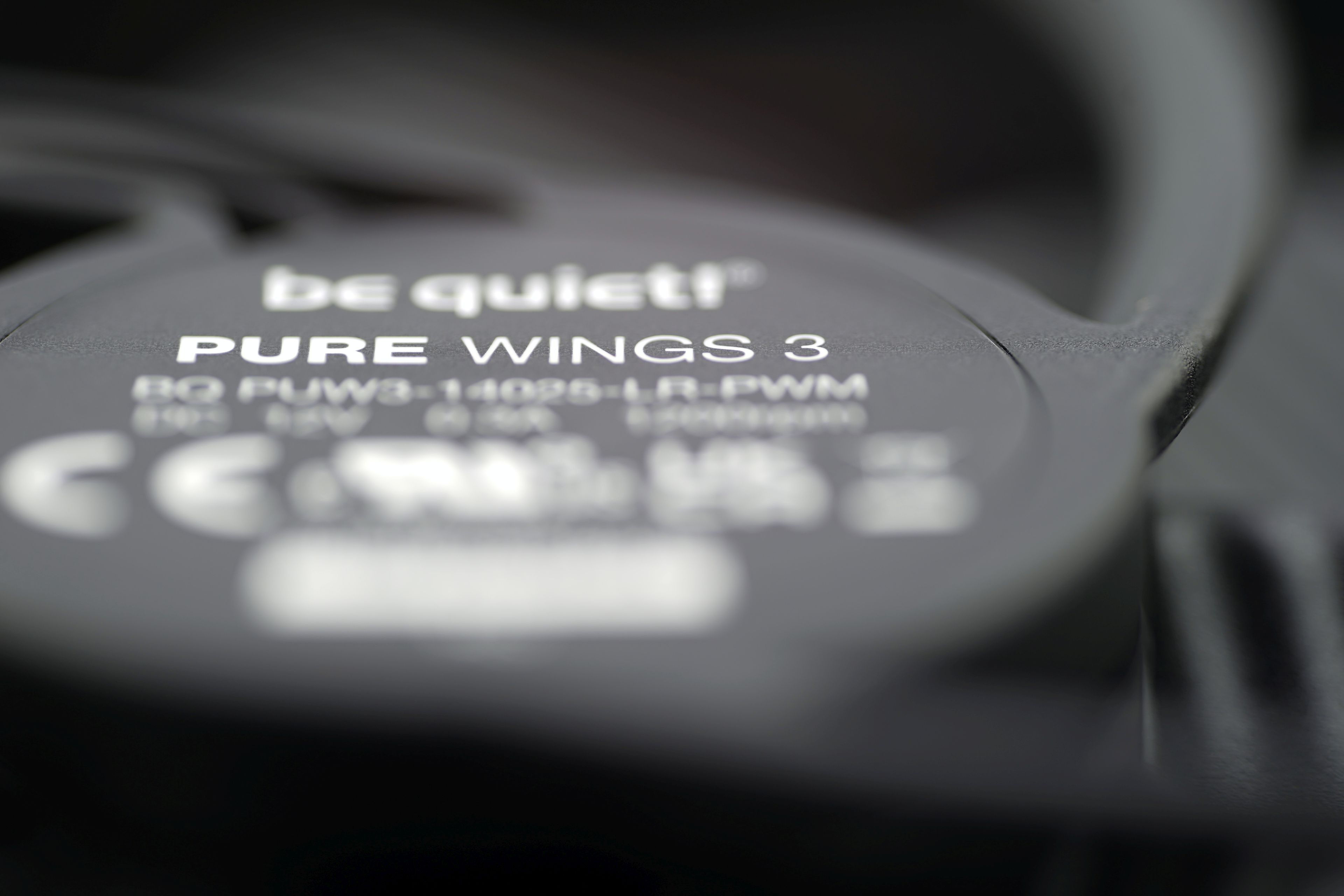
The long break is over, back to fans. BeQuiet! recently updated its entry-level line – Pure Wings – and at least the slower 140-millimeter models have to be on your radar. The Pure Wings 3 fans in the BL108 variant represent an extremely efficient low-cost option for some situations, while not suffering from the common shortcomings of their price class. What’s quiet here is not only the aerodynamic component, but also the motor one.
Base 6 equal noise levels…
There are several options by which to normalize the test modes for fans. In the previous chapter, we wrote that perhaps the least appropriate option is equal speed.
Settings according to the same static pressure or flow are for consideration, but we find it most sensible in the long term to normalize the measurement modes according to the same noise levels. Firstly because decibels are a logarithmic unit and all others scale linearly, but mainly because you can orientate fastest by the same noise levels. The easiest way to compare the efficiency of fans is just by how they perform at the same sound pressure level. Of all the options, this is the one that most people can best imagine and bounce off of when considering other variables.
The individual noise level modes are adjusted from low levels continuously to higher levels. All users will find their results in the tests, regardless of whether they prefer very quiet operation at the limit of audibility or whether high performance is paramount.
The quietest mode corresponds to 31 dBA, followed by 33 dBA, and for each additional mode we add 3 dBA, which always doubles the noise level (36, 39, 42 and 45 dBA). Finally, we measure the fans at maximum power. Here, each one already has a slightly different noise level, which we also report. If there are missing measurements between the results for any of the fans, this means that it was not possible to set the target noise level. Either because its minimum speed exceeds the quietest mode of 31 dBA or vice versa because the fan is quieter than 45 dBA at maximum power.
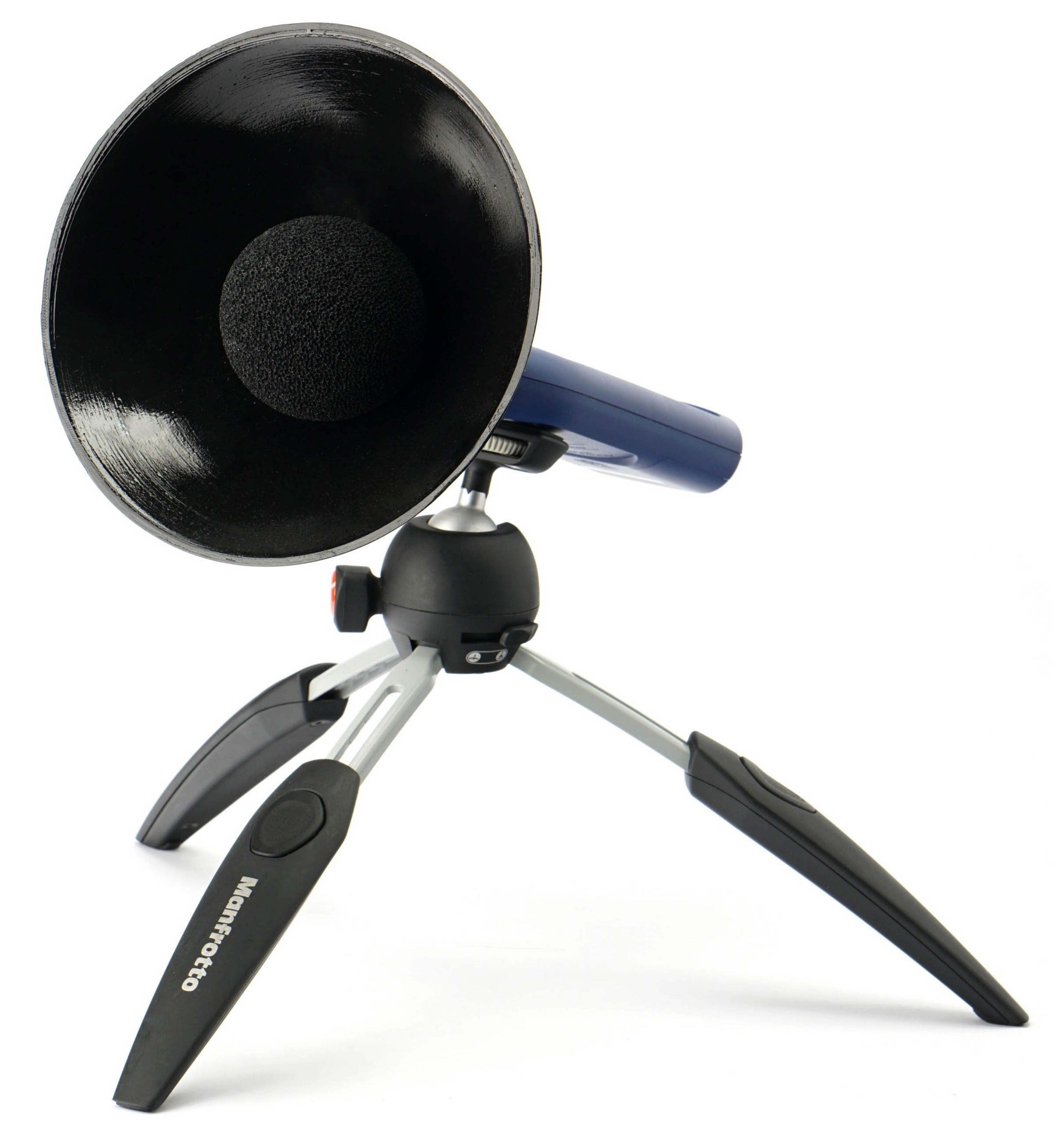
It is important to add that our noise level measurements are incomparable to the values quoted by the fan manufacturers in their specifications. One of the reasons is because we use a parabola-shaped collar around the sensor of the noise meter, which increases sensitivity. This is important in order to distinguish and set to the same noise level even modes at very low speeds, especially 31 dBA.
The noise meter next to the fan is quite close for sufficient resolution. The distance between the frame and the sensor is 15 centimeters. The sensor is positioned in such a way that there is no distortion or that the noise level measurements are not affected by airflow. Therefore, the noise meter is centered perpendicularly to the frame that defines the depth of the fan. Everything is always at the same angle and at the same distance. We use an inclinometer and markers to set the distances precisely and always the same.

We use a Reed R8080 noise meter to measure noise levels. This allows real-time averaging of samples, which is important for fine-tuning individual modes. We tune the fans until the specified noise level is reached to two decimal places, for example 31.50 dBA. The noise meter is the only instrument we calibrate inside our testlab. The other instruments have been calibrated by the relevant technical institutes. However, in the case of the noise meter, calibration is required before each test and we therefore have our own calibrator. This is already calibrated externally according to the standard.


Yay, I have been starving for HWcooling fan reviews for a while now.
The links are broken in the last page. It’s spelled bl-108 in the last page but the url of the article itself is spelled bl108.
Fixed. Thanks! 🙂
Thanks for that enormous quantity of information, now, being compared the Pure Wings 2 140mm vs Pure Wings 3 140mm which would be best ? and it would be reasonable to replace PW2 with PW3 ?
We have not tested the older Pure Wings (2) fan in 140 mm format. Some correlations and better estimates can be made after the results of the 120 mm PW3 are completed (there will be a comparison with the 120 mm PW2). Although, of course, it will not be completely accurate. With the size of the blades the character of the noise and the colour of the sound changes. And also across formats it is not just a matter of making the impeller in the 1.00:1.16 scale ratio.
Well, the results of the 140-millimeter Pure Wings 2 might be added eventually, but it’s not a big priority.