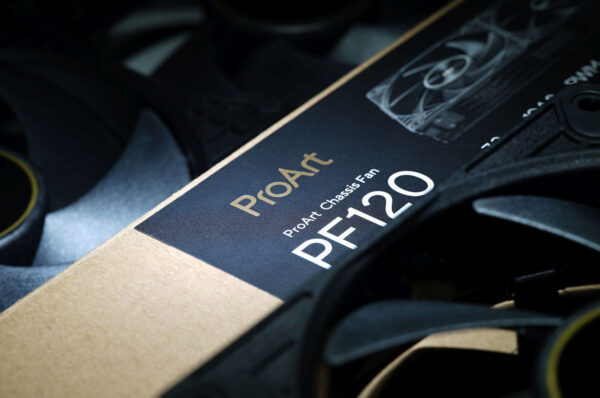
It wants to go head‑to‑head with the Phanteks T30-120 fan, while also having a slight edge in every respect. That’s Asus’s marketing—and now comes reality in HWCooling’s in‑depth analysis. The ProArt PF120 fans are truly something exceptional and worth paying attention to. High cooling efficiency and elegant daisy‑chaining are just the beginning. The overall design of Asus’s fans is impressive. Read more “Asus ProArt PF120: The most efficient fan at low noise level”
Category: Extra tests
ID-Cooling AT-120-K: Ring below blade tips?
The first ID-Cooling fan in our database, and it immediately features one unconventional element—the blade ring is positioned differently than usual. Its placement bellow the blade tips is typical of high-speed fans, and the AT-120-K model indeed spins at very high speeds. Despite that, it can also be significantly slowed down while maintaining attractive cooling efficiency even at lower noise levels. And all of this comes at an attractive price point. Read more “ID-Cooling AT-120-K: Ring below blade tips?”
Antec Storm 120: Efficient in the middle price class
After many years, we finally managed to get our hands on the Antec Storm 120. That is, 120 mm fans combining an attractive (and efficient) geometry with good price accessibility. Although these are not outright cheap fans, the price is still relatively low. The result is quite appealing. Don’t look for technical perfection here, but “for that kind of money” it is good. Especially if you also value other things than the price/performace ratio. Read more “Antec Storm 120: Efficient in the middle price class”
Endorfy Stratus 120 White ARGB: Illuminated, inexpensive, efficient
Efficient ARGB fans are rare—especially when, in addition to a low price, they also offer a less common variant. In this case we mean white materials, from which the illuminated Stratus fans are made. To begin with, here is an analysis of these fans in the physical 120 mm format. Prepare for tests packed with details that this article brings. A serious candidate for selection? Absolutely. Read more “Endorfy Stratus 120 White ARGB: Illuminated, inexpensive, efficient”
Phanteks T30-140: Exceptionally efficient XXL fan
It arrived quietly, but we had been looking forward to it for a very long time. In its form factor, the Phanteks T30-140 fan works wonders and often defeats everything that stands in its way. Yes, even the Noctua NF-A14x25 G2 PWM is often the “next in line”, albeit at the cost of a thicker profile. Airflow is exceptionally high (and consequently cooling performance) through obstacles. Larger fans now have a new dominant model. Read more “Phanteks T30-140: Exceptionally efficient XXL fan”
DeepCool FD12 V2: Maximum airflow, minimal price
Lower price, higher cooling efficiency. That is what distinguishes the FD12 V2 fans (compared to their predecessors). DeepCool has improved the aerodynamic performance of the newer FD12 (V2) in several ways, making them more attractive despite the lower price. Much of this is due to the impeller ring, a feature not previously used. Arctic (with the P12 Pro fans) should take notice. Read more “DeepCool FD12 V2: Maximum airflow, minimal price”
HAVN H12: Teeth, protrusions… segmentation everywhere you look
Blades, hub—everywhere there are features disrupting an otherwise smooth design. This kind of detailing defines the HAVN H12 at first glance—and the second impression is just as striking. With the kind of geometry the H12 brings to the table, reaching the absolute top tier is possible. In practice, however, it’s essential to find the right scenarios and fine-tune the right settings to end up truly satisfied. Read more “HAVN H12: Teeth, protrusions… segmentation everywhere you look”
The end, or just the beginning? 100 fans in HWCooling tests
Our database now includes one hundred fans—75 in the 120 mm format and 25 models with a physical size of 140 mm. In this article, we have compiled all data into unified charts. What was once separated for clarity is now brought together again, and the commentary will also include a… look ahead regarding fan testing. But we can already reveal that there is still a lot more to come. Read more “The end, or just the beginning? 100 fans in HWCooling tests”
Arctic P12 Pro Reverse A-RGB: Looking good, working well!
The impeller is oriented so that, in the installed position, nothing visually obstructs the view. This refers to the stator struts, which can otherwise “spoil” the appearance. But this is not just about looks—it is about combining them with the efficient geometry of the proven five-blade design with a stabilizing ring (familiar from the P12 A-RGB). It is not exactly the same design, though, if only because what used to be behind the impeller is now in front of it. Read more “Arctic P12 Pro Reverse A-RGB: Looking good, working well!”
Analysis of DeepCool’s efficient 120 mm fan—the FD12
We couldn’t deprive you of the results for this model. Just ahead of the release of the second version of the DeepCool FD12, we’re publishing the results of the first so you have a comparison available—not only with the technically more modern variant, but also with competing fans. As for the FD12’s characteristics, even within its price class they are already attractive. In the end, judge for yourself based on hundreds of measurements. Read more “Analysis of DeepCool’s efficient 120 mm fan—the FD12”
Asus Prime GeForce RTX 5070 with 3× Arctic P9 PWM PST Deshroud
Alongside our previous tests of premium 92 mm Noctua fans, we’re adding something for value-focused users. For the more affordable Prime-series card, these are a better match. We’ll measure how much quieter the card gets after swapping the stock fans for budget 92 mm Arctic P9 PWM PST models with sleeve bearings, and compare the noise to the Arctic P9 PWM PST CO variant with dual ball bearings for continuous operation. Read more “Asus Prime GeForce RTX 5070 with 3× Arctic P9 PWM PST Deshroud”
Asus Prime GeForce RTX 5070 with 3× Noctua NF-A9 Deshroud
Most mid-range Asus card models allow easy removal of the shroud. We have already tried classic 120mm fans on the card, which do not fit very well on a narrow and long card. With them, the card becomes significantly wider and they do not cover the heatsink along its entire length. A trio of smaller 92mm fans fits a 30cm card better. After testing the low-profile NF-A9x14, we will try how the NF-A9 with the standard 25mm height performs. Read more “Asus Prime GeForce RTX 5070 with 3× Noctua NF-A9 Deshroud”
MSI GeForce RTX 5060 Ventus 2x OC 8 GB review: A Solid Baseline
The Ventus 2X OC model with 8 GB of memory is the most affordable GeForce RTX 5060 variant from MSI. It features a compact dual-slot cooler with a length of 20 cm, making it suitable even for small-form-factor cases. The cooler is slightly louder than average due to overly high fan speeds, but it has sufficient headroom for manual fan speed reduction. But with 8 GB of memory, compromises are necessary in the most demanding games. Read more “MSI GeForce RTX 5060 Ventus 2x OC 8 GB review: A Solid Baseline”
Sapphire Pulse AMD Radeon RX 9070 16GB Review: Better Pay More
When the RX 9070 launched, nearly all reviews focused on pricier, factory-overclocked 245 W versions. Cards with reference clocks are far less common. We’re examining one of them—the basic Sapphire Pulse RX 9070—with stock specs: a 2520 MHz boost and a reduced 220 W power limit. In practice, though, at reference clocks the card seems to ends up a little slower in tests than it should be. Read more “Sapphire Pulse AMD Radeon RX 9070 16GB Review: Better Pay More”
Asus Prime GeForce RTX 5070 With 3× Noctua NF-A9x14 Deshroud
On most mid-range Asus graphics cards, the shroud is easy to remove. We already tried classic 120 mm fans on this card, but they do not suit its narrow, long PCB: they make the card much wider and still fail to cover the heatsink along its full length. A trio of 92 mm Noctua fans fits better on the 30 cm card, and the range includes the low-profile NF-A9x14 for noticeably quieter cooling at lower speeds overall. Read more “Asus Prime GeForce RTX 5070 With 3× Noctua NF-A9x14 Deshroud”


Latest comments