



The first ID-Cooling fan in our database, and it immediately features one unconventional element—the blade ring is positioned differently than usual. Its placement bellow the blade tips is typical of high-speed fans, and the AT-120-K model indeed spins at very high speeds. Despite that, it can also be significantly slowed down while maintaining attractive cooling efficiency even at lower noise levels. And all of this comes at an attractive price point.
We are familiar with impeller rings, but in this position they are relatively rare. ID-Cooling has placed it in front of the blade ends (or tips), similarly to some primarily high-speed fans such as the Nidec Servo Gentle Typhoon. The primary purpose of this ring is to reinforce otherwise more flexible blades, preventing unwanted vibrations or even potential structural failure of the fan. At high speeds, combined with insufficiently rigid materials, such issues could indeed occur. The presence of the ring allows the use of cheaper materials while also reducing vibrations that would otherwise form on the impeller. These would then transfer to the frame and create secondary noise. Even without that, vibrations themselves can produce undesirable tonal peaks that degrade acoustic performance.
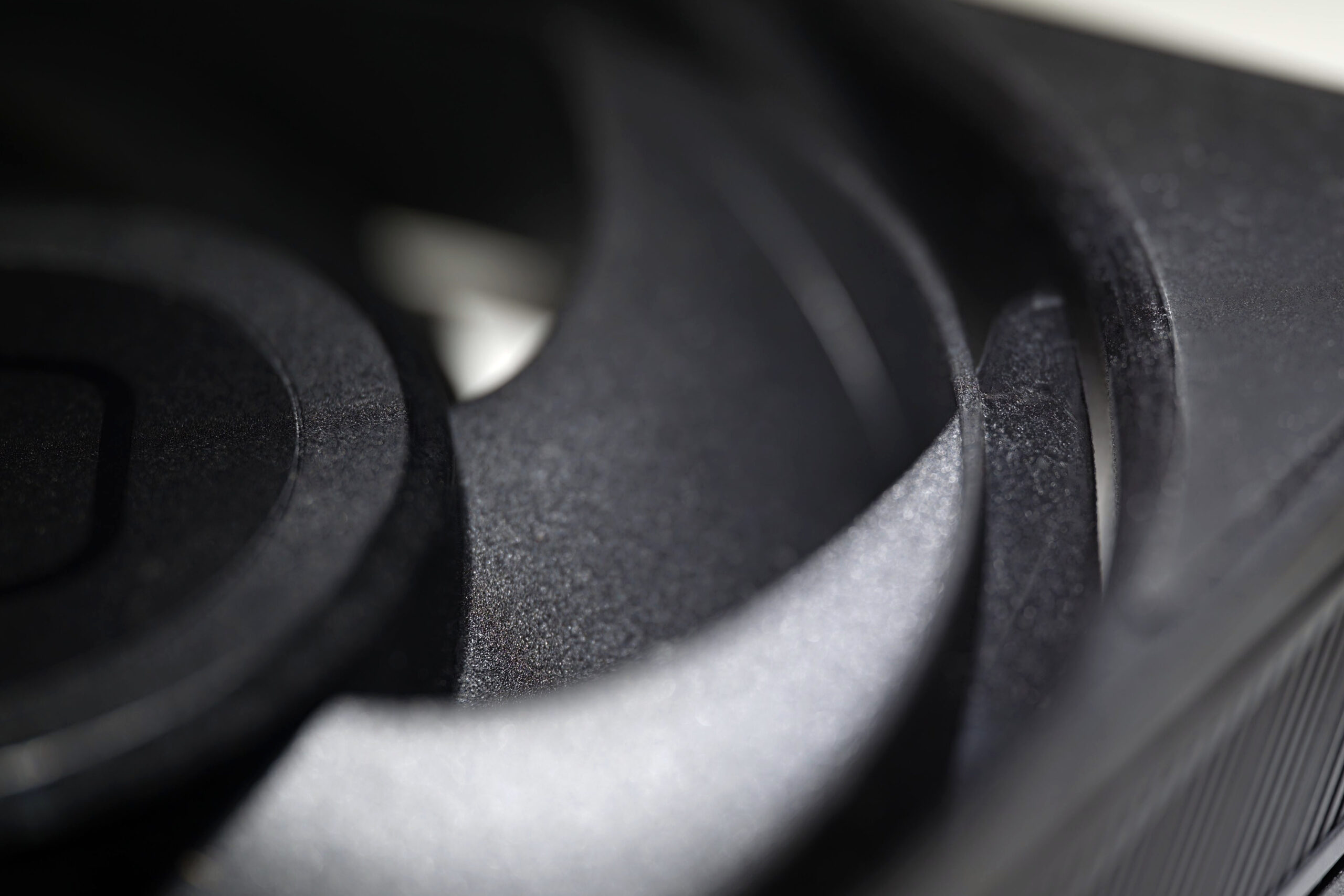
Sometimes the ring is also justified as a means of increasing pressure in critical areas, where airflow separation is reduced. In any case, with the AT-120-K fan, not only is the ring notable, but also the blade geometry itself. This is something we would describe as featuring efficient shapes. Still, it should be noted that the hub is relatively large (with a diameter of approximately 52 mm), and its area takes up a significant portion of the fan’s total cross-section.
Although this is nothing dramatic and such a dimension suggests that the mechanical design could indeed be robust (and that is welcome at maximum speeds exceeding 3000 RPM), it certainly reduces airflow. That is, compared to fans with a smaller (and more subtle) hub than the AT-120-K model. The overall strength (and robustness) of the fan is truly high even with the chosen shape of the impeller blades. There is both the ring and the use of PBT reinforced with glass fibers.

Static pressure will, judging by the shape of the impeller, be decent. The specifications list it as high and our measurements do not contradict that, but this applies to maximum speeds. The text above points to what the level of static pressure might be at quieter operation and thus what the drop in airflow (and therefore cooling performance) will be due to an obstacle standing in the fan’s path.


The AT-120 fan also exists in a fully white version, with the suffix “W” (White). In addition to the AT-120-K model, there is also the AT-120-W model.
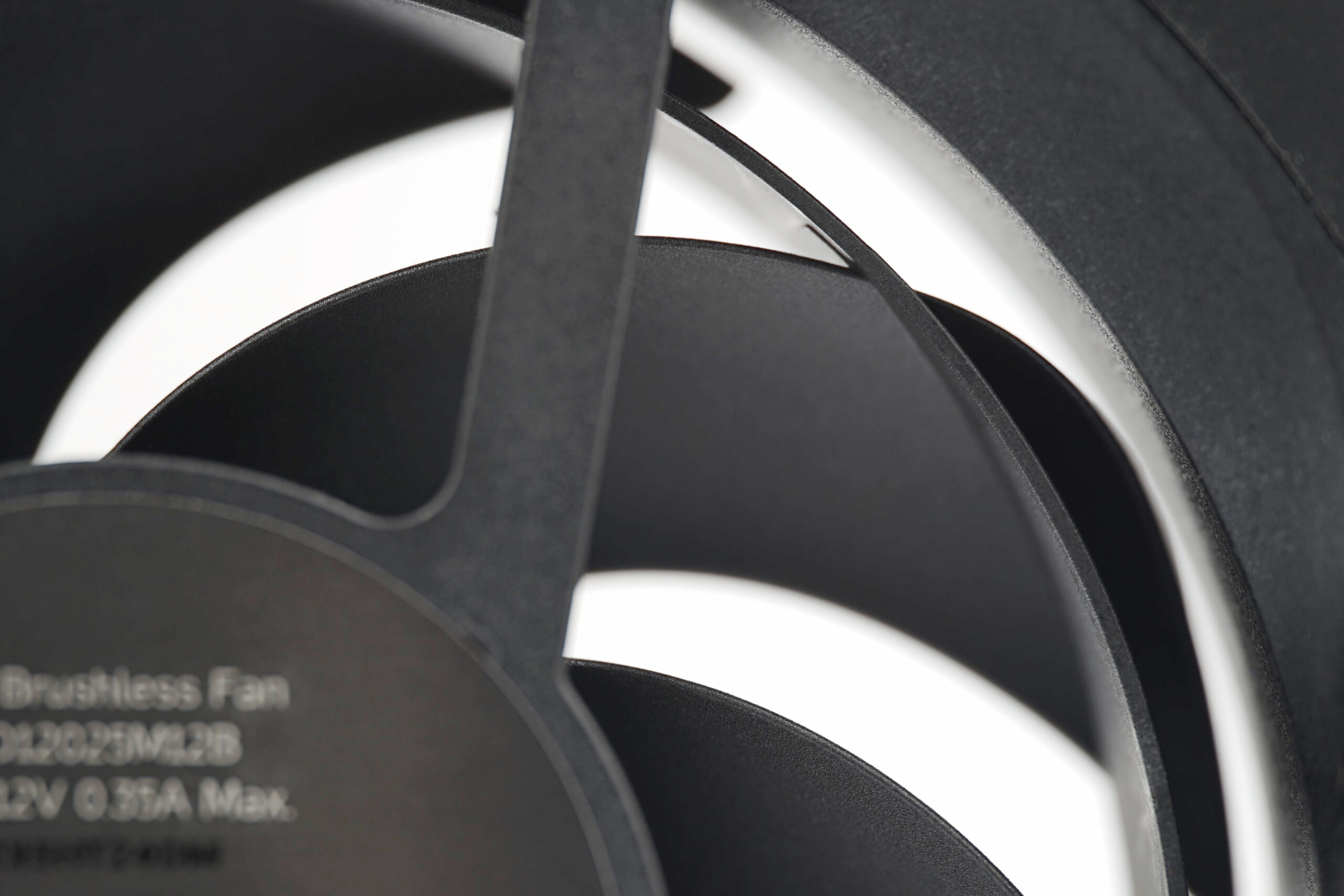
On the longer cable (approx. 55 cm) there are two connectors. One 4-pin for connecting the fan itself and the other (in fact 3-pin, although the housing is 4-pin—one pin for PWM control is traditionally shared) for connecting another fan in sequence. This is best if you connect the fan to a header with a higher specified load than one ampere. Even with two fans this will not be exceeded in terms of operating power consumption, but at startup the current is higher. There, considering that you can briefly reach around 0.7 A per fan, a certain risk exists.

Please note: The article continues in the following chapters.



