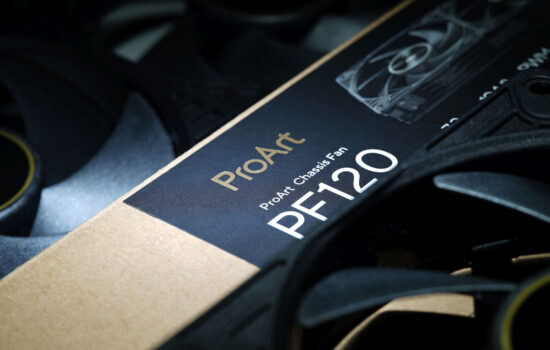
It appears that Asus is taking fans seriously. The specifications and design elements of the new ProArt PF120 model look “dangerous”—that is, they suggest that cooling efficiency could be genuinely very high. Not only in terms of maximum speed (accompanied by higher noise), but also at noise-normalized levels comparable across products. This is hinted at by efficient geometry, LCP blades, a 28 mm thick profile, and many other factors.
Asus’s new 120 mm fan has high ambitions. ProArt PF120 is made from liquid crystal polymers (LCP)—that is, when it comes to the impeller. The impeller itself has seven blades with distinctly curved leading edges, of a type that, based on our experience, tends to be aerodynamically efficient.
To achieve the highest possible airflow even in applications with obstacles, high static pressure is also promised. And it could indeed be high. The gaps between the blades are relatively small, and there is also a small (0.5 mm) clearance between the blade tips and the wall of the frame tunnel. This also reduces dead space that lowers static pressure and thus airflow through obstacles. Static pressure at maximum speed (3000 rpm) is specified to reach up to 7.3 mm H2O with an airflow of roughly 179 m3/h. This is stated in the official specifications on Asus’s product pages, both for the single-pack and the triple-pack. These are the configurations in which the fans can be purchased. You can then choose by color—ProArt PF120 fans are available in both black and white. Yes, white LCP, known for example from Fractal Design Momentum fans.

The frame has an above-standard thickness (28 mm) and also features connectors for more elegant installation, via contacts integrated into the fan frame. How it will be with the current draw of three such fans (and potential exceeding of 1 A) will likely only become clear in our tests.

Retail prices are expected to start at around 40 EUR for a single fan; for the triple pack there could be some volume discount, with prices around 100 EUR (for three ProArt PF120 fans) being realistic. This also depends on the country where you purchase the fans. They certainly are and will remain expensive, as the emphasis here is on achieving the most attractive functional characteristics possible. Attention is also paid to making the fans visually appealing.

The surface of the impeller hub is metal, with concentric circles, and CNC machining is also mentioned—primarily in connection with the bearing housing, which is intended to contribute to high durability as well as high precision. From that, vibration intensity also depends. Vibrations should also be reduced at the level of smoother impeller rotation, as as many as six poles and stators are used, and a three-phase torque is applied. Well—we will see in the tests. The results for the Asus ProArt PF120 fans will likely expand our database.
English translation and edit by Jozef Dudáš