Technology sanctions—like those imposed on China—are often criticised as something that compels affected states to develop self-reliant alternatives, boosting their economy. It is not that simple, but China now appears to be making progress in its efforts to make its technology industry self-sufficient and capable of manufacturing everything domestically: not only locally fabbed chips, but also machines for making them.
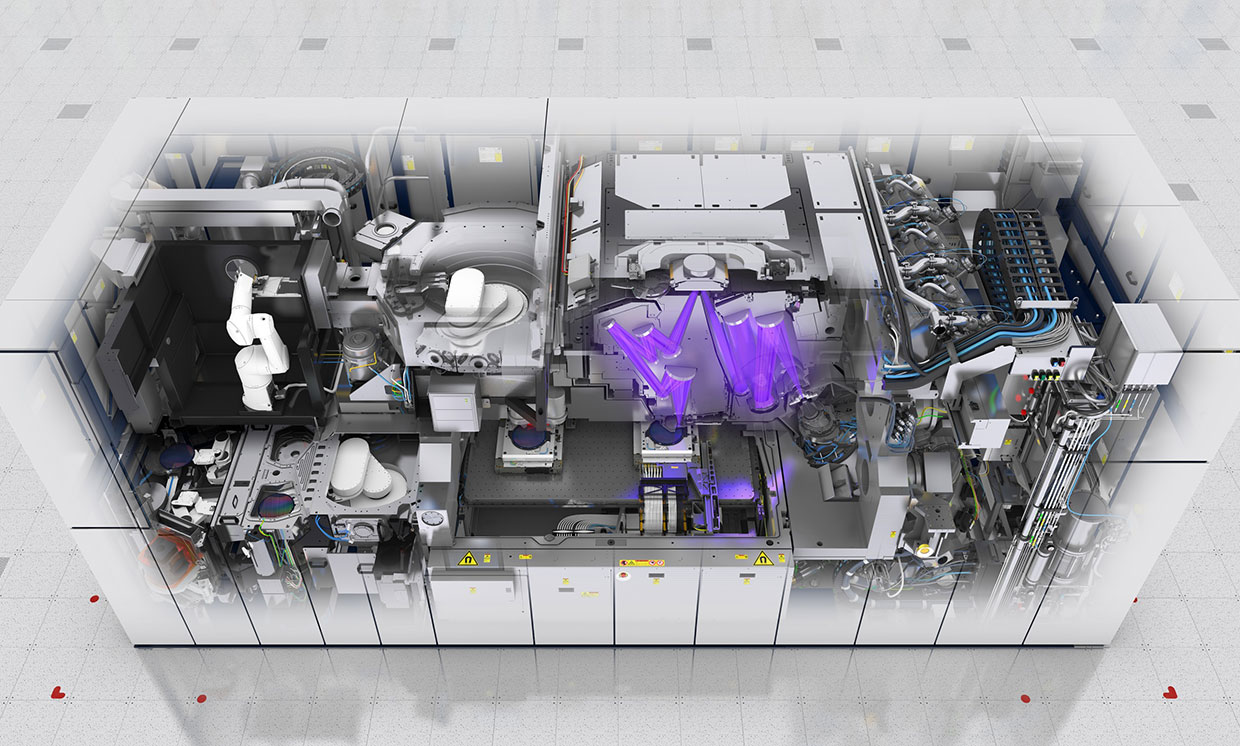
The Information reports that Chinese company Shanghai Yuliangsheng Technology has now begun manufacturing its own machines for so-called DUV immersion optical lithography. These are known as scanners—machines that use light to expose the prepared surface of a silicon wafer during the process by which patterns are transferred from masks onto the wafer itself in chip manufacturing. Through successive steps, transistors and subsequently the metal interconnect layers are created. These machines are crucial for advanced chip manufacturing, but China has not had domestic alternatives until now; they have been supplied by “Western” companies led by the Dutch firm ASML.
ASML is best known as the unique supplier of extremely sophisticated machines using EUV technology, for which there is currently no substitute. Thanks to their use of extreme ultraviolet radiation with a wavelength of 13.5 nm, these machines can create much smaller structures on a chip. EUV is a critical technology for manufacturing logic chips on 5nm and smaller process nodes, as well as the latest generations of DRAM memory.
By contrast, DUV (deep ultraviolet) refers to the conventional older technology that preceded EUV, using argon-fluoride excimer lasers with a wavelength of 193 nm. The term immersion indicates that the machine’s resolution is improved by the refraction of light in a liquid—achieving results beyond what the relatively long 193nm wavelength could effectively project sharply onto the chip surface without this aid. The fact that a Chinese company has managed to launch production of such machines for the first time is therefore not, in itself, a technological breakthrough, as both technologies have been used by established chip manufacturers for decades (and ASML also supplies these machines). What is significant for China is that it finally has its own source of them, allowing the machines to be used, for example, by companies subject to sanctions for strategic-security reasons, such as those involved in military manufacturing.
These Chinese DUV optical lithography machines are also only in low-volume production so far, with five units expected to be manufactured this year. From 2027, output is expected to reach 20 machines per year, which would already be more significant. However, ASML’s production is much higher than that of the Chinese company—ASML reportedly delivered 131 DUV scanners serving the same purpose to the market in 2026. Shanghai Yuliangsheng Technology expects its machines to be purchased by Chinese foundry manufacturers SMIC and Hua Hong, as well as Chinese memory manufacturer CXMT.
The machine does not appear to be assembled entirely from components manufactured in China, although these are expected to make up the majority. Some parts, possibly including certain key components, are imported from Japan. Therefore, if manufacturing on older pre-EUV process nodes is to become completely independent in China, these remaining components will also have to be replaced. Even in its current form, however, the machine could represent a developmental step toward such a milestone.
Another question is whether the company will eventually manage to develop the much more complex EUV technology—or copy it from ASML. EUV radiation with a wavelength of 13.5 nm is generated by plasma created when precisely metered tin droplets are irradiated and vaporised with laser pulses. It was extraordinarily difficult not only to make this process work, but above all to develop machinery capable of keeping it running continuously and reliably at the high light output required for sufficiently fast chip production.
Domestic DUV may not be at the same technical level
However, the fact that Chinese manufacturers will have the option of acquiring an alternative to Western machines does not necessarily mean that the sanctions are causing them no harm. There is a considerable possibility that domestic lithography machines may deliver lower output quality, reliability, or operational efficiency—resulting in greater downtime, but perhaps also lower throughput. There were probably reasons why the established suppliers led by ASML came to dominate the industry and why Chinese companies used their equipment instead of developing their own, and this technological lead will not be closed overnight. Inferior domestically sourced manufacturing equipment could then put chips made using these machines at a cost disadvantage compared with global competitors.
Huawei may serve as a good example. Due to sanctions, the company had to stop manufacturing its own mobile chips for a time because it lost access to production at TSMC and to CPU architectures licensed from Arm. After several years, however, it overcame these obstacles and returned with new processors manufactured by domestic SMIC, featuring its own CPU and GPU cores. This was seen as evidence that the company had managed to overcome US sanctions. But is it a victory? Even after several different generations have been released, these chips still lag significantly behind in performance and energy efficiency and cannot match the current technologies of global companies, whether Qualcomm, MediaTek, Samsung, or Apple. So it can be said that the sanctions are working.
Sources: techPowerUp, The Information
English translation and edit by Jozef Dudáš
⠀