


Significantly smaller than any case we’ve tested so far. The question is how this smaller size will affect cooling efficiency. Motherboard compatibility is narrower—the largest that fits is Mini-ITX, but the CPU cooler can still be tall, the graphics card long, and the PSU can even be full-size ATX. Yes, even that has a place in the DeepCool CH160. Even a case this small has enough space for large components.
Conclusion
A very good SFF case that’s also affordable. While you do need to buy fans separately for the DeepCool CH160, this at least ensures you get exactly the ones you want inside (and you don’t pay extra for stock fans you wouldn’t use anyway). We see this approach as positive—you just need to remember to order system fans along with the case, unless you already have some prepared.
Although the DeepCool CH160 is quite an airy and perforated case, adding fans still makes sense. With active cooling, it achieves comparable results to larger cases, even at very low noise levels with only a “symbolic” airflow. In this regard, everything is well proven, and you don’t have to worry about overheating.
It’s true that more power-hungry components (even compared to the ones we used for testing) will need intensive cooling, but that’s more about their own heatsinks than about the “cooling options” contributed by the DeepCool CH160 case. Air circulation with efficient FT12 fans (we also have a dedicated analysis) is certainly sufficient even for higher-end PC builds that can fit into this SFF case.
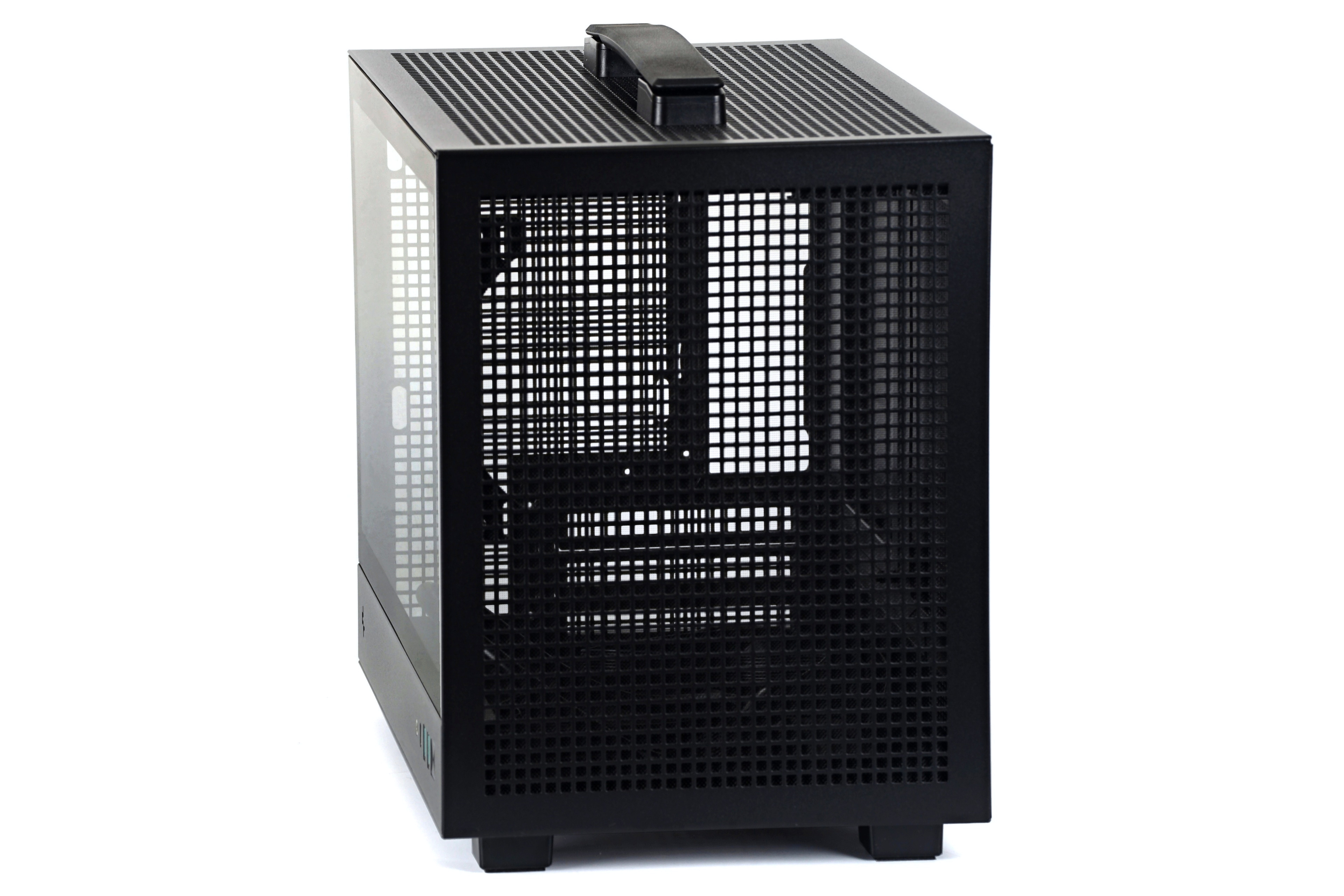
Some may find the limited motherboard support, restricted to Mini-ITX, a drawback, while others may see it as exactly why they’d buy the case. It really is small and space-saving, with a sensible interior layout.
At the front position behind the panel, you do have to choose between mutually exclusive options, but that’s true for competing cases too. DeepCool has done a good job here, and in the relatively lower price category, the external I/O includes features such as USB-C (10 Gbps, USB 3.2 Gen 2). Add to that the top handle for LAN parties, where you can also conveniently charge your modern smartphone. At 60 EUR, this is definitely solid value, though there’s still that power cable routing solution…
Within a week, we’ll be back with a test of the larger CH260 case, which we’ll compare directly to the smaller CH160. The editorial award “Smart buy!” for the already tested case (DeepCool CH160) goes out today.
English translation and edit by Jozef Dudáš
| DeepCool CH160 |
| + Small, space-saving dimensions... |
| + ... extra effort put into portability (handle on the top) |
| + Support for tall CPU coolers... |
| + ... and long graphics cards |
| + Design optimized for efficient cooling |
| + Relatively fine dust filters (with a fairly “aerodynamic” structure) |
| + Convenient installation of all components |
| + Attractive price |
| + The manufacturer doesn’t force bundled fans (you can choose your own)... |
| - ... but that also means you’ll have to pay extra for them. The case ships without fans—an “extra hassle” |
| - No support for liquid cooler radiator installation |
| Approximate retail price: 60 EUR |


It’s great that they offer a mesh side panel variant.
That really is a nice variant. 🙂
I don’t know to what extent the perforated side panel can help cooling, but it probably depends on the situation. With a top-flow CPU cooler there will likely be some benefit, and possibly even without it (for the graphics card, for example). But who knows… with side perforations, case pressure certainly drops to some extent, and with it also the airflow from the system fans. It would probably need to be tested, and hopefully we’ll get to it sometime. It won’t be with the DeepCool CH160 cases, but maybe with some others that also have multiple side panel variants. We’ll see…
… next up in our case testing, we’ll be looking at how the CH260 performs passively, or rather what kind of drop in cooling performance can occur compared to a configuration with added fans. 🙂
I am looking forward! I think the mesh panel can be useful in a transport use case, as indicated by the handle on top. Anyway, it’s great to have a choice.
I agree. The Mesh variant definitely makes sense for logistical reasons as well—a metal side panel won’t shatter under harder impacts. 🙂
–“…we’ll be looking at how the CH260 performs passively, or rather what kind of drop in cooling performance can occur compared to a configuration with added fans.”
👍